
MIT scholar Delia Wendel's new book uncovers the forgotten history of how ordinary Rwandans and international aid workers first documented the 1994 genocide, creating the foundation for the country's official memorials before state control took over.
The 1994 Rwandan genocide unfolded over 100 days, a period of systematic mass murder that claimed hundreds of thousands of lives. In the immediate aftermath, while the world was still processing the scale of the atrocities, local citizens and aid workers began the painstaking work of documenting what had happened. They cleaned and preserved remains, photographed evidence, and marked sites of massacres. This grassroots effort, driven by a need for truth-telling and justice, laid the groundwork for what would eventually become Rwanda's official genocide memorials.
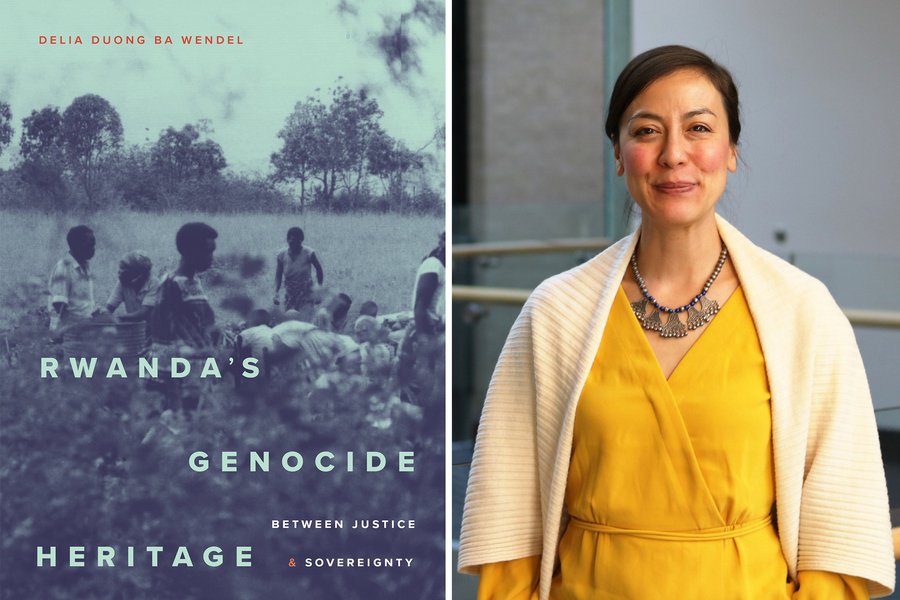
MIT scholar Delia Wendel meticulously traces this history in her new book, Rwanda's Genocide Heritage: Between Justice and Sovereignty, published by Duke University Press. Through over a decade of research, including extensive fieldwork across more than 30 villages in Rwanda, Wendel recovers the story of the individuals who first took on the "gruesome" work of memorialization. Her research reveals that the state's control over this memory was not inevitable, but rather a later development that followed independent, ethically-driven initiatives.
"I'm seeking to recuperate this forgotten history of the ethics of the work, while also contending with the motivations of state sovereignty that has sustained it," says Wendel, the Class of 1922 Career Development Associate Professor of Urban Studies and International Development in MIT's Department of Urban Studies and Planning (DUSP). The book is freely available through the MIT Libraries.
The Unseen Labor of Memory
The work of memorialization began not with government decrees, but with the urgent need of survivors and witnesses to make the invisible visible. Louis Kanamugire, a Rwandan who lost his parents in the genocide and later became the first head of the country's Genocide Memorial Commission, was a pivotal figure. He felt it was necessary to preserve and display the remains of victims, believing that material evidence was crucial for both legal justice and societal healing.
This involved a physically and emotionally harrowing process. Kanamugire and others cleaned and preserved bodies and bones, transforming sites of horror into spaces of testimony. As Wendel notes, this work was driven by a dual purpose: to provide undeniable evidence of the genocide and to begin the difficult process of societal repair.
Equally important was the work of Mario Ibarra, a Chilean aid worker for the U.N. who investigated atrocities, photographed evidence extensively, and contributed to the Genocide Memorial Commission. Wendel's book provides the first detailed account of his contributions, highlighting the crucial relationship between global human rights practices and local survivors' quest for justice.
"The story of Rwanda memorialization that has typically been told is one of state control," Wendel observes. "But in the beginning, the government followed independent initiatives by this human rights worker and local residents who really spurred this on."
From Memory to Official History
The transition from private memory to public, officially recognized history is fraught with tension. For survivors and their families, the act of disclosure is a form of repair and empowerment. "What they’re wishing to happen is a form of repair, or justice, or empowerment, that comes with disclosing those histories. That truth-telling aspect is really important," Wendel explains.
However, this process is not without its paradoxes. The very act of making violence visible can risk re-traumatizing survivors or emphasizing the dehumanization victims suffered. Wendel describes these as "irresolvable dilemmas" felt by those doing the work.
"The book is about the tensions and paradoxes between the ethics of this work and its politics, which have a lot to do with state sovereignty and control," she says. "It’s rooted in the tension between what’s invisible and what’s visible, between this bid to be seen and to recognize the humanity of the victims and yet represent this dehumanizing violence."
A Global Pattern: Trauma Heritage
Wendel situates Rwanda's experience within a broader global phenomenon she terms "trauma heritage." This is the act of making visible violence that was actively hidden, intervening in power dynamics, and creating public spaces for silenced pain. She observes similar trajectories in other countries, particularly in the Global South, across Africa and South America.
These efforts seek recognition of harm and forms of justice and repair. Yet, as Wendel notes, they are always entangled with political contexts. In Rwanda's case, the memorialization process unfolded within a state that, while having regained control through military victory, maintained considerable control over expression and official narratives.
The Enduring Work of Memory Justice
The book has been praised by other experts in the field. Pumla Gobodo-Madikizela, a professor at Stellenbosch University in South Africa who studies the psychological effects of mass violence, commended Wendel's "extraordinary narratives" about the book's principal figures. Gobodo-Madikizela noted that they "not only preserve the remains but also reclaim the victims’ humanity. … Wendel shows how their labor becomes a defiant insistence on visibility that transforms the act of cleaning into a form of truth-telling, making injustice materially and spatially undeniable."
For her part, Wendel hopes the book will engage readers interested in Rwandan and African history, the practices and politics of public memory, human rights and peace-building, and the design of public memorials built in the aftermath of traumatic historical episodes.
"Rwanda’s genocide heritage remains an important endeavor in memory justice, even if its politics need to be contended with at the same time," she concludes. The work of those first memorializers—survivors, neighbors, and international aid workers—created a foundation that continues to shape how Rwanda and the world understand one of the darkest chapters of the 20th century.
Book Details:
- Title: Rwanda's Genocide Heritage: Between Justice and Sovereignty
- Author: Delia Wendel
- Publisher: Duke University Press
- Availability: Freely available through the MIT Libraries
Related Resources:
Comments
Please log in or register to join the discussion