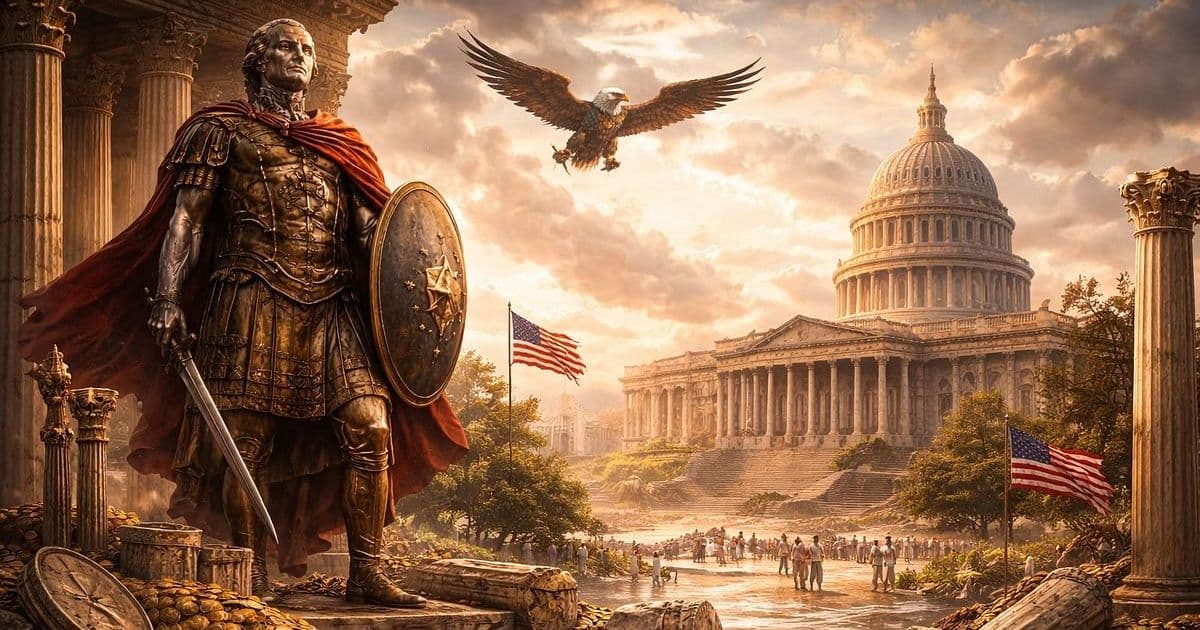
Empires rarely fall to external enemies. They collapse when their internal arithmetic breaks down. The British Empire's journey from global hegemon to IMF supplicant in just four decades reveals a pattern of imperial mathematics that the United States is now following with eerie precision.
Empires rarely fall in dramatic moments of realization. They do not collapse because they suddenly discover moral limits, nor because independence movements alone overwhelm them. Empires fall when their internal arithmetic breaks down. When the money runs out, ideology, armies, and prestige become ornamental.
The British Empire's descent from unchallenged global hegemon in 1939 to IMF-dependent state by 1976 is the clearest modern demonstration of this rule. When viewed alongside the deeper historical pattern of Rome's decline, the trajectory of the United States becomes less exceptional and more familiar. America was founded consciously as a "New Rome," but it now risks repeating Rome's final act through the same mechanisms that destroyed both Rome and Britain: debt, currency decay, middle-class erosion, and imperial overreach.
The Architecture of Imperial Finance
At its peak, Britain embodied imperial finance at its most refined. On the eve of World War II, it controlled nearly a quarter of the world's land and population. The pound sterling functioned as the world's reserve currency, underpinning global trade and investment. The City of London was the nerve center of international finance, supported by centuries of commercial networks and the discipline of the gold standard.
Britain was not merely powerful; it was solvent. It was the world's largest creditor nation, exporting capital, underwriting infrastructure across continents, and financing governments abroad. Naval dominance protected trade routes, but it was sterling not ships that truly sustained empire.
This mirrors Rome at its height, when a stable currency, a broad middle class, and reliable taxation financed legions and roads stretching from Britain to Mesopotamia. The denarius maintained its weight and purity for two centuries, the middle class of citizens and veterans formed the backbone of military recruitment and civic life, and the tax system—however imperfect—generated sufficient revenue to maintain infrastructure and pay soldiers.
The First Cracks: World War I
World War I shattered this equilibrium. Britain spent roughly £35 billion on the war, compared to a pre-war GDP of around £2.5 billion. To finance it, the state raised taxes sharply, expanded income tax to unprecedented levels, issued war bonds, borrowed heavily especially from the United States, and liquidated overseas assets accumulated over generations. Debt surged from £650 million to £7.4 billion, an eleven-fold increase.
Crucially, Britain suspended the gold standard in 1914, severing the monetary anchor that had given sterling credibility. Like Rome debasing the denarius to pay its legions, Britain began financing power through monetary compromise rather than productivity.
The interwar attempt to restore imperial normalcy proved disastrous. Britain returned to the gold standard in 1925 at pre-war parity, overvaluing the pound in a transformed global economy. Exports became uncompetitive, deflation set in, unemployment rose, and economic stagnation became structural. The empire still existed geographically, but its financial foundations were hollowing out.
Rome experienced a similar illusion in its later centuries: borders intact, titles preserved, but the economic engine no longer capable of sustaining them. The third-century crisis saw emperors maintaining the fiction of imperial control while the currency was debased by 95%, trade networks frayed, and the middle class evaporated into a mass of coloni tied to the land.
The Fatal Blow: World War II
World War II delivered the fatal blow. Britain spent another £28 billion, at peak devoting more than half of GDP to total war. By 1941, Britain was effectively bankrupt. Gold reserves were depleted, overseas investments sold, and shipping losses mounted. Survival depended on U.S. Lend-Lease program.
Though often framed as generosity, Lend-Lease was conditional: dismantling imperial trade preferences, opening markets to American goods, and accepting U.S. oversight. Britain no longer dictated the rules of the system it had built.
By 1945, public debt reached roughly 250 percent of GDP—far worse than Greece at the height of its crisis. Britain had transformed from the world's greatest creditor into its largest debtor.
At Bretton Woods in 1944, this loss of sovereignty was formalized. John Maynard Keynes proposed a neutral global currency to prevent dominance by any single power. The United States rejected it. Harry Dexter White ensured the dollar, backed by gold at $35 an ounce, became the world's reserve currency. Britain acquiesced because it had no alternative.
Reserve status—the ability to run deficits, borrow cheaply, and export inflation—passed permanently to Washington. This moment echoes Rome's transition from a republic of citizen-taxpayers to an empire dependent on tribute, debasement, and coercion.
The Unraveling: From Empire to Insolvency
The dismantling of the British Empire followed not from altruism but from insolvency. Indian independence in 1947 was fiscally unavoidable. Maintaining garrisons, administrators, and infrastructure across a restive empire was no longer affordable. The same logic applied across Africa and Asia in the following decades. Britain liquidated empire because it could not pay for it.
Rome did the same when it abandoned distant provinces it could no longer defend or administer. Aurelian withdrew from Dacia in 275 CE, not because the province lacked strategic value, but because the cost of defending it exceeded the resources available. The empire contracted inward, preserving the core by sacrificing the periphery.
Sterling crises became chronic. The pound was devalued by 30 percent in 1949. The 1956 Suez Crisis exposed Britain's true status. Militarily, Britain and France succeeded in retaking the canal. Financially, they were powerless. Eisenhower threatened sanctions, oil cutoffs, sterling sales, and IMF loan blocks. The pound wobbled; Britain withdrew in humiliation. Eden resigned.
Military power without monetary sovereignty proved illusory—just as Rome discovered when mercenary armies demanded pay the state could no longer provide.
The final phase was ignominious but predictable. Further devaluation in 1967, persistent deficits, stagflation, strikes, industrial decay, and brain drain earned Britain the label "the sick man of Europe." In 1976, Britain went to the IMF for a bailout, accepting austerity dictated by international bureaucrats. Empire, reserve currency, and policy autonomy were gone.
The Imperial Pattern
This pattern—war debts, reserve loss, deficits, devaluation, creditor dependence, and asset liquidation—is not uniquely British. It is imperial mathematics. Rome followed it over centuries; Britain compressed it into decades.
The United States now shows early but unmistakable signs of the same trajectory.
America as New Rome: Historical Consciousness
America was consciously founded as a New Rome. The Founders studied Roman history obsessively, borrowing its republican ideals, symbols, architecture, and warnings. The Capitol, the eagle, Latin mottos, and the Senate were not aesthetic choices but ideological ones. America saw itself as Rome reborn—wiser, restrained, immune to imperial decay.
Yet Rome itself believed the same thing. The Roman Republic transformed into empire while maintaining republican forms. The United States may be following an analogous path: preserving democratic institutions while accumulating imperial burdens that those institutions cannot sustain.
Parallel Decay: Three Pillars
Like Rome and Britain before it, America's strength rested on a broad middle class, a credible currency, and global financial privilege. Today, all three are under strain.
The Debt Burden
Federal debt stands around $38.4–38.5 trillion, with debt-to-GDP near 124 percent. Interest payments approach $1 trillion annually, rivalling defence spending. This is not sustainable arithmetic.
Rome faced a similar crisis in the third century. When Aurelian doubled soldiers' pay to secure loyalty, the state could only meet the obligation by minting more coins with less silver. The denarius, which contained nearly 100% silver under Augustus, contained less than 5% by 270 CE. The result was price inflation that destroyed the middle class and made long-term economic planning impossible.
Britain's equivalent came after World War I, when debt service consumed a growing share of government revenue, crowding out investment in infrastructure, education, and industry. The empire maintained its commitments while its productive capacity atrophied.
America's path follows the same logic. Each year, a larger portion of federal revenue must service debt, reducing flexibility to respond to crises, invest in productive capacity, or maintain social stability.
Currency Decay
Since abandoning the gold peg in 1971, the dollar has lost roughly 86 percent of its purchasing power. The dollar's reserve share, while still dominant, has declined to around 57–58 percent as alternatives slowly emerge.
Rome debased its currency to pay its army. Britain borrowed to fight existential wars. America finances permanent deficits to sustain global commitments, entitlements, and a sprawling bureaucracy.
The result is the same: pressure on the currency, erosion of the middle class, and declining state capacity. Infrastructure decays, social cohesion frays, and legitimacy weakens.
Middle-Class Erosion
Rome's middle class—the citizens who owned land, paid taxes, and served in the legions—gradually disappeared. Conquest enriched the elite while small farmers lost land to latifundia. The military became professionalized and loyal to generals rather than the state.
Britain's middle class—the commercial bourgeoisie who drove industrial innovation and provided civic stability—saw its wealth eroded by inflation, taxation, and the shift from manufacturing to finance. The welfare state temporarily masked the decline but could not reverse it.
America's middle class has shrunk through deindustrialization, financialization, and the inflation of asset prices that make home ownership and wealth accumulation increasingly difficult. Political polarization reflects this erosion—when the middle class loses economic security, it loses faith in institutions.
The Arithmetic of Imperial Overreach
Empires become overextended when the cost of maintaining control exceeds the benefits of extraction. Rome's frontiers required constant military presence, but the tax base could not support it. Britain's global commitments required naval supremacy, but sterling's reserve status could not finance it indefinitely.
America's global military footprint—over 750 bases in more than 80 countries—costs hundreds of billions annually. The dollar's reserve privilege makes this affordable in the short term, but the long-term cost appears in the form of debt accumulation and the eventual erosion of that privilege.
The Suez Moment: When Financial Reality Intervenes
As Rome discovered, identity collapses before borders do. Britain's Suez moment arrived in 1956. America's equivalent may lie a decade or two ahead, when financial reality forces a retreat from global obligations not by choice, but by necessity.
Empires do not end because they want to. They end because the numbers leave no alternative.
The Greenland Episode: A Limes for the Modern Age
Recent events provide a window into this dynamic. The saga over Greenland has emerged as a revealing emblem of America's transformation into a Second Rome—an empire still dominant in force, but increasingly reliant on coercion, financial pressure, and perimeter control rather than durable alliances.
Trump's open threats over Greenland, followed by his abrupt retreat, exposed how casually Washington now weaponizes tariffs, security guarantees, and even military rhetoric to extract concessions. The episode did lasting damage because it confirmed what allies already fear: deals with the United States under Trump carry no permanence.
This credibility shock was compounded by Europe's quiet but potent counter-leverage—the implicit threat of selling U.S. Treasuries—which quickly forced Washington to de-escalate. As with late Rome, power remains immense, but it is constrained by financial reality.
Trump's public diatribe against Canadian PM Mark Carney following his WEF speech on the decline of the post-war international order further underscored the rift. Carney merely articulated what markets already price in—that the old U.S.-centric system is fraying. Washington's angry response betrayed insecurity, not confidence.
Greenland, in this context, functions as a fortified frontier—a limes designed to shield the imperial core through missile defence, Arctic surveillance, and control over rare earths, even as cohesion on the periphery weakens.
The Hedging of Allies
Europe has drawn its own conclusions, accelerating strategic hedging through trade and security partnerships with powers like India. Canada's recent economic overtures toward China despite Trump's revived Monroe Doctrine rhetoric mark an even sharper break, signalling that even North American partners no longer accept U.S. veto power over their external alignments.
Canada is seeking to deepen ties with Europe, India & China as trading partners, while France's Macron is soon headed towards India for mega Rafale jet deal and British PM Starmer is headed towards Beijing. It clearly shows Washington slowly losing the VETO power over global trade & alignments as countries look to hedge United States in a fractured global order which is collapsing under its weight.
Like Rome retreating to defensible borders while losing ideological authority, the United States is prioritizing homeland insulation over alliance management, debasing not its currency alone but trust itself.
The Pattern of Imperial Late Phase
The Greenland episode, Treasury pressure, WEF clashes with Europe, and Canada's defiance—together, the withdrawal from Syria & Iraq, the Trade Wars—all form a single pattern: an empire still feared, still powerful, but increasingly transactional, inward-looking, and compelled by financial arithmetic rather than shared legitimacy—hallmarks not of ascent, but of imperial late phase.
Rome did not fall when its banners were torn down, but when its borders became walls, its money became illusion, and its allies became liabilities. America now echoes that rhythm: fortifying frontiers like Greenland, debasing trust instead of coin, and mistaking leverage for loyalty.
The Inward Collapse
History's poetry is unforgiving: empires do not die when they are defeated, but when they no longer persuade, and what was once a republic of shared purpose becomes an empire of guarded frontiers and diminishing faith.
Rome believed it could rule by force after belief faded; America risks believing the same. In both cases, the empire does not collapse outward in fire, but inward in silence—when partners hedge, citizens disengage, and power remains vast yet hollow.
The mathematics of empire is unforgiving. When debt exceeds productive capacity, when currency loses credibility, when the middle class erodes, and when commitments outstrip resources, decline becomes inevitable. Britain learned this lesson in the twentieth century. Rome learned it in the third. America is learning it now.
The question is not whether the pattern holds, but whether America recognizes the arithmetic before the numbers leave no alternative.
Comments
Please log in or register to join the discussion