
A deep dive into Adi Shamir's 1979 cryptographic breakthrough that enables secure secret distribution without single points of failure.
The need for distributed trust in digital systems has created renewed interest in cryptographic techniques that eliminate single points of failure. Among these, Shamir's Secret Sharing stands out for its elegant mathematical foundation and practical applications. First published by Adi Shamir (the 'S' in RSA) in 1979, this method allows secrets to be divided into pieces that can be reconstructed only when a sufficient number are combined, while any subset smaller than the threshold reveals nothing about the original secret.
The mathematical simplicity of Shamir's approach belies its profound implications for security. The core concept relies on a fundamental geometric principle: two distinct points determine exactly one straight line. A single point, however, does not—infinitely many lines can pass through a single point, each crossing the vertical axis at different locations. By hiding a secret at the point where a line crosses the vertical axis, and distributing points from that line to different parties, the system ensures that any single share reveals nothing about the secret, while any two shares can reconstruct the entire line and thus reveal the secret.
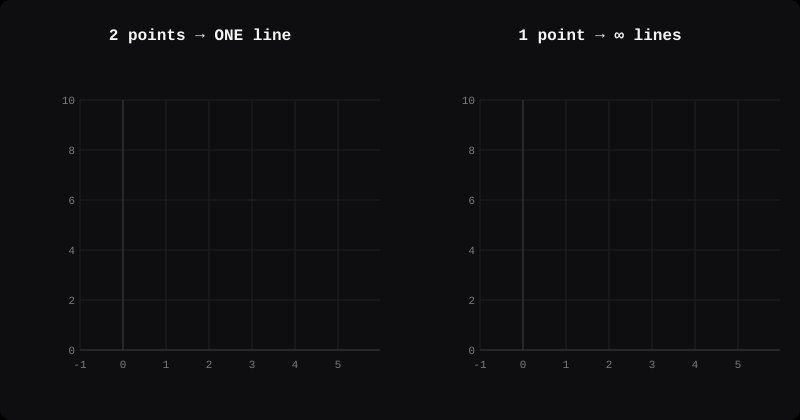
This geometric intuition extends to higher thresholds. For a 3-of-n scheme, a parabola (second-degree polynomial) is used, which requires three points to determine uniquely. In general, a threshold of k uses a polynomial of degree k-1, where the secret corresponds to the value at x=0. Each participant receives one point (x,y) from the polynomial, and only when k points are combined can the polynomial be reconstructed and the secret revealed.
Real-world implementations, such as those used in Ente's Legacy Kit, demonstrate the practical value of this approach. The mathematical elegance translates directly to cryptographic security: not only is computing the secret from fewer than k shares computationally difficult, but in the ideal case, any subset of fewer than k shares contains no information whatsoever about the secret. This property, known as perfect secrecy, represents a stronger guarantee than most cryptographic systems can provide.
Despite its theoretical strengths, practitioners note implementation challenges. "The beauty of Shamir's scheme is in its mathematical purity," explains a security researcher who has implemented the system, "but real deployments must contend with edge cases like secure key generation, proper random number generation, and protection against side-channel attacks." Additionally, while the scheme provides perfect secrecy for the secret itself, implementations often introduce other potential vulnerabilities through key management, secure computation environments, or recovery mechanisms.
The adoption of Shamir's Secret Sharing across various platforms reflects its versatility. From cryptocurrency wallets requiring multiple signatures to corporate governance systems that distribute trust, the mathematical framework continues to find new applications. "What makes this approach compelling," notes a blockchain security expert, "is how it aligns with real-world organizational structures. Companies naturally want to require multiple officers for critical decisions, and Shamir's method provides a mathematical foundation for that requirement without introducing artificial complexity."
As digital systems increasingly require distributed trust mechanisms, techniques like Shamir's Secret Sharing gain prominence. The approach represents a rare instance where theoretical cryptographic perfection meets practical implementation needs, offering both mathematical elegance and real-world applicability. Whether protecting master keys, enabling secure account recovery, or designing blockchain governance systems, the 1979 breakthrough continues to influence how we think about trust and security in distributed systems.
For developers interested in implementing Shamir's Secret Sharing, resources like Adi Shamir's original paper and Bruce Schneier's analysis provide deeper insights. Modern implementations can be found in cryptographic libraries like libsodium and specialized tools like Shamir's Secret Sharing implementations on GitHub.
This article covers the mathematical foundation of the "any two, never one" principle that makes Shamir's Secret Sharing so powerful. The technique represents a perfect example of how abstract mathematical concepts can solve concrete security problems, bridging the gap between theoretical computer science and practical application.
Comments
Please log in or register to join the discussion