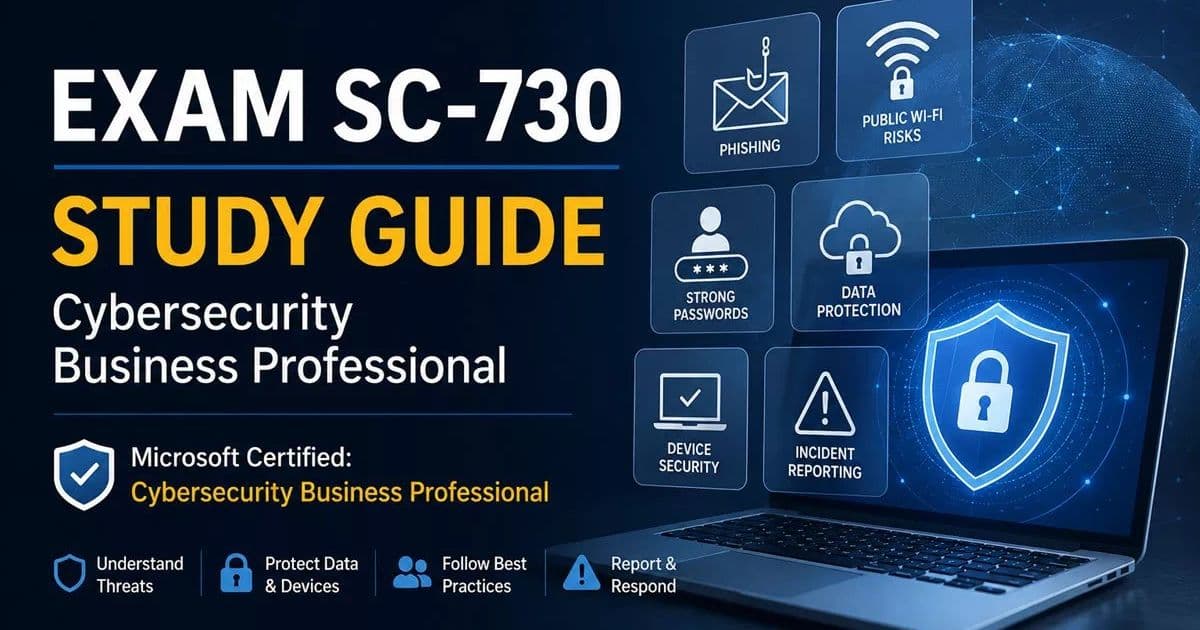
Microsoft’s new Cybersecurity Business Professional certification targets non‑technical staff who handle data, collaborate in the cloud, and use AI tools. This guide breaks down what changed, compares the SC‑730 exam to related Microsoft certifications, and outlines a practical preparation plan that balances risk awareness, basic security controls, and incident‑response reporting.
How to Pass Microsoft Exam SC‑730: Cybersecurity Business Professional – A Strategic Study Guide
What changed?
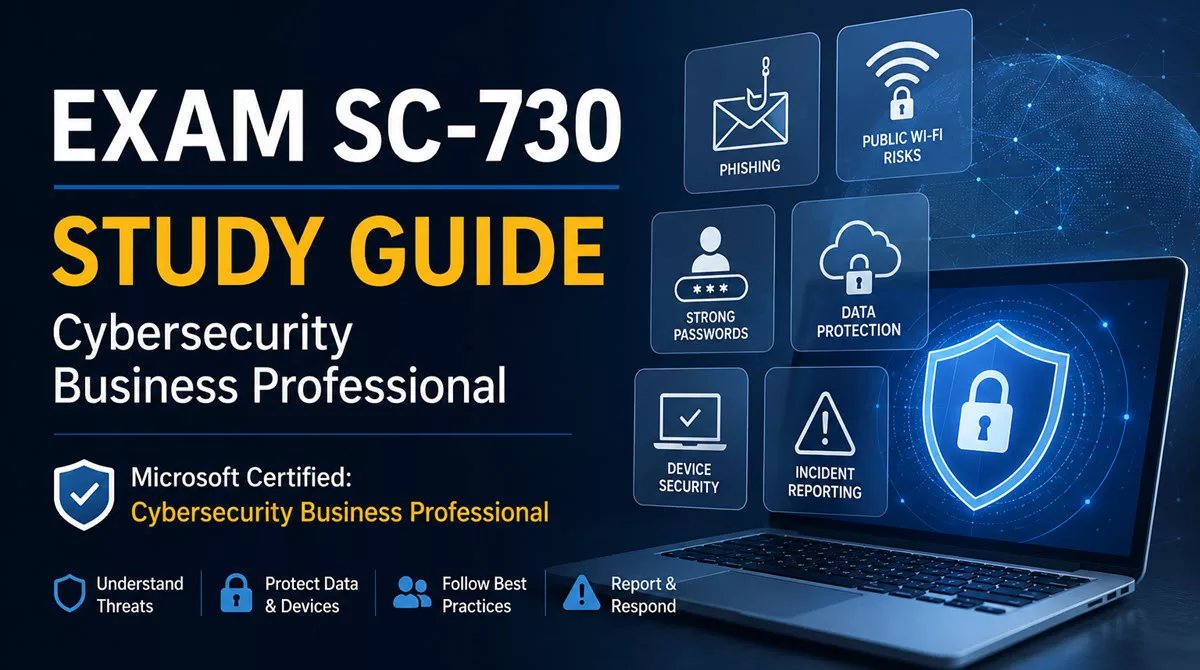
Microsoft added a Cybersecurity Business Professional (CBP) certification in May 2026. Unlike the technical tracks (SC‑900, AZ‑500, SC‑200), the SC‑730 exam is aimed at everyday business users—administrative staff, analysts, project managers, marketers, salespeople, and anyone who works with Microsoft 365, Teams, SharePoint, or AI‑powered productivity tools. The exam is still in beta, the passing score is 700, and a formal practice assessment will appear after the beta phase ends.
The shift reflects a broader industry move: security responsibility is no longer confined to dedicated teams. Organizations now expect every employee to recognize phishing, protect credentials, and report incidents. The SC‑730 credential formalizes that expectation and gives HR, compliance, and leadership a measurable way to prove baseline security awareness across the workforce.
Provider comparison – SC‑730 vs. other Microsoft certs
| Certification | Target audience | Core focus | Exam weight (domains) | Typical cost* |
|---|---|---|---|---|
| SC‑730 – Cybersecurity Business Professional | Business users (non‑technical) | Basic threat awareness, safe data handling, incident reporting | Risks & threats 30‑35 % • Concepts 25‑30 % • Practices 25‑30 % • Reporting 10‑15 % | Beta exam – free (discount code for early adopters) |
| SC‑900 – Security, Compliance, and Identity Fundamentals | Anyone starting in security | High‑level overview of Microsoft security stack | Fundamentals 100 % | US $99 |
| SC‑200 – Security Operations Analyst | Security analysts | Monitoring, investigation, response with Sentinel | Investigation 40 % • Response 30 % • Configuration 30 % | US $165 |
| AZ‑500 – Azure Security Technologies | Cloud engineers | Hardening Azure services, identity, network security | Azure security 100 % | US $165 |
| SC‑401 – Administering Information Security in Microsoft 365 | M365 admins | Governance, compliance, data loss prevention | Governance 45 % • Compliance 35 % • DLP 20 % | US $165 |
*Pricing reflects standard retail rates as of July 2026; discounts may apply for beta participants.
Strategic takeaways
- Scope – SC‑730 is the only Microsoft exam that explicitly excludes configuration tasks. If you already hold SC‑900, you can treat SC‑730 as a practical extension that tests scenario‑based decision making.
- Prerequisites – No formal experience is required, but familiarity with everyday tools (Outlook, Teams, OneDrive, SharePoint, AI chat assistants) is essential. A quick review of the free SC‑900 fundamentals learning path can fill knowledge gaps.
- Business impact – Companies that certify a large percentage of their workforce with SC‑730 can lower phishing click‑through rates and improve incident‑reporting speed, which translates into measurable risk reduction and insurance premium benefits.
Business impact – why the certification matters
- Reduced attack surface – When 80 % of staff can spot a spear‑phishing email, the likelihood of credential theft drops dramatically. Studies from the Microsoft Security Intelligence Report show a 35 % decrease in successful credential‑based attacks after organization‑wide security awareness programs.
- Faster breach containment – Employees trained to follow a simple “recognize‑verify‑report” workflow can alert security teams within minutes, cutting average dwell time from 5 days to under 24 hours.
- Compliance alignment – Many regulations (GDPR, CCPA, HIPAA) require documented security‑awareness training. SC‑730 provides a vendor‑backed credential that satisfies auditors without building a custom curriculum.
- Talent differentiation – For business analysts or project managers, the CBP badge signals a security‑minded mindset, making them more attractive for cross‑functional roles and internal promotions.
How to prepare – a step‑by‑step plan
1. Map the exam domains to daily work scenarios
| Domain | Real‑world example | Study focus |
|---|---|---|
| Cybersecurity concepts (25‑30 %) | Explaining the shared‑responsibility model in a team meeting | Review Microsoft’s Zero Trust overview and be ready to cite who is responsible for device security vs. cloud security. |
| Risks & threats (30‑35 %) | Receiving a suspicious email that appears to be from HR | Practice identifying phishing cues (urgency, mismatched URLs, unexpected attachments). Use the free Phishing Simulation Lab to test yourself. |
| Basic security practices (25‑30 %) | Setting up MFA on a personal device used for work | Walk through the MFA enrollment flow in Azure Entra ID and note the fallback options (authenticator app, hardware key). |
| Report & respond (10‑15 %) | Lost laptop on a business trip | Memorize the incident‑report template recommended by Microsoft (date, type, data affected, actions taken). |
2. Build a “scenario library”
Create a spreadsheet with three columns: Situation, Correct action, Reference. Populate it with examples from the official study guide, the Microsoft Learn SC‑730 module (once available), and real incidents you’ve seen in your organization. Review the library daily for 15 minutes.
3. Leverage free Microsoft resources
- Microsoft Learn – Even though a dedicated learning path isn’t published yet, the Security Fundamentals modules cover most concepts.
- Microsoft Security Awareness Center – Download the printable phishing‑checklist and the MFA quick‑start guide.
- GitHub – Security‑Awareness‑Toolkit – Community‑maintained quiz scripts that simulate phishing emails. Clone the repo and run the quiz locally:
git clone https://github.com/microsoft/security-awareness-toolkit.
4. Practice with realistic “sandbox” questions
Since the beta exam does not return a score, treat each practice question as a learning checkpoint. After answering, write a short justification for the chosen answer; this reinforces the decision‑making process required on the actual test.
5. Schedule the exam with a buffer
Plan to sit the exam after you have completed at least 20 scenario drills and feel comfortable explaining each decision out loud. Book the slot through the Microsoft Learn exam page and set a reminder to review the incident‑report template the day before.
Quick reference cheat‑sheet (printable)
- Phishing cues: urgent language, mismatched URLs, unknown sender, attachment you weren’t expecting.
- MFA rule: Never approve a prompt you didn’t initiate. Deny and report.
- Data‑sharing rule: Never paste PII, financial data, or confidential business info into public AI tools. Use approved Copilot or Azure OpenAI endpoints.
- Lost device protocol: Report within 30 minutes, provide device ID, location, and last login time.
- Incident report fields: Date/time, type, affected data, device/account, actions taken, evidence (screenshots).
Exam day checklist
- Verify you have a stable internet connection and a quiet environment.
- Have a government‑issued ID ready for identity verification.
- Keep a notepad handy for jotting down any unfamiliar terminology.
- Remember the core mantra: Recognize → Verify → Protect → Report.
Next steps after certification
- Add the Microsoft Certified: Cybersecurity Business Professional badge to your LinkedIn profile and corporate directory.
- Share the badge internally to encourage peers to certify; a higher certification rate improves overall security posture.
- Consider pairing SC‑730 with SC‑900 for a broader foundation, or move toward SC‑401 if you later transition into a governance role.
Prepared by a cloud‑and‑cybersecurity consultant with years of experience guiding enterprises through Microsoft’s certification ecosystem.
Comments
Please log in or register to join the discussion