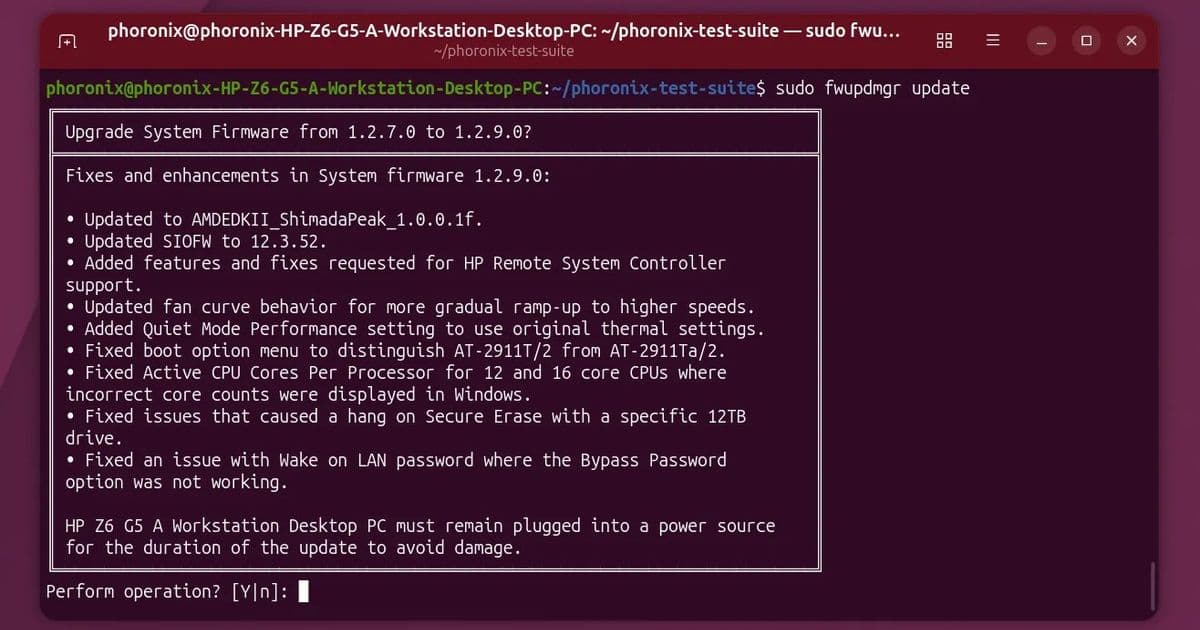
HP has become the third premiere sponsor of the Linux Vendor Firmware Service (LVFS) and fwupd project, following Dell and Lenovo's recent $100k+ annual commitments. The sponsorship signals growing OEM commitment to Linux firmware update infrastructure, with HP already supporting LVFS on select hardware including ZBook laptops and Z6 workstations.
The Linux firmware update ecosystem just got a significant vote of confidence. HP has joined Dell and Lenovo as a premiere sponsor of the Linux Vendor Firmware Service (LVFS) and its associated fwupd daemon, marking a substantial win for open-source firmware management on Linux.
What LVFS/Fwupd Actually Does
For those unfamiliar with the project, LVFS serves as the critical bridge between hardware vendors and Linux end-users when it comes to firmware updates. The fwupd daemon, developed primarily by Richard Hughes at Red Hat, provides a standardized way to deliver firmware updates across different hardware components—from system BIOS/UEFI firmware to device firmware in peripherals like USB docks, graphics cards, and storage controllers.
Historically, Linux users have faced a fragmented and often neglected firmware update experience. Without vendor support, users were left manually flashing firmware using vendor-specific tools or, worse, booting into Windows just to update their BIOS. LVFS solves this by providing a vendor-neutral infrastructure that major OEMs can leverage to push firmware updates directly through the Linux desktop's software update mechanisms.
HP's Entry as Premiere Sponsor
Richard Hughes announced HP's premiere sponsorship this week, just days after Dell and Lenovo made similar commitments. The premiere sponsor tier represents contributions exceeding $100,000 annually—significant funding that helps sustain the development and maintenance of this critical open-source infrastructure.
HP already supports LVFS/fwupd on several product lines, including:
- ZBook Ultra G1a mobile workstations
- Z6 G5 A workstations
- Various USB docking stations
This existing hardware support makes HP's sponsorship particularly meaningful. Unlike some sponsors who contribute without active product support, HP has demonstrated commitment to the ecosystem through actual driver and firmware distribution via the LVFS.
Why This Matters for Linux Users
The significance of this sponsorship wave extends beyond just funding. Premiere sponsorships signal that major OEMs view Linux as a legitimate platform for their professional and consumer hardware—not just an afterthought.
For enterprise deployments particularly, reliable firmware update paths are essential for security compliance and system maintenance. When HP, Dell, and Lenovo all support LVFS, IT departments can manage firmware updates consistently across mixed-vendor fleets using standard Linux tools rather than maintaining separate update workflows for each hardware vendor.
The sponsorship also helps ensure that future HP hardware will continue receiving LVFS support. With financial stakes involved, vendors are incentivized to maintain and expand their firmware distribution through the service.
Looking Forward
With three major OEMs now as premiere sponsors, the pressure mounts on other hardware vendors to similarly support the project. AMD, Intel, and NVIDIA have historically provided firmware blobs through LVFS, but consumer-facing OEM sponsorship from companies like ASUS, Acer, and Microsoft would further solidify the ecosystem.
For Linux users considering HP hardware, the sponsorship provides additional confidence that firmware updates will be available through standard system update mechanisms rather than requiring workarounds or Windows dual-boots.
The LVFS project continues to expand its supported device categories, with recent work on improving security verification, better handling of signed firmware, and expanded support for component-level firmware beyond just system BIOS.
Comments
Please log in or register to join the discussion