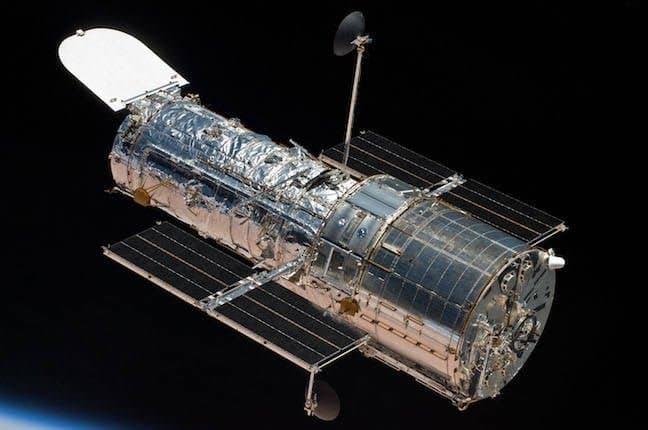
The Hubble Space Telescope is descending faster than expected due to solar activity, with astronomer Jonathan McDowell warning it could re-enter Earth's atmosphere as early as 2028 without a reboost mission.
The Hubble Space Telescope, humanity's most iconic space observatory, is on a collision course with Earth that could end as early as 2028, according to new analysis from astronomer Jonathan McDowell. The telescope's orbit is decaying at an accelerating rate, with recent solar activity causing Earth's atmosphere to expand and create increased drag on the aging spacecraft.
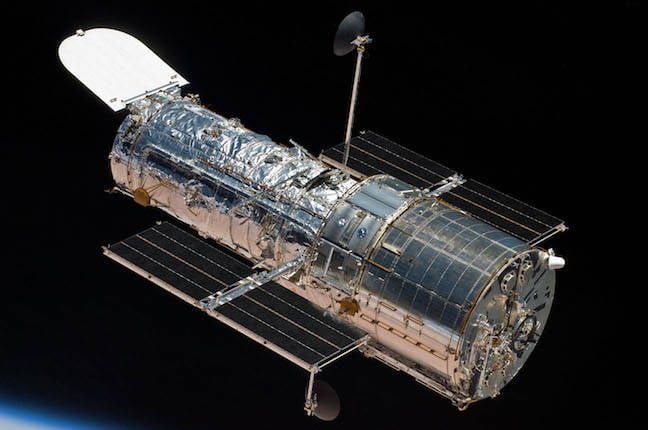
McDowell, who posted his findings on Bluesky, shared a stark visualization of Hubble's orbital decay that shows the telescope dropping from an initial altitude of more than 600 kilometers to well below 500 kilometers in recent years. The plot reveals an accelerating descent that has quickened in the past few years, raising urgent questions about the telescope's future.
Unlike the International Space Station, which regularly performs reboost maneuvers to maintain its orbit, Hubble lacks the capability to raise its own altitude. The telescope was designed for servicing by Space Shuttle crews, with the final servicing mission in 2009 leaving behind a docking adapter for potential future spacecraft. However, with the Space Shuttle fleet retired since 2011, no approved mission exists to perform the critical reboost that could extend Hubble's life by years or even decades.
The timing couldn't be worse. NASA is currently focused on attempting to rescue the Swift observatory, which has dropped below 400 kilometers in altitude. The agency has paused most science operations on Swift to buy time for a reboost mission planned for later this year. This rescue effort highlights the growing challenge of maintaining aging spacecraft in low Earth orbit as solar activity increases during the current solar cycle.
Solar activity plays a crucial role in orbital decay. As the Sun becomes more active, it heats Earth's upper atmosphere, causing it to expand. This expanded atmosphere creates more drag on satellites in low Earth orbit, pulling them downward faster than normal. The current solar maximum has exacerbated Hubble's orbital decay, but even in quieter solar periods, the telescope would eventually succumb to atmospheric drag without intervention.
Dr. John Grunsfeld, former astronaut and retired associate administrator of NASA's Science Mission Directorate, warned in 2025 that Hubble faces "death by a thousand cuts." Beyond the orbital decay, the telescope has been operating with a relatively flat budget for years, which translates to approximately 30 percent less funding in real terms when accounting for inflation. This budget pressure has forced NASA to make difficult decisions about the telescope's future.
Hubble's technical challenges compound the orbital issues. The telescope transitioned to single-gyro mode in 2024 after multiple gyroscope failures. It originally launched with six gyroscopes for pointing control, but three have failed completely, and a fourth shows signs of degradation. Engineers had hoped to extend the telescope's operational life by carefully managing its remaining hardware, but without altitude maintenance, these efforts may be futile.
The potential loss of Hubble represents more than just the end of a single mission. Since its launch in 1990 aboard Space Shuttle Discovery, the telescope has revolutionized our understanding of the universe. It has provided breathtaking images of distant galaxies, helped determine the age of the universe, and discovered countless astronomical phenomena. Its contributions to science have been immeasurable, making the prospect of its uncontrolled re-entry particularly poignant.
NASA Administrator Jared Isaacman previously proposed a mission to boost Hubble's orbit in 2022, but the idea was ultimately rejected. The rejection likely stemmed from both technical challenges and budget constraints, as NASA faces competing priorities across its science and human spaceflight programs. The agency's current focus on lunar exploration and Mars preparation leaves little room for expensive servicing missions to aging telescopes.
The situation mirrors broader challenges facing space agencies worldwide. As more satellites crowd low Earth orbit and solar activity fluctuates, maintaining spacecraft positions becomes increasingly difficult and expensive. The Hubble situation serves as a case study in the limitations of current space technology and the difficult choices facing space agencies as they balance new missions against maintaining existing assets.
Without a reboost mission in the next few years, Hubble will continue its descent toward inevitable re-entry. The telescope's massive size means it won't completely burn up in the atmosphere, potentially creating debris that could reach Earth's surface. While the risk to people is minimal given the planet's vast oceans and unpopulated areas, the uncontrolled nature of such an event would be a disappointing end to one of humanity's greatest scientific instruments.
The clock is ticking. McDowell's analysis suggests Hubble is already on a trajectory toward 2028 re-entry, but even if that timeline proves optimistic, the fundamental problem remains unchanged. Without intervention, Earth's most famous telescope will become a brief, spectacular fireball in the sky, ending three decades of groundbreaking discoveries and leaving astronomers to wonder what might have been if only we had acted sooner.
Comments
Please log in or register to join the discussion