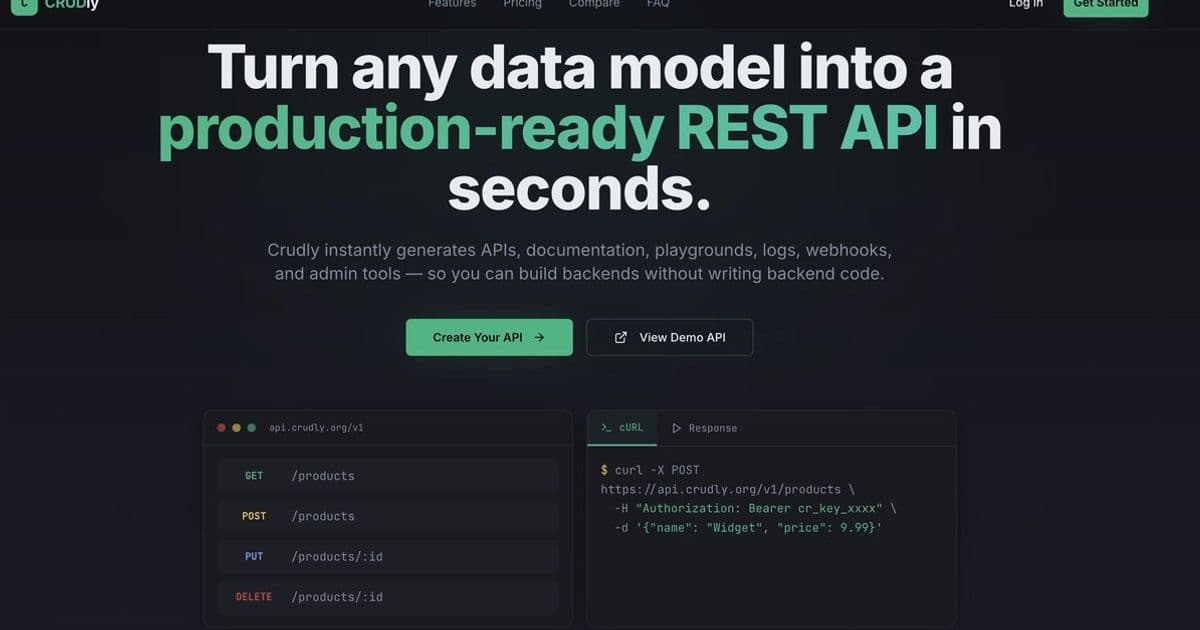
Crudly eliminates the tedious backend development process by generating REST APIs from schema definitions without requiring code or server setup, enabling rapid prototyping and development.
Eliminating Backend Tedium with Schema-Generated APIs
Every developer who builds side projects has faced this pattern: you have a frontend idea, but immediately need to pause and build a backend. Not because backend development is conceptually difficult, but because it's tedious. The same patterns repeat endlessly: define models, wire up routes, handle errors, write documentation, set up authentication. This repetitive work often slows down innovation and turns promising projects into unfinished experiments.
This observation led to the creation of Crudly, a platform that eliminates the need to build traditional backends for many use cases. Instead, developers define schemas and immediately get functional REST APIs.
The Architecture Approach: Dynamic Runtime Routing
The most significant architectural decision in Crudly is that it doesn't generate code. Unlike traditional approaches that scaffold a new Express application for each user, Crudly uses dynamic runtime routing. All requests to api.crudly.org/v1/{project}/{collection} hit the same handler. At request time, the system reads your schema configuration, validates the request against it, and serves or persists data accordingly.
This approach has several advantages:
No cold starts: Since there's no isolated application per project, requests don't suffer from initialization delays common in serverless architectures.
Simplified infrastructure: A single, well-maintained API server handles all projects, reducing operational complexity.
Consistent performance: All projects share the same optimized runtime environment.
Instant updates: When you modify a schema, the changes are immediately reflected in the API behavior without requiring deployments.
This pattern is similar to tools like Hasura and PostgREST, but with a more constrained surface area. Unlike those tools, Crudly doesn't require GraphQL knowledge or pointing to your own database instance. The contract is simple: create a collection, get endpoints.
Comprehensive Feature Set
What sets Crudly apart from simpler API generators is its complete feature set. Many tools solve the immediate problem of API generation but leave developers to figure out adjacent concerns. Crudly includes:
1. Built-in HTTP Client (Playground)
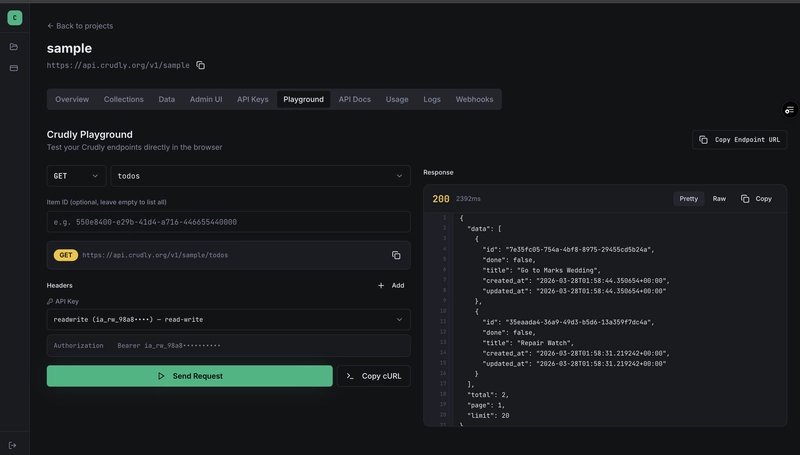
A browser-based HTTP client similar to Postman, directly integrated into the dashboard. This eliminates context switching during development. You can select a collection, choose an HTTP method, and make requests without leaving your workflow. Responses display with proper formatting, status codes, and timing information.
2. Auto-generated Documentation
Each collection automatically gets documentation that reflects the actual schema. When schemas change, documentation updates accordingly. The curl examples use real endpoint URLs with your specific project identifiers, eliminating the need to maintain separate Swagger or OpenAPI specifications.

3. Request Logging
Real-time traffic visibility from the dashboard, with filtering by method, status, endpoint, and date. This feature has proven valuable for catching integration bugs in client applications simply by observing the request patterns and error responses.

4. Webhook Support
POST callbacks triggered on create, update, or delete events per collection. This enables integration with external services like n8n, Zapier, or custom services without requiring polling mechanisms.
5. API Key Authentication
Read-only and read-write keys per project, generated and revoked from the dashboard. Authentication follows the standard Authorization: Bearer header pattern, making it compatible with most HTTP clients.
6. Admin Panel
A generated data dashboard that allows browsing records, creating entries, editing, and deleting. This serves both development needs and provides a non-technical interface for content management.
Deliberate Constraints and Trade-offs
Crudly's design includes intentional constraints that define its scope and capabilities:
No custom logic: Unlike platforms like Firebase or Supabase, Crudly doesn't support custom functions or business logic. This constraint simplifies the architecture and maintains the five-minute setup promise.
No middleware hooks: The absence of middleware prevents cross-cutting concerns like logging, caching, or transformation at the API level.
No computed fields: All fields must be explicitly defined in the schema without derived values.
No joins across collections: Each collection operates independently without relationships or foreign keys.
These constraints aren't limitations but deliberate design decisions. Each time the author considered adding "just a bit" of custom logic support, they evaluated whether it would break the core promise of having a working API in under five minutes. Usually, it would.
Architectural Trade-offs
The dynamic routing approach that makes Crudly possible comes with important trade-offs:
Advantages:
- Instant provisioning: New APIs are available immediately after schema definition
- Consistent performance: No per-project resource allocation or cold starts
- Simplified operations: Single codebase to maintain rather than managing thousands of user applications
- Cost efficiency: Shared infrastructure reduces resource consumption
Limitations:
- Performance isolation: One project's traffic spike could potentially impact others
- Customization constraints: The generic approach limits specialized optimizations
- Scalability challenges: As the number of projects grows, the single handler must efficiently route and validate increasingly diverse schemas
Use Cases Where Crudly Excels
Crudly fills specific niches in the development ecosystem:
1. Rapid Prototyping and MVPs
Developers can wire up a real API before committing to building a proper backend. This reduces the risk of investing significant time in infrastructure for projects that might not materialize.
2. Frontend Demos and Portfolios
Instead of mocking data with static JSON files, developers can build demos that actually persist data, creating more impressive and realistic showcases.
3. Internal Tools
Quick admin data stores for side dashboards without standing up additional services. This is particularly valuable for small teams that need to manage internal data without dedicating resources to backend infrastructure.
4. Hackathons
The entire backend setup takes less time than arguments about which framework to use, allowing teams to focus on building unique features rather than boilerplate infrastructure.
Comparison to Alternatives
Crudly exists alongside several similar approaches, each with different trade-offs:
Traditional DIY Backend
- Pros: Complete control, can implement any custom logic
- Cons: Time-consuming, requires maintenance, operational overhead
BaaS (Backend as a Service) like Firebase
Pros: Rich features, real-time capabilities, custom functions
Cons: Can become complex, vendor lock-in, potential cost escalations
Crudly advantage: Simpler, more constrained, faster setup for basic needs
Firebase advantage: More powerful, more flexible, larger ecosystem
API Gateway with Code Generation
Pros: Familiar workflow, can add custom code
Cons: Still requires writing and maintaining code, deployment overhead
Crudly advantage: Truly zero-code, instant updates
Code generation advantage: More familiar to many developers, easier to customize
GraphQL APIs like Hasura
Pros: Flexible queries, real-time subscriptions, efficient data fetching
Cons: Learning curve, potential over-fetching/under-fetching, complexity
Crudly advantage: Simpler REST interface, easier to understand for many use cases
GraphQL advantage: More powerful data retrieval patterns
The Future of Schema-Driven Development
Crudly represents a broader trend toward schema-driven development, where the schema serves as the source of truth for both data structure and API behavior. This approach aligns with the principle of declarative programming, where developers specify what they want rather than how to implement it.
The success of platforms like Hasura, PostgREST, and now Crudly suggests that many applications don't need the flexibility of custom code—they need reliable, predictable APIs that match their data structures. As these platforms mature, we may see more sophisticated schema-driven capabilities that maintain the simplicity of declarative approaches while accommodating more complex requirements.
Conclusion
Crudly addresses a real pain point in the development workflow: the tedious, repetitive nature of building backends for simple applications. By focusing on a constrained set of features and leveraging dynamic runtime routing, it delivers on the promise of instant API generation without sacrificing essential functionality.
The most valuable aspect of Crudly may not be the technology itself, but the mindset shift it represents: questioning whether we need to build backends at all for certain use cases. Sometimes the constraint of "no custom logic" isn't a limitation but a catalyst for simpler, more focused applications.
For developers who've spent weekends building yet another CRUD API for a side project, Crudly offers a way to bypass that work entirely. It doesn't replace the need for sophisticated backends when custom logic is required, but for the vast number of applications that just need persistent data with a REST interface, it may be all that's necessary.
If you're tired of building backends for simple projects, Crudly is worth exploring. The free plan allows you to create a project, add a collection, and have a working API in about two minutes—time that's better spent building the actual application rather than its infrastructure.
Comments
Please log in or register to join the discussion