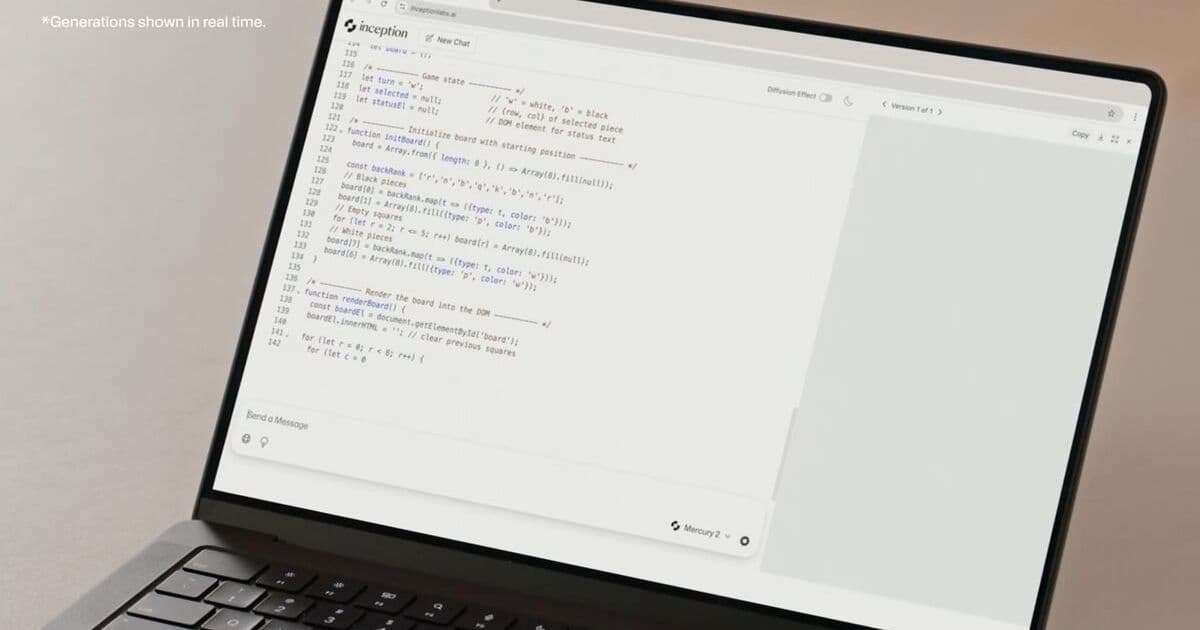
Stefano Ermon's Inception releases Mercury 2, a diffusion-based AI model promising faster and cheaper question-answering capabilities than competitors delivers a technical approach distinct from transformer models.
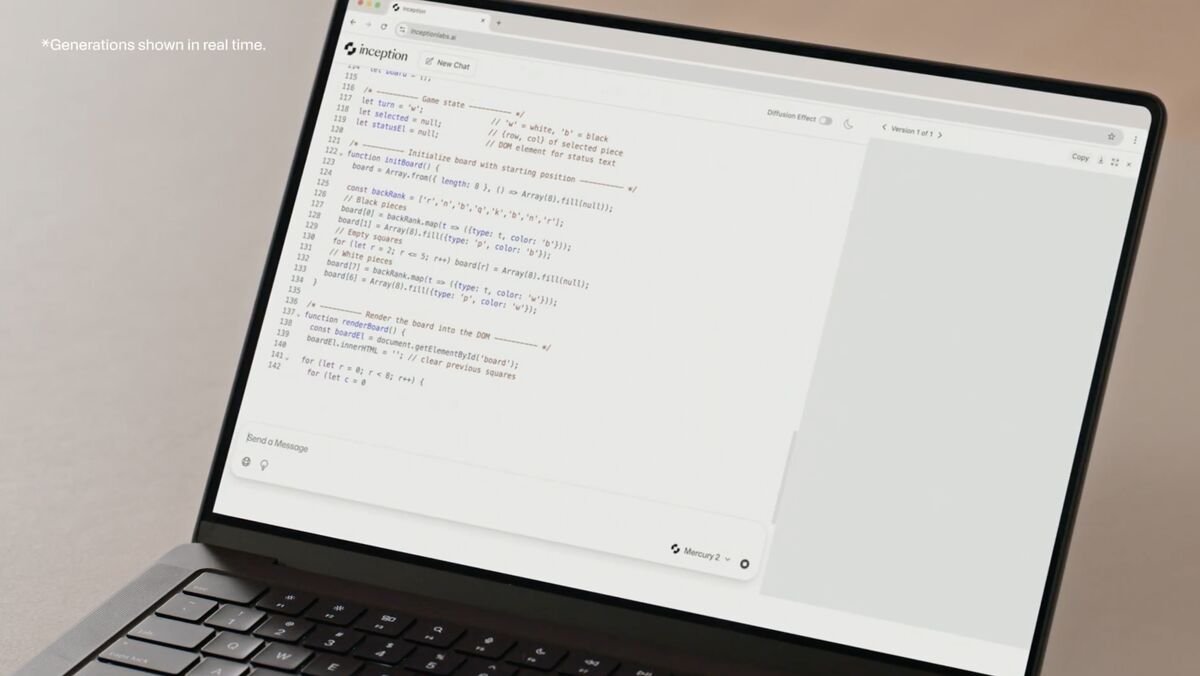
Stanford professor Stefano Ermon's AI startup Inception has unveiled Mercury 2, a diffusion model architecture adapted for conversational AI that claims significant efficiency advantages over established question-answering systems. Unlike transformer-based models dominating the field (GPT, Claude, Gemini), Mercury 2 applies principles from image-generation diffusion models to text processing - an approach that reportedly enables faster response times at lower computational costs.
The core innovation lies in Mercury 2's reverse diffusion process for text generation. Where transformers predict tokens sequentially, diffusion models start with random noise and iteratively refine outputs toward coherent responses. This allows parallel processing of entire responses rather than token-by-token generation. Inception claims this architecture reduces latency by 40-60% compared to similarly sized transformer models while cutting inference costs by approximately 70% on comparable hardware.
Technical documents indicate Mercury 2 uses a modified continuous-time diffusion framework with learned noise schedules optimized for linguistic structures. The model operates through three phases: initial noise generation, context-aware denoising via encoder attention mechanisms, and output refinement. Benchmarks provided by Inception show 2.8x faster throughput than Mistral 8x22B when handling complex queries involving multi-step reasoning on NVIDIA H100 clusters.
Practical applications target high-volume enterprise use cases where latency and cost per query directly impact viability:
- Customer service bots handling concurrent conversations
- Research assistance tools scanning large document sets
- Real-time technical support systems
The trade-offs become apparent in specialized domains. Mercury 2 shows weaker performance than transformer equivalents in tasks requiring long-context retention (100K+ tokens) and exhibits higher error rates when handling highly structured inputs like legal contracts or programming syntax. Ermon acknowledges these limitations, noting the architecture prioritizes speed over precision in knowledge-intensive scenarios.
Market context reveals intensifying competition in efficient inference. While startups like Mistral and Anthropic optimize transformer architectures, diffusion approaches remain rare in text generation. Mercury 2's release coincides with Meta's massive AMD GPU procurement and xAI's military contract, highlighting industry focus on scaling AI infrastructure economically.
Independent verification remains pending. Without published peer-reviewed papers or third-party benchmark access, claims rely on Inception's internal testing. The diffusion approach also faces inherent challenges: training requires specialized techniques unlike transformer fine-tuning pipelines, potentially limiting developer adoption. As enterprises prioritize inference economics, Mercury 2 presents an architecturally distinct option - but its ultimate viability depends on overcoming precision gaps and establishing developer ecosystem support.
Stefano Ermon's academic contributions to diffusion models (including foundational papers on noise-conditioned training) lend technical credibility to the approach. However, real-world deployment will determine whether this diffusion detour from transformer dominance delivers sustainable advantages or becomes a specialized niche solution.
Comments
Please log in or register to join the discussion