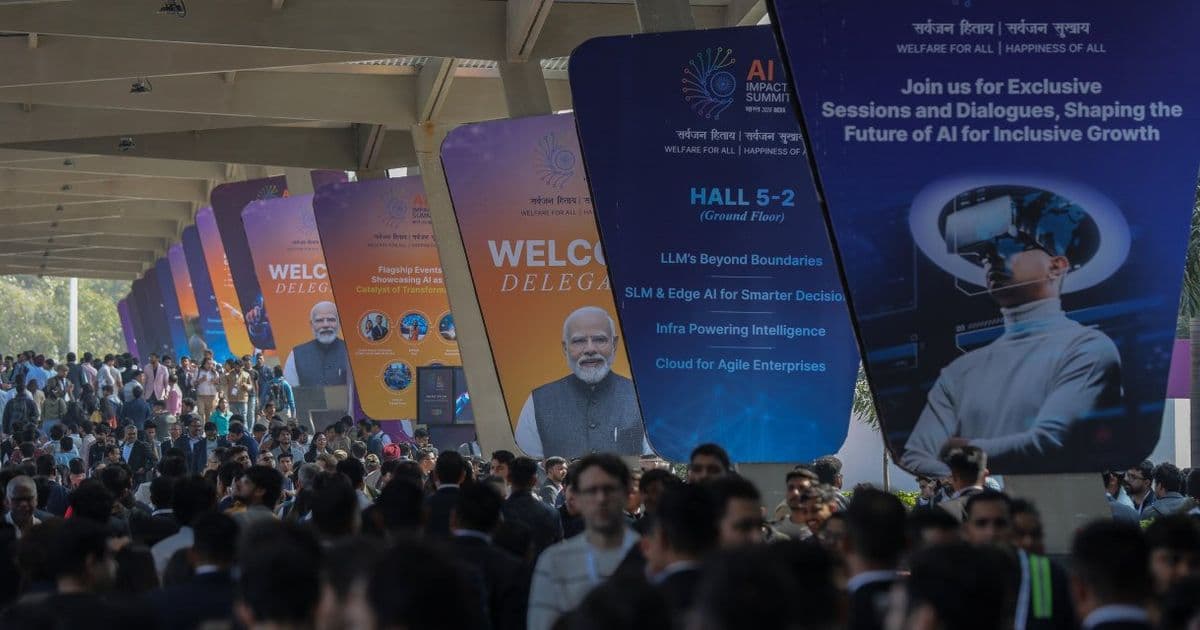
India is positioning itself as a leader in cost-effective AI solutions tailored to local challenges as it hosts its AI Impact Summit in New Delhi this week.
As India prepares to host its AI Impact Summit in New Delhi this week, the country is set to promote a frugal AI strategy focused on solving local issues. The world's most populous country is looking at how it can become an artificial-intelligence power without breaking the bank.
The summit comes at a crucial time for India's tech ambitions. With a population exceeding 1.4 billion and a growing digital economy, India sees AI as a critical driver for economic growth, but recognizes that Western-style AI development models may not be sustainable or appropriate for its unique challenges.
Frugal Innovation at the Core
India's approach centers on what officials call "frugal AI" - developing artificial intelligence solutions that are cost-effective, resource-efficient, and specifically designed to address local problems. This strategy acknowledges India's constraints: limited infrastructure in rural areas, diverse linguistic landscape with 22 official languages, and the need to serve both tech-savvy urban populations and those with minimal digital literacy.
The country's AI mission, led by CEO Abhishek Singh, is expected to push for international agreement on a "global AI commons" during the summit. This would involve creating shared AI resources and frameworks that developing nations can access and build upon, rather than competing for expensive proprietary systems.
Local Solutions for Local Problems
India's AI strategy focuses heavily on practical applications that can deliver immediate value:
- Agricultural AI: Systems to predict crop yields, optimize irrigation, and provide real-time market prices to farmers
- Healthcare Diagnostics: AI tools that can operate with limited internet connectivity and work with lower-quality medical images
- Language Processing: Models trained on India's diverse languages and dialects, many of which lack digital representation
- Financial Inclusion: AI-powered credit scoring and fraud detection for the unbanked population
These applications require different approaches than the massive, compute-intensive models being developed in Silicon Valley. Indian researchers are working on smaller, more efficient models that can run on basic smartphones or edge devices with limited processing power.
The Economic Context
India's frugal AI strategy also reflects economic realities. While the country has seen tremendous growth in its tech sector, with companies like Fractal becoming India's first AI unicorn in 2022, there's recognition that the Western venture capital model may not be sustainable for all AI development.
Recent data shows that Indian AI startups are increasingly focused on solving specific, high-impact problems rather than pursuing general artificial intelligence. This pragmatic approach has attracted investment from both domestic and international sources, though the market remains challenging - Fractal's shares fell 5% amid a weak Indian IPO market despite raising $313 million.
Global Positioning
The summit represents India's bid to position itself as a leader in "AI for the Global South" - developing AI solutions that can be adapted for other developing nations facing similar challenges. This positioning could give India significant diplomatic leverage as countries worldwide grapple with AI governance and development strategies.
India's approach contrasts sharply with the massive AI investments being made by the US and China. While those countries focus on building ever-larger models and infrastructure, India is betting that efficiency and localization will prove more valuable in the long run.
Challenges Ahead
Despite the promising strategy, India faces significant hurdles:
- Infrastructure Gaps: Limited high-speed internet and computing resources in rural areas
- Talent Pipeline: Need for more AI researchers and engineers trained in frugal innovation approaches
- Data Quality: Much of India's data remains unstructured or in formats that are difficult for AI systems to process
- Regulatory Framework: Developing appropriate regulations that protect citizens while enabling innovation
The Summit's Significance
The AI Impact Summit in New Delhi represents more than just another industry conference. It's India's formal announcement to the world that it intends to chart its own course in AI development - one that prioritizes accessibility, efficiency, and local impact over raw computational power.
As the summit unfolds, the tech world will be watching to see whether India's frugal AI strategy can deliver on its promise of making artificial intelligence a tool for inclusive growth rather than a resource only available to wealthy nations and corporations.
Comments
Please log in or register to join the discussion