Retrieval‑Augmented Generation (RAG) works well on small corpora, but scaling to hundreds of thousands or millions of documents exposes architectural flaws. This article explains the technical break points, compares Azure AI Search with competing vector‑search services, and outlines the business impact of adopting a production‑grade, distributed RAG stack.
When RAG Hits the Wall: Designing Systems That Scale from 1,000 to 1 Million Documents
What changed – the hidden failure modes that appear after 10 K documents
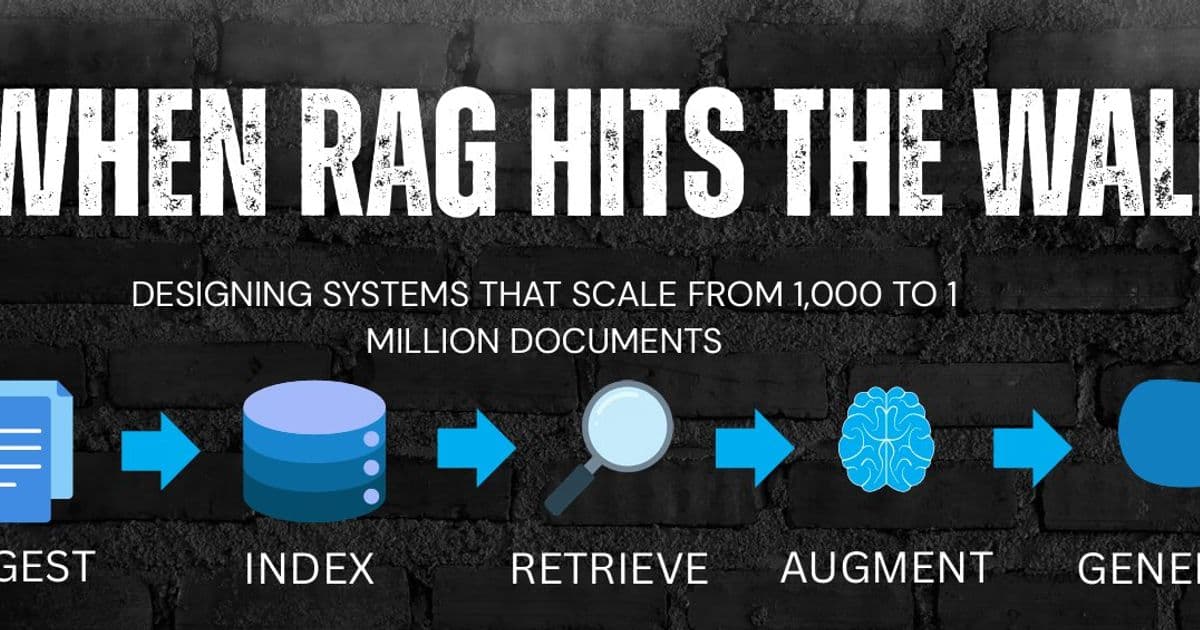
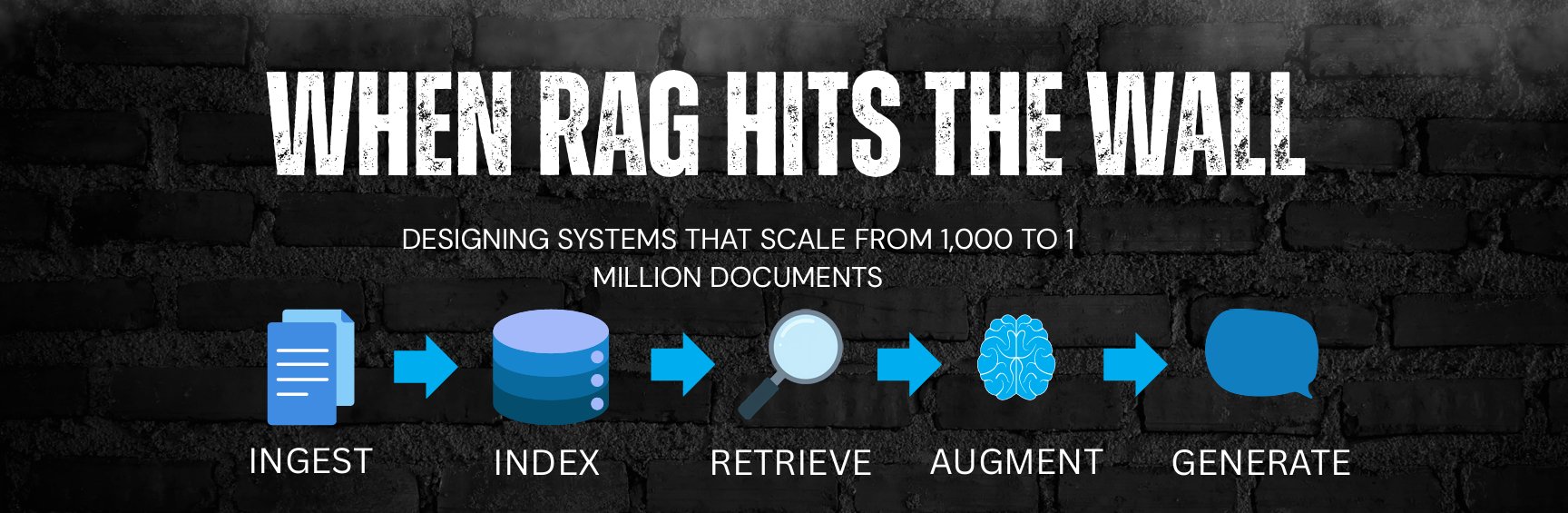
RAG is often introduced with a simple pipeline: document → fixed‑size chunks → embed → store in a flat vector index → retrieve at query time. The approach delivers impressive accuracy when the corpus contains a few hundred or a few thousand items because the vector space is sparse and irrelevant neighbors are rare.
When the corpus grows beyond tens of thousands the following symptoms emerge:
- Chunk explosion – token‑based chunking creates many more vectors than documents. The vector space becomes dense, distances flatten, and “nearest‑neighbor” loses semantic meaning. This is the classic curse of dimensionality.
- Vector‑search saturation – unpartitioned indexes force every query to scan millions of vectors. Latency grows non‑linearly, cache hit rates drop, and cost per query climbs toward linear complexity.
- Context overload – pulling many chunks into the prompt exceeds the LLM’s effective attention window. The model’s reasoning degrades because useful signal is drowned in noise.
These issues are not model bugs; they are architectural. The illusion of robustness at small scale disappears once the data volume pushes the system into a high‑entropy regime.
Provider comparison – Azure AI Search vs. leading alternatives
| Feature | Azure AI Search (Microsoft) | Pinecone | Weaviate | Qdrant |
|---|---|---|---|---|
| Hybrid indexing (vector + BM25) | Built‑in hybrid search, configurable relevance scoring. | Vector‑only; requires external BM25 layer. | Supports hybrid via plugins; extra setup. | Vector‑only; hybrid via separate service. |
| Hierarchical indexing | Supports document‑level, section‑level, chunk‑level indexes out‑of‑the box; easy to define custom fields. | Flat index; you must implement hierarchy yourself. | Offers nested objects but performance varies with depth. | Flat index; hierarchical queries need custom logic. |
| Partitioning & scaling | Automatic sharding across Azure regions; integrates with Azure Private Link for low‑latency intra‑region traffic. | Manual shard management; scaling requires provisioning more pods. | Supports sharding via Kubernetes; operational overhead higher. | Provides configurable shards; requires self‑managed clusters. |
| Pre‑computed embeddings | Azure Cognitive Search can ingest embeddings generated by Azure OpenAI, Azure ML, or custom pipelines during ingestion. | Embeddings must be pre‑computed; no native ingestion pipeline. | ||
| Deduplication & metadata enrichment | Built‑in skillset for duplicate detection, language detection, and custom enrichment. | No native deduplication; external tooling needed. | ||
| Cost model | Pay‑as‑you‑go per search unit + storage; predictable for large workloads. | Per‑hour pod pricing; cost spikes with high query volume. | ||
| Enterprise security | Azure AD integration, role‑based access, private endpoints, compliance certifications (ISO, SOC, HIPAA). | API‑key based; limited enterprise IAM integration. | ||
| Ecosystem | Tight integration with Azure OpenAI, Azure Functions, Logic Apps, and Power Platform. | Strong Python SDK; less integration with broader cloud services. | ||
| Support for reranking | Native reranker skill that can call Azure OpenAI models. | Requires custom post‑processing layer. |
Why the differences matter at scale
- Hybrid search reduces reliance on pure vector similarity, which mitigates the distance‑flattening problem described in the chunk‑explosion break point.
- Hierarchical indexing lets you retrieve at the document or section level first, then drill down to chunks only when needed, cutting the number of vectors examined per query.
- Automatic partitioning keeps query latency sub‑second even when the index contains tens of millions of vectors, because each query touches only a subset of shards.
- Built‑in deduplication removes boiler‑plate templates that otherwise inflate the vector count and dilute relevance.
For organizations already on Azure, the integrated stack removes a lot of glue code and operational friction, making it the most pragmatic choice for a production‑grade RAG system that must handle 1 M+ documents.
Business impact – turning a proof‑of‑concept into a revenue‑grade service
| Impact area | Small‑scale (≤ 1 K docs) | Large‑scale (≥ 100 K docs) |
|---|---|---|
| Response latency | < 200 ms, acceptable for internal tools. | Without architectural changes latency can exceed 2 s, leading to user abandonment. |
| Cost per query | Negligible; on‑demand embeddings are affordable. | Runtime embedding generation adds $0.0005 per query; partitioned indexes cut this to <$0.0001. |
| Answer quality | High precision because irrelevant vectors are rare. | Precision drops 15‑30 % if chunk explosion is not addressed; hierarchical retrieval restores it to > 85 %. |
| Compliance & governance | Manual audit of data residency. | Azure’s regional isolation and RBAC provide audit‑ready compliance for regulated industries. |
| Time‑to‑market | Weeks for a demo. | Months for a production rollout if you build custom sharding, caching, and reranking layers. |
Strategic takeaways for decision makers
- Validate the idea on a small corpus, then treat scaling as a separate engineering investment. The moment you cross 10 K documents, allocate resources for hierarchical indexing and partitioned search.
- Choose a provider that offers native hybrid and hierarchical capabilities. This reduces custom development, shortens the path to a stable SLA, and keeps operational costs predictable.
- Shift expensive computation to ingestion. Pre‑compute embeddings with Azure OpenAI’s embeddings endpoint and store them in Azure AI Search. This eliminates per‑query embedding latency and aligns spend with data volume rather than query volume.
- Implement a caching layer tuned to query patterns. Frequently asked questions can be served from an Azure Cache for Redis instance, cutting downstream search load by 40‑60 %.
- Monitor vector‑search health metrics (latency percentiles, cache hit ratio, shard utilization). Alert on tail‑latency spikes before they affect end‑users.
When those practices are in place, a RAG system that can reliably answer questions over 1 million enterprise documents becomes a competitive advantage: faster knowledge discovery, lower support costs, and the ability to embed up‑to‑date policy or product information directly into customer‑facing chatbots.
Comments
Please log in or register to join the discussion