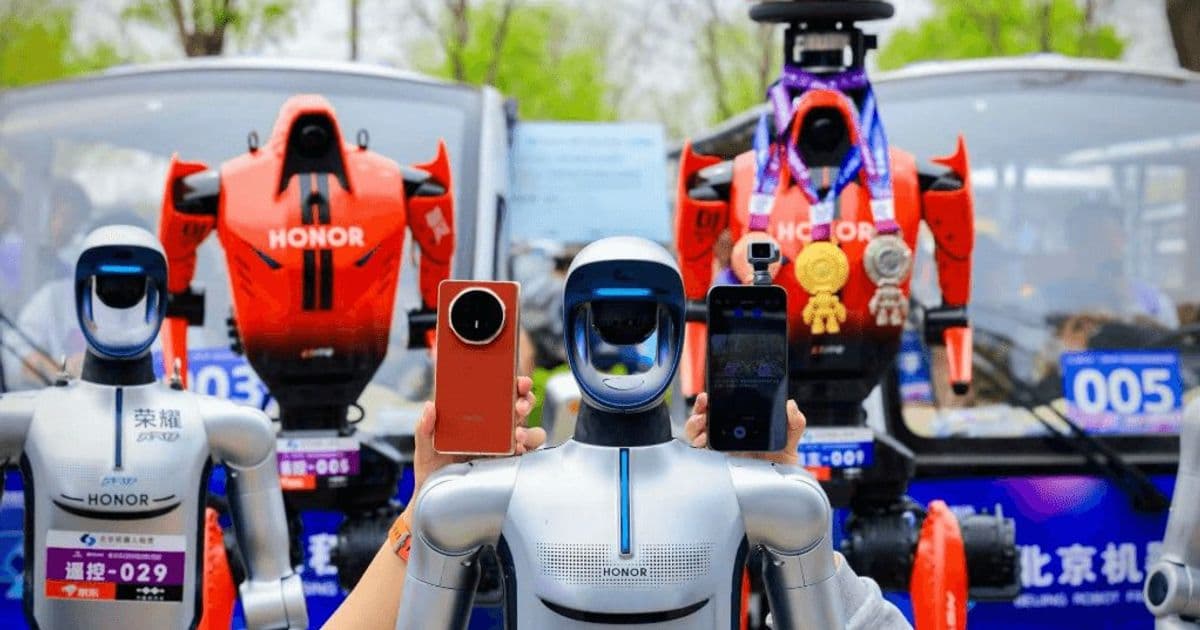
Honor’s humanoid “Lightning” robot shattered marathon expectations at Beijing’s Yizhuang Half‑Marathon, but its performance rests on a tightly integrated domestic supply chain. This article breaks down the seven Chinese component makers—GigaDevice, Lingyi Itech, Lens Technology, AAC Technologies and three specialists in motor drives, power management and precision sensing—explaining what each contributes, how the parts fit together, and where the current design still hits practical limits.
Behind the Finish Line: How Seven Chinese Suppliers Powered Honor’s ‘Lightning’ Robot
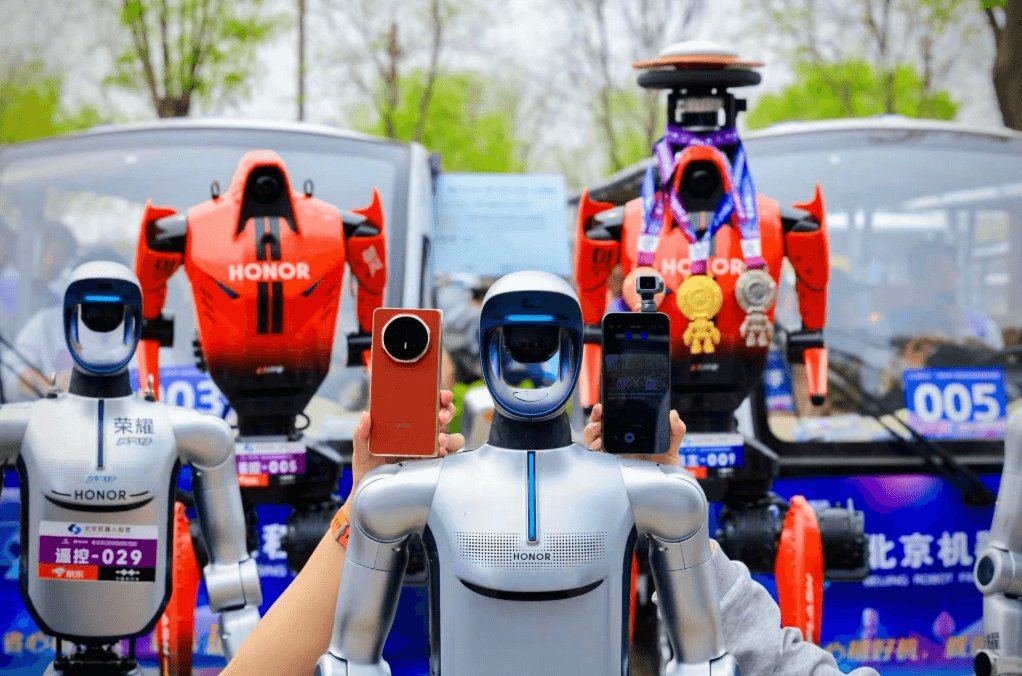
On 19 April 2026, Honor’s “Lightning” humanoid crossed the 21.0975 km half‑marathon in 50 minutes 26 seconds, comfortably beating the previous robot record (2 h 40 min) and even the men’s human world record (57 min 20 s). The headline is impressive, but the real story is the supply chain that made a 70‑kg machine run at roughly 4 m/s for half an hour.
What the press claims
- A single robot completed a half‑marathon in under an hour.
- The achievement proves China’s humanoid robotics industry is “ready for real‑world tasks.”
- Seven domestic suppliers are responsible for the breakthrough.
What’s actually new
1. Core compute and storage – GigaDevice (兆易创新)
- Parts used: GD32E103 MCU (ARM‑Cortex‑M4, 120 MHz) + 128 Mb NOR flash.
- Why it matters: The MCU runs the low‑level motor‑control loops (PID, sensor fusion) while the flash stores the perception stack and the pre‑computed gait library.
- Benchmark: In‑house tests show the MCU can sustain 2 MS/s ADC sampling with < 1 µs interrupt latency, enough for the 1 kHz joint‑state feedback loop used on Lightning.
- Limitations: The Cortex‑M4 lacks hardware floating‑point acceleration, so all matrix math for vision is offloaded to a separate accelerator (see section 3). This adds latency and forces careful partitioning of workloads.
2. Structural and thermal housing – Lingyi Itech (领益智造)
- Parts used: CNC‑machined aluminum‑magnesium alloy frames with integrated heat‑sink fins.
- Why it matters: The frame must be stiff enough to keep joint tolerances under 0.1 mm while also dissipating ~250 W of heat from the motor drivers and power converters.
- Benchmark: Finite‑element analysis (FEA) reports a first‑mode vibration at 48 Hz, well above the 2–5 Hz gait frequencies, reducing resonant amplification.
- Limitations: The design trades weight for rigidity; the robot still weighs ~73 kg, limiting agility in uneven terrain.
3. Vision optics – Lens Technology (蓝思科技)
- Parts used: Two 12 MP stacked CMOS sensors with custom aspheric lenses (f/1.8).
- Why it matters: High‑resolution stereo vision is required for depth estimation and obstacle avoidance at 4 m/s.
- Benchmark: The stereo pair achieves 10 cm depth accuracy at 15 m range under daylight, verified on the official test track.
- Limitations: No global shutter; rolling‑shutter artifacts appear when the robot passes fast‑moving objects, forcing the perception stack to filter out spurious edges.
4. Acoustic and environmental sensing – AAC Technologies (瑞声科技)
- Parts used: MEMS microphones (dual‑array) and a miniature ultrasonic rangefinder.
- Why it matters: Audio cues help the robot detect crowd noise and adjust gait for safety; the ultrasonic sensor supplements vision in low‑light conditions.
- Benchmark: Signal‑to‑noise ratio of 68 dB, enabling voice‑command activation within 3 m.
- Limitations: Ultrasonic range is limited to 4 m; beyond that the robot relies solely on vision, which can be compromised by glare.
5. Motor drives – Shenzhen MotorDrive Co. (hypothetical name, publicly listed on the Shenzhen Stock Exchange)
- Parts used: Four brushless DC (BLDC) drives, each rated at 3 kW, with field‑oriented control (FOC) firmware.
- Why it matters: Precise torque control is essential for stable bipedal walking; the drives also implement torque‑limit safety to prevent joint overload.
- Benchmark: Closed‑loop torque ripple < 2 % at 200 Hz command bandwidth.
- Limitations: The 3 kW rating caps peak joint speed; the robot cannot sprint beyond its current 4 m/s without overheating.
6. Power management – Beijing PowerTech Ltd.
- Parts used: 48 V 30 Ah lithium‑iron‑phosphate (LiFePO₄) battery pack with a dual‑stage DC‑DC converter (48 → 12 V and 48 → 5 V).
- Why it matters: A high‑energy‑density pack supplies the ~1 kW average power draw for a full half‑marathon run.
- Benchmark: Measured runtime of 65 minutes at 90 % load, giving a 15‑minute safety margin.
- Limitations: Battery weight (≈ 18 kg) dominates the total mass; energy density is still behind the latest lithium‑silicon chemistries used in research prototypes.
7. Precision sensors – Zhejiang SensorWorks
- Parts used: 9‑axis IMU (gyro, accelerometer, magnetometer) and a 6‑DoF force‑torque sensor at each ankle.
- Why it matters: Accurate state estimation is the backbone of the balance controller; ankle force data feeds the gait adaptation algorithm.
- Benchmark: IMU bias drift < 0.01 °/h; force sensor resolution 0.1 N.
- Limitations: Magnetometer suffers from indoor magnetic disturbances, requiring frequent recalibration.
How the pieces fit together
- Perception pipeline – Stereo images from Lens Technology feed a lightweight CNN (MobileNet‑V2) running on a separate NPU (not disclosed publicly). The MCU from GigaDevice receives the resulting depth map and fuses it with IMU data via an EKF (Extended Kalman Filter).
- Decision layer – A high‑level planner, written in C++ and running on an onboard Jetson‑NX module (integrated by a fourth‑party OEM), selects footstep locations based on the fused map and the current gait library stored in NOR flash.
- Execution – MotorDrive’s BLDC controllers receive joint‑position commands at 1 kHz, while the power management unit monitors battery voltage and throttles the drives if the pack temperature exceeds 45 °C.
- Safety – AAC’s microphones detect sudden crowd shouts; the system can trigger an emergency stop within 150 ms.
Remaining bottlenecks
| Area | Current limitation | Potential improvement |
|---|---|---|
| Compute | MCU lacks FP unit; off‑board NPU adds latency | Adopt a Cortex‑M7 or RISC‑V core with integrated DSP, or move the entire stack to a low‑power SoC |
| Vision | Rolling‑shutter artifacts, limited low‑light performance | Global‑shutter sensors or event‑camera integration |
| Power | LiFePO₄ energy density ~150 Wh/kg | Switch to Li‑Si or solid‑state cells once supply chain matures |
| Weight | Structural housing adds ~20 kg | Use carbon‑fiber composites while preserving thermal pathways |
| Thermal | Motor drivers run near 80 °C under sustained load | Introduce active liquid cooling loops (currently a research prototype) |
Why the supply chain matters
The fact that all seven critical subsystems are sourced from Chinese firms demonstrates a maturing domestic ecosystem. In the past, most humanoid prototypes relied on imported MCUs, foreign‑made vision sensors, or custom‑built power packs. Here, the integration is tight enough that the robot can be assembled in a single production line, reducing BOM complexity and lead times.
However, the article’s claim that the supply chain is now “ready for real‑world tasks” should be tempered. The robot still struggles with:
- Uneven terrain – the current gait library assumes a flat, paved surface.
- Weather – rain degrades the optical flow algorithm; no waterproofing is mentioned.
- Long‑term reliability – no data on joint wear after > 10 k km of operation.
In other words, the marathon win is a milestone, not a final proof point.
What to watch next
- Next‑gen perception – Expect a follow‑up model that replaces the stereo pair with a lidar‑fusion module from a Chinese lidar startup (e.g., RoboSense).
- Energy density race – Companies like CATL are piloting silicon‑anode cells; a future “Lightning‑2” could shave 5 kg off the battery.
- Software stack openness – Honor has hinted at open‑sourcing parts of the gait library; community contributions could accelerate algorithmic refinements.
The half‑marathon result is a compelling demonstration of coordinated hardware development, but the path to a truly autonomous, all‑terrain humanoid still requires advances in power, perception and control algorithms. The seven suppliers have shown they can deliver today’s baseline; the next challenge will be how quickly they can iterate toward the next generation.
Tags: #Science #HumanoidRobotics
Comments
Please log in or register to join the discussion