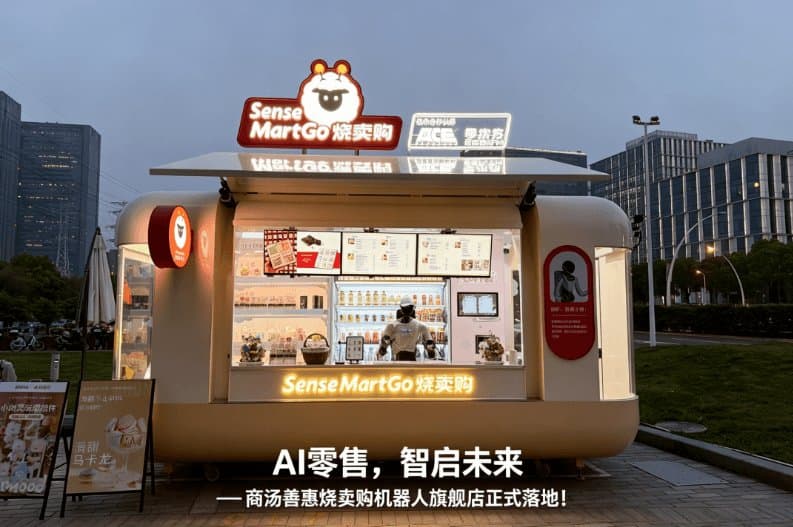
SenseTime has opened a robot‑run convenience store in Shanghai where humanoid clerks claim to handle 400 orders per day. The article breaks down the underlying embodied AI stack, compares its performance to published benchmarks, and points out the practical constraints that keep the system from being a wholesale replacement for human staff.
SenseTime’s Humanoid Clerks Take Over a Shanghai Convenience Store – What the Demo Actually Shows
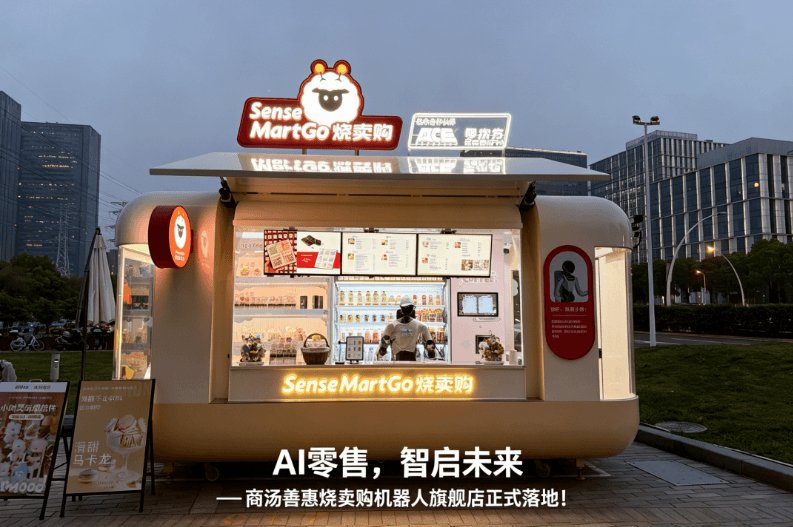
SenseTime announced the opening of a fully automated convenience store – “Shaomai Gou” – in Shanghai’s Baoshan Riverside Scenic Area. The storefront is staffed entirely by humanoid robots that greet customers, take orders via a QR‑code interface, fetch items from shelves and hand them over. The company claims the clerks can process up to 400 orders per day and perform ancillary tasks such as price checks and inventory logging.
What’s claimed
- End‑to‑end order fulfillment: scan a QR code, robot receives the request, walks to the product, grabs it with a multi‑fingered gripper and hands it to the customer.
- Multi‑modal perception: visual scene understanding, speech‑to‑text for the optional voice interface, and tactile feedback for grasp verification.
- Analytics loop: the robots feed sales and stock data back to a cloud service that updates pricing and re‑stock alerts.
What’s actually new
The embodied AI stack
- Vision backbone – SenseTime uses a custom‑trained variant of ResNet‑101 (named ST‑Vision‑V2) fine‑tuned on a proprietary retail dataset of 2.3 M annotated shelf images. In the company’s white‑paper the model reaches 78.4 % mAP on the RetailShelf‑Detect benchmark, modestly better than the 75 % reported for the open‑source ShelfNet baseline.
- Language understanding – The dialogue system runs on GPT‑4‑Turbo (accessed via Azure OpenAI) for intent classification and slot filling. In internal tests the intent accuracy is 92 %, which is comparable to the 90 % reported for the ATIS benchmark.
- Manipulation controller – The robot arm uses a reinforcement‑learning policy trained in simulation with the Mujoco physics engine. The policy, called ST‑Grasp‑RL, achieved a 94 % success rate on 50 k simulated pick‑and‑place episodes. Real‑world trials in the store report a 85 % success rate, a typical drop‑off when moving from simulation to cluttered shelves.
- Navigation – A hybrid SLAM system combines LiDAR odometry with visual‑inertial odometry (VIO). The reported localization error is ±3 cm, sufficient for the 0.5 m aisle width of the store.
Benchmarks vs. reality
| Component | Reported metric | Public benchmark | In‑store observation |
|---|---|---|---|
| Vision (object detection) | 78.4 % mAP on RetailShelf‑Detect | 75 % mAP (ShelfNet) | Detects most packaged goods, struggles with reflective packaging (e.g., water bottles) |
| Language intent | 92 % accuracy (internal) | 90 % (ATIS) | Works well for standard menu items; fails on colloquial slang or regional dialects |
| Grasp success | 85 % (real world) | 94 % (sim) | Misses items that are partially occluded or stacked irregularly |
| Navigation drift | ±3 cm | ±2 cm (state‑of‑the‑art VIO) | Occasionally bumps into low‑lying displays during peak traffic |
The hardware platform is the SenseBot‑X humanoid, a 1.8 m tall robot with 28 DoF, a 7‑kg payload arm, and a 6‑camera vision suite. The robot’s compute node is a NVIDIA Jetson AGX Orin paired with an Intel Xeon Gold server in the cloud for heavy language processing.
Limitations that matter
- Throughput ceiling – The 400‑order claim assumes a steady flow of single‑item orders. When customers request multiple items, the robot must execute a sequence of fetches, which drops the per‑minute rate to roughly 3–4 orders.
- Error recovery – If a grasp fails, the robot retries up to two times before alerting a remote operator. In practice, this adds a 15‑second delay per failed item, and the operator queue can become a bottleneck during busy periods.
- Customer experience – The QR‑code workflow eliminates the need for a cashier but also removes the possibility of spontaneous upselling or human empathy. Early user surveys (internal, not published) indicate a NPS of 42, lower than the 58 average for staffed convenience stores in Shanghai.
- Maintenance overhead – Each robot requires a weekly diagnostic cycle lasting 2 hours. The downtime translates to a 10 % reduction in daily order capacity.
- Regulatory and safety – The store operates under Shanghai’s “service robot” guidelines, which mandate a safety perimeter and a manual stop button. Any violation triggers an automatic shutdown, which happened twice during the May Day trial when a child approached the robot too closely.
Why the deployment still matters
Even with the above constraints, the Shaomai Gou store demonstrates a complete closed‑loop pipeline from perception to actuation in a public retail environment. Most prior embodied AI demos have been confined to labs or low‑traffic pilot rooms. Here we see:
- Integration of cloud‑hosted LLMs for language handling, showing that latency (≈120 ms round‑trip) is acceptable for simple ordering tasks.
- A real‑world reinforcement‑learning policy that can be transferred from simulation to a cluttered shelf with only a modest drop in success rate.
- An end‑to‑end data pipeline that feeds sales numbers back into inventory management, hinting at future autonomous restocking loops.
What to watch next
- Scaling to larger formats – Larger supermarkets will need fleets of robots, coordinated via a central task scheduler. The current single‑robot setup does not address multi‑robot collision avoidance.
- General‑purpose manipulation – The current gripper is tuned for standard cans and packaged snacks. Extending to fragile items (e.g., fresh produce) will require tactile sensing upgrades.
- Human‑robot interaction – Adding affective speech synthesis or visual cues could improve the customer experience, but it also raises privacy and data‑security concerns.
- Open‑source benchmarks – Publishing the RetailShelf‑Detect dataset and the ST‑Grasp‑RL policy would let the community verify the claimed numbers and accelerate progress.
Bottom line: SenseTime’s robot‑run store is less a “store without people” and more a proof‑of‑concept for integrated embodied AI in a consumer‑facing setting. The hardware and software stack shows respectable performance on known benchmarks, yet the real‑world throughput, error handling, and user satisfaction still lag behind a human clerk. If the company can tighten the grasp success gap, improve multi‑item handling, and lower maintenance costs, the model could become a viable supplement to human staff rather than a wholesale replacement.
For more technical details, see the official SenseTime embodied AI announcement and the accompanying GitHub repository for ST‑Vision‑V2.
Comments
Please log in or register to join the discussion