Intel's Arrow Lake Refresh desktop CPUs will launch on March 23, 2026, featuring upgraded Core Ultra 7 and Core Ultra 5 models with more cores and DDR5-7200 support, though the high-end Core Ultra 9 290K Plus has reportedly been cancelled due to product overlap concerns.
Intel's Arrow Lake Refresh desktop CPU lineup is officially on the calendar, with review embargoes lifting on March 23, 2026 at 6AM PST, according to reliable hardware leaker @momomo_us. The refresh will serve as a stopgap between the current Arrow Lake generation and the upcoming Nova Lake desktop CPUs expected to debut by year's end.
Core Count Upgrades Define the Refresh
The Arrow Lake Refresh represents a straightforward iterative upgrade rather than a architectural leap. Each SKU receives additional cores compared to its predecessor:
Core Ultra 7 270K Plus:
- 24 cores total (8P+16E) vs 20 cores (8P+12E) on 265K
- P-core turbo boost increased from 5.2 GHz to 5.3 GHz
- Native CUDIMM support upgraded to DDR5-7200
Core Ultra 5 250K Plus:
- 18 cores total (6P+12E) vs 14 cores (6P+8E) on 245K
- Same P-core turbo boost at 5.3 GHz
- Native CUDIMM support upgraded to DDR5-7200
Core Ultra 5 250KF:
- 18 cores total (6P+12E)
- No integrated GPU
- Same DDR5-7200 CUDIMM support
Pricing Leaks Suggest Aggressive Positioning
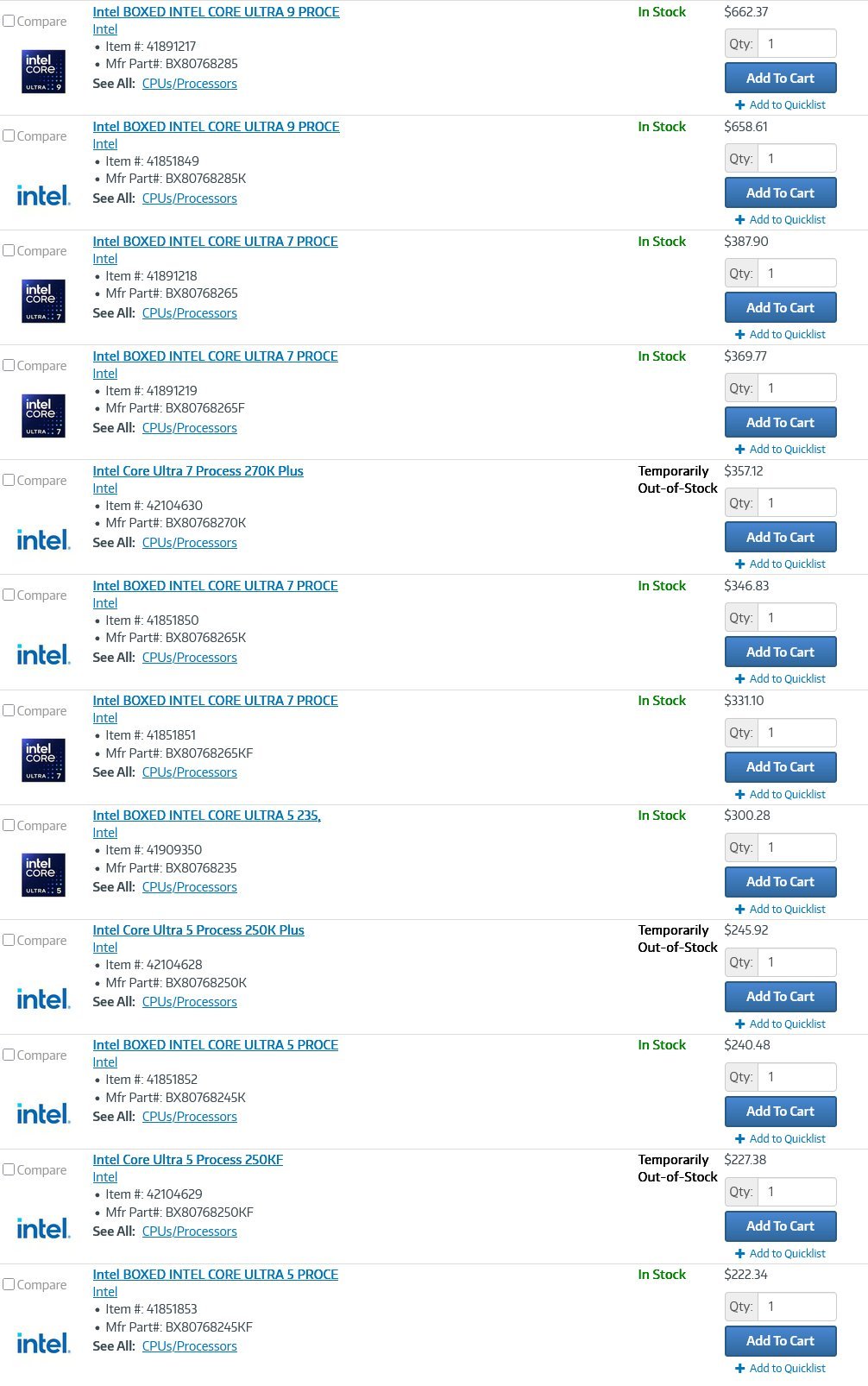
Early pricing from an undisclosed retailer shows Intel positioning these refreshes competitively:
- Core Ultra 5 250K Plus: $245.92 (down from 245K's $319 MSRP)
- Core Ultra 7 270K Plus: $357.12 (down from 265K's $394 MSRP)
- Core Ultra 5 250KF: $227.38 (down from 245KF's $294 MSRP)
However, current street pricing tells a different story. The Core Ultra 5 245KF regularly sells for $199 on Newegg with promotional bundles, while the 265K can be found for $275. This discrepancy between MSRP and actual market prices highlights the volatility in today's CPU market.
The Core Ultra 9 290K Plus Cancellation Explained
The most significant development is the apparent cancellation of the Core Ultra 9 290K Plus. According to Videocardz's sources, Intel decided against releasing this SKU because the existing Core Ultra 9 285K already features 24 cores, creating unacceptable product overlap.
Unlike AMD's approach with the Ryzen 7 9850X3D—which offers only a clock-speed bump over its predecessor—Intel requires more substantial improvements to justify a refresh. The company's philosophy appears to be avoiding situations where two SKUs in the same tier offer identical core counts but different clock speeds.
This decision leaves Arrow Lake Refresh without a true high-end desktop (HEDT) option, potentially creating a gap in Intel's product stack between the 24-core 285K and the upcoming Nova Lake series.
Technical Improvements Beyond Core Counts
The DDR5-7200 CUDIMM support represents a meaningful improvement for enthusiasts. CUDIMM (Clocked Unbuffered DIMM) memory offers better signal integrity than standard UDIMM modules while maintaining lower latency than registered ECC memory. The 200MHz increase from DDR5-7000 to DDR5-7200 may seem modest, but it provides headroom for overclockers and ensures compatibility with the latest high-speed memory kits.
Market Context and Competitive Landscape
The Arrow Lake Refresh arrives at a crucial time for Intel. The company faces intense competition from AMD's Ryzen 9000 series and must balance the need to refresh its product stack against the impending launch of Nova Lake. By focusing on core count increases rather than clock-speed bumps alone, Intel aims to deliver tangible performance improvements that justify new product introductions.
However, the absence of a Core Ultra 9 refresh could prove problematic. Enthusiasts seeking the absolute best Intel has to offer will need to either stick with the 285K or wait for Nova Lake, potentially pushing some customers toward AMD's offerings in the interim.
What This Means for System Builders
For those planning new builds in early 2026, the Arrow Lake Refresh offers compelling value propositions:
- Core Ultra 5 250K Plus: An 18-core CPU at $245 represents excellent multi-threaded performance for content creation and productivity workloads
- Core Ultra 7 270K Plus: The 24-core configuration at $357 provides workstation-class performance at mainstream prices
- DDR5-7200 CUDIMM support: Future-proofs systems for high-speed memory configurations
System builders should note that these CPUs will likely require new motherboards with updated firmware to support the refreshed silicon properly.
The Road to Nova Lake
The Arrow Lake Refresh appears designed to maintain Intel's desktop presence while Nova Lake development concludes. With Nova Lake expected by year's end, these refreshed parts may have a relatively short retail lifecycle. However, their aggressive pricing and core count improvements could make them attractive options for users who don't want to wait for the next architectural leap.
As March 23 approaches, expect more details about clock speeds, power consumption, and performance benchmarks to emerge. The success of this refresh strategy will largely depend on how well Intel can communicate the value proposition of these upgraded core counts against both their predecessors and competing AMD offerings.
For now, Arrow Lake Refresh represents Intel's bet that more cores at lower prices will be enough to maintain momentum in the desktop CPU market while the company prepares its next-generation architecture.
Comments
Please log in or register to join the discussion