Intel introduces 11 new Bartlett Lake processors using LGA 1700 socket with P-core-only architecture for embedded and edge applications, offering up to 12 cores with enhanced determinism and reliability.
Intel has officially launched its long-rumored Bartlett Lake processor family, introducing 11 new SKUs that maintain compatibility with the LGA 1700 socket while targeting commercial embedded and edge computing applications rather than the consumer desktop market.
Unlike previous speculation about value-oriented gaming chips, Bartlett Lake represents Intel's strategic push into mission-critical embedded systems where deterministic performance and reliability outweigh raw computational power. The processors feature a P-core-only architecture, eliminating the hybrid design complexity found in Intel's 12th through 14th-generation consumer chips.
Technical Architecture and Core Configurations
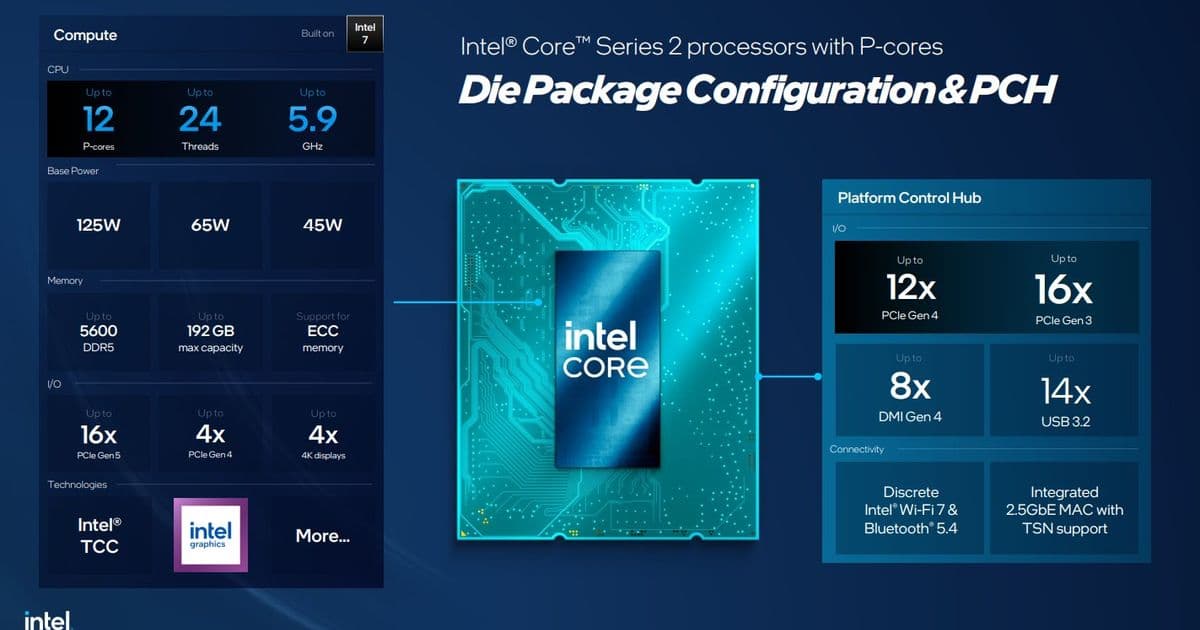
The Bartlett Lake lineup centers around three fundamental designs: 12-core, 10-core, and 8-core variants, each available in multiple TDP configurations. All chips utilize Intel's 7nm process technology (10nm class) and the Raptor Cove microarchitecture previously seen in Raptor Lake consumer processors.
The 12-core Core 9 273PQE operates at 3.4 GHz base and 5.9 GHz boost frequencies with a 125W TDP, while the 10-core Core 7 253PQE runs at 3.5 GHz/5.7 GHz, and the 8-core Core 5 223PQE achieves 4.0 GHz/5.5 GHz. Lower power variants include 65W and 45W models with reduced clock speeds to accommodate thermal constraints in embedded environments.
Notably, Intel offers Core 5 variants with slightly reduced clock speeds (200MHz lower maximum boost and base clocks) at both 65W and 45W TDP levels, providing additional flexibility for specific deployment requirements.
Memory and I/O Capabilities
Memory support reaches up to 5,600 MT/s DDR5 with ECC capabilities and a maximum capacity of 192GB, addressing the needs of enterprise and industrial applications requiring large memory footprints and error correction. The processors include up to 16 PCIe 5.0 lanes from the CPU, plus four PCIe 4.0 lanes, with the PCH contributing an additional 12 PCIe 4.0 lanes and 16 PCIe 3.0 lanes.
Intel's Direct Media Interface 4 (DMI 4) provides up to eight lanes of connectivity, first introduced with 600-series chipsets. This comprehensive I/O configuration ensures compatibility with a wide range of embedded peripherals and expansion cards.
Embedded-Specific Features
Bartlett Lake incorporates several features specifically designed for embedded and edge deployments. Long-Term Servicing Contract (LTSC) support for Windows ensures extended software compatibility and stability over product lifecycles. Intel's Time Coordinated Computing (TCC) and Time-Sensitive Networking (TSN) support enable precise timing and synchronization critical for industrial automation and real-time applications.
The focus on stability manifests in the multiple TDP variations and conservative all-core boost clocks, prioritizing consistent performance over peak burst capabilities. This approach aligns with the requirements of embedded systems where predictable behavior under varying workloads proves more valuable than maximum single-threaded performance.
Performance Claims and Market Positioning
Intel positions Bartlett Lake against AMD's embedded offerings, claiming the Core 9 273PE (12 cores, 65W) delivers up to 4.4x lower maximum PCIe latency, 2.5x more deterministic response time, and 3.8x better deterministic performance compared to the Ryzen 7 9700X in embedded configurations. However, Intel has not yet published the benchmark methodology or test conditions supporting these claims, making independent verification difficult.
Without retail availability, pricing remains undisclosed and will be determined through individual agreements with commercial partners. Intel has explicitly stated there are no plans for consumer market releases, though gray market availability through secondary channels remains possible.
Edge Computing Expansion
Alongside Bartlett Lake, Intel highlighted its Core Ultra Series 3 (formerly Panther Lake) deployments in edge computing scenarios. The company claims up to 1.7x higher performance in image classification, 1.9x lower large language model latency, and 4.5x higher throughput for vision action models compared to Nvidia's Jetson AGX Orin 64GB platform for robotics applications.
Intel also emphasizes Total Cost of Ownership advantages, estimating up to $5,549 in savings when using a single Panther Lake SoC versus dual-system configurations with discrete accelerators like Jetson AGX Orin and Jetson Thor in robotics deployments.
Socket Longevity Strategy
The decision to maintain LGA 1700 compatibility represents a strategic choice to leverage existing motherboard infrastructure while delivering updated performance characteristics for embedded markets. This approach reduces development costs and accelerates time-to-market for commercial customers already invested in LGA 1700 ecosystem components.
By focusing on embedded applications rather than competing in the saturated consumer desktop market, Intel can extract additional value from its LGA 1700 platform investment while addressing the growing demand for reliable, deterministic computing in industrial, automotive, and edge computing scenarios.
The Bartlett Lake launch underscores Intel's commitment to serving specialized market segments where traditional consumer-focused architectures may not adequately address the unique requirements of embedded and edge computing applications.
Comments
Please log in or register to join the discussion