
Intel's ANV Vulkan driver now includes experimental support for VK_EXT_descriptor_heap extension, bringing improved performance and efficiency for Linux gaming and compute workloads.
Intel's open-source Vulkan driver for Linux, known as ANV, has gained experimental support for the VK_EXT_descriptor_heap extension, a significant improvement for Vulkan API performance and efficiency. This development, merged into Mesa 26.2, represents a major step forward for Intel's Linux graphics capabilities, particularly for users with Arc Graphics cards.
What Are Descriptor Heaps and Why Do They Matter?
The VK_EXT_descriptor_heap extension, introduced with Vulkan 1.4.340 in January 2026, enables explicit management of descriptors and the memory used for descriptors. In graphics programming, descriptors are data structures that connect shader resources (like textures, buffers, and samplers) to the actual memory locations where these resources reside.
Traditional Vulkan implementations handle descriptor management implicitly, which can lead to unnecessary CPU overhead and suboptimal memory usage. With descriptor heaps, applications gain direct control over how descriptors are allocated, organized, and accessed, resulting in:
- Reduced CPU overhead by minimizing descriptor updates
- Better memory efficiency through explicit management
- Improved performance for modern Vulkan applications
- Enhanced compatibility with DirectX translation layers like VKD3D-Proton

Intel's Implementation and Current Status
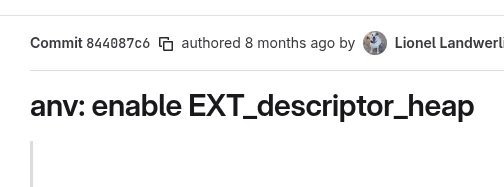
Intel's implementation of descriptor heap support has been in development for approximately eight months, with the initial merge request being open for the past three months. The code has now been successfully integrated into the Mesa 26.2 codebase, though it remains behind an experimental flag.
Currently, users must enable this feature by setting the ANV_DEBUG=experimental environment variable. The extension is not advertised by default, and Intel developers are continuing to work on parser issues related to untyped descriptor pointers. Additional test coverage and user testing will be needed before this feature can be enabled by default.
The implementation faced some challenges during development, particularly around untyped descriptor pointers, which initially held up the merge process. Intel developers have addressed these issues and are now focusing on stability and performance optimization.
Competitive Landscape
Intel joins both AMD and NVIDIA in supporting descriptor heaps in their Vulkan drivers:
- AMD's RADV driver already has descriptor heap support, which was merged last month for Mesa 26.1
- NVIDIA's proprietary Vulkan driver has supported descriptor heaps since the R595 driver series
This positions Intel as slightly behind its competitors in implementing this important Vulkan extension, though the gap is closing with the Mesa 26.2 release.
Performance Implications
For Linux gamers and developers, descriptor heap support promises several benefits:
- Improved Steam Play performance: Enhanced compatibility and performance for Windows games running through Proton and VKD3D-Proton
- Reduced CPU overhead: Less time spent on descriptor management means more resources available for actual rendering
- Better Arc Graphics performance: Intel's discrete graphics cards will benefit from more efficient resource handling
- Future-proofing: As Vulkan applications increasingly adopt descriptor heaps, early adopters will have a smoother experience
Technical Deep Dive
The VK_EXT_descriptor_heap extension introduces several new concepts and capabilities:
- Heap objects: New Vulkan objects that allocate and manage descriptor storage
- Descriptor buffers: Alternative to descriptor sets that allow for more flexible descriptor management
- Typed/untyped descriptor pointers: Different ways to reference descriptors in memory
Intel's implementation focuses on creating efficient pathways for these new concepts while maintaining compatibility with existing Vulkan applications. The experimental status indicates that Intel is still working on optimizing the implementation and ensuring robustness across different use cases.
Looking Forward
With Mesa 26.2 scheduled for release soon, Linux users with Intel hardware will be able to test this experimental feature. The question remains whether Intel will promote descriptor heap support from experimental to default by the time of release, or if it will remain behind the environment variable flag.
Given that descriptor heaps represent a significant optimization for Vulkan performance, it's likely that Intel will work to stabilize this feature quickly. The extension's importance for Windows gaming compatibility through Steam Play adds further incentive for rapid development.
For users interested in testing this feature, the process involves:
- Ensuring Mesa 26.2 is installed (once released)
- Setting ANV_DEBUG=experimental before running Vulkan applications
- Monitoring performance and compatibility with favorite applications
- Providing feedback to Intel and Mesa developers
Conclusion
Intel's addition of experimental descriptor heap support represents a significant advancement for the ANV Vulkan driver. While still in development, this feature promises improved performance and efficiency for Linux gaming and compute workloads, particularly for users with Intel Arc Graphics cards.
As descriptor heaps become increasingly important in the Vulkan ecosystem, Intel's implementation will help close the gap with competitors and provide Linux users with a more feature-complete and performant graphics experience. The experimental status suggests that users should expect further refinements in future Mesa releases, but the foundation is now in place for what promises to be a significant performance enhancement.
For more information on Intel's open-source graphics drivers, visit the Intel Linux Graphics GitHub repository. Details on the VK_EXT_descriptor_heap extension can be found in the Vulkan specification.
Comments
Please log in or register to join the discussion