Intel is preparing a new entry-level chip family called Wildcat Lake to replace the aging Alder Lake-N and Twin Lake processors in budget laptops, mini PCs, and tablets. Based on the same Panther Lake architecture but with significant cutbacks, these 6-core chips promise better performance and modern features like Thunderbolt 4 and an NPU, though they'll be limited to single-channel memory and fewer PCIe lanes.
Intel's Alder Lake-N and Twin Lake chips have become the go-to processors for budget mini PCs, entry-level laptops, and compact devices. These low-power chips deliver significantly better CPU and graphics performance than the Intel Celeron and Atom processors they replaced, making them popular with manufacturers and users alike. However, they're based on several-year-old architecture, and Intel is now preparing their successor.
Enter Intel's new Wildcat Lake lineup. This upcoming entry-level platform will be part of the Intel Core Series 3 family (notably without the "Ultra" designation) and will eventually replace Alder Lake-N and Twin Lake in budget devices. While details are still emerging, Intel has confirmed several key specifications that reveal how this new chip family will position itself in the market.
The Architecture Foundation: Same DNA, Different Implementation
Wildcat Lake shares its architectural foundation with Intel's higher-end Panther Lake chips, which Intel officially launched this week. Both families are built on Intel's latest generation architecture, but Wildcat Lake represents a more budget-conscious implementation.
The Panther Lake family includes three main segments:
- 16 CPU cores + 12 Xe3 GPU cores
- 16 CPU cores + 4 Xe3 GPU cores
- 8 CPU cores + 4 Xe3 GPU cores
Additionally, Intel revealed two entry-level Panther Lake chips: the Core Ultra 5 322 and Core Ultra 5 332. These feature 2 Performance cores, 4 Low-Power Efficiency cores, and 2-core graphics. Documentation has been somewhat inconsistent—initial product briefs suggested these were 8-core chips, but individual product pages clarify they're actually 6-core processors. These entry-level Panther Lake chips maintain 12 PCIe lanes and operate within 25-55W TDP ranges.
Wildcat Lake Specifications: Strategic Compromises
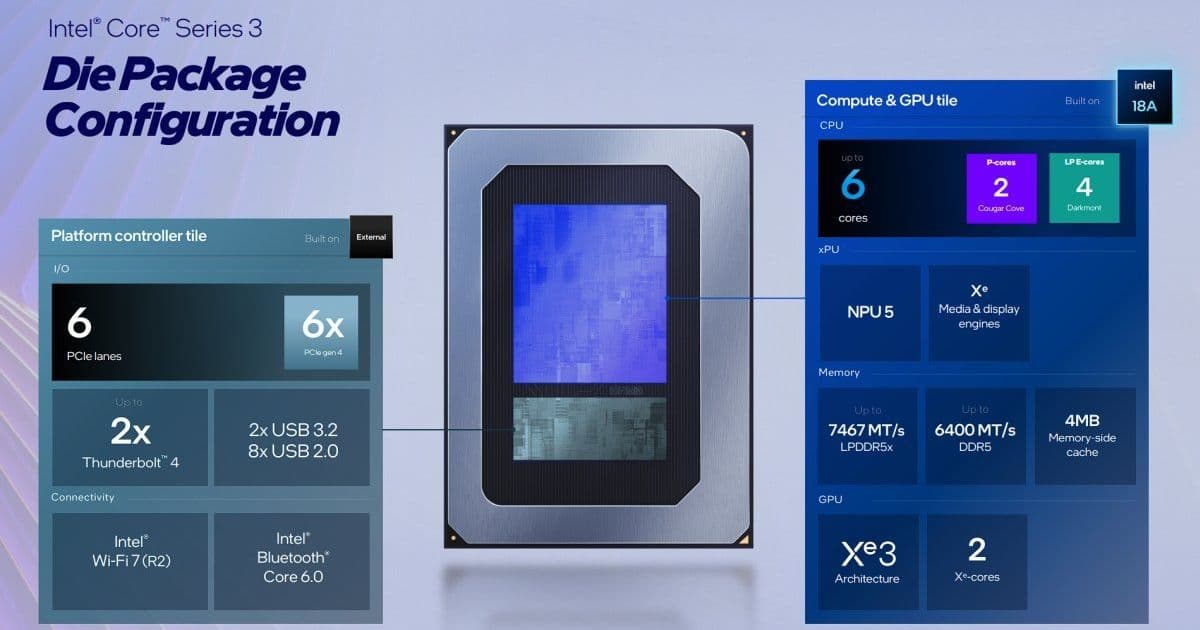
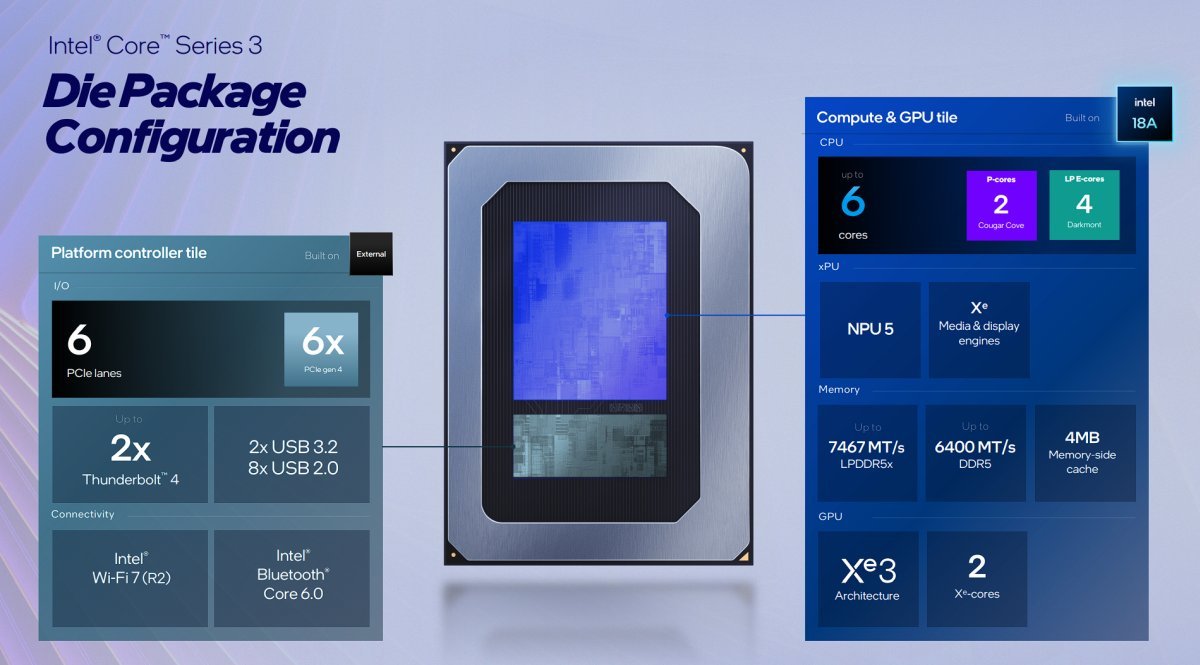
Wildcat Lake chips will feature the same core configuration as these entry-level Panther Lake processors:
- 2 x Performance CPU cores
- 4 x Low-Power Efficiency CPU cores
- 2 x Intel Xe GPU cores
- NPU with up to 18 TOPS of AI performance
However, Intel has made several strategic compromises to hit the budget segment:
Cache Reduction: Wildcat Lake chips will have only 4 MB of cache, compared to 12-18 MB in Panther Lake chips. This is a significant reduction that will impact performance, particularly in memory-intensive workloads.
PCIe Lane Limitations: Wildcat Lake supports only 6 PCIe 4.0 lanes, while Panther Lake chips have 8 PCIe 4.0 lanes plus 4 or 12 PCIe Gen 5 lanes. This limitation will affect expansion capabilities and storage performance.
Thunderbolt Support: Wildcat Lake supports up to 2 Thunderbolt 4 ports, compared to 4 on Panther Lake. While this is still an upgrade over Alder Lake-N (which lacks Thunderbolt support entirely), it's a noticeable reduction.
Power Envelope: Wildcat Lake operates within a 12-25W TDP range, significantly lower than Panther Lake's 25-55W or 80W ranges. This makes it suitable for fanless designs and ultra-thin devices.
Memory Configuration: Like Intel's N-series chips, Wildcat Lake only supports single-channel memory, despite supporting up to 32GB of LPDDR5x-6800 or 64GB of DDR5-6400. This single-channel limitation will impact memory bandwidth, which can be a bottleneck for certain workloads.
Other confirmed features include support for WiFi 7, Bluetooth 6, and UFS storage—modern connectivity options that Alder Lake-N lacks.
Performance Expectations and Market Positioning
Wildcat Lake should deliver a meaningful performance improvement over Alder Lake-N and Twin Lake chips. The newer architecture, combined with higher clock speeds and improved efficiency, should provide noticeable gains in both single-core and multi-core performance. The integrated Xe graphics should also offer better performance than the current UHD Graphics found in Alder Lake-N.
However, Wildcat Lake will clearly trail even entry-level Panther Lake processors. The reduced cache, single-channel memory, and fewer PCIe lanes create performance ceilings that will be apparent in more demanding scenarios.
For the target market—budget Chromebooks, Windows laptops, tablets, and mini PCs—these limitations are likely acceptable tradeoffs. Most entry-level devices don't require extensive expansion capabilities or dual-channel memory bandwidth. The performance boost over Alder Lake-N, combined with modern features like Thunderbolt 4 and AI acceleration, represents a significant upgrade for budget-conscious buyers.
Developer and OEM Implications
For device manufacturers, Wildcat Lake offers a compelling upgrade path. The 12-25W TDP range enables designs similar to current Alder Lake-N devices but with better performance and modern I/O. The Thunderbolt 4 support is particularly valuable, enabling external GPU enclosures, high-speed storage arrays, and multi-monitor setups that weren't possible with Alder Lake-N.
The NPU with 18 TOPS of AI performance opens up new possibilities for on-device AI applications. While this is modest compared to higher-end chips, it's sufficient for basic AI workloads like background blur in video calls, voice recognition, and some image processing tasks.
For developers, Wildcat Lake represents a standardized platform for budget devices. The consistent architecture across the Core Series 3 family simplifies optimization efforts. However, the single-channel memory limitation requires careful consideration for memory-intensive applications.
Timeline and Availability
Intel hasn't announced specific release dates for Wildcat Lake chips, but given that they're positioned as replacements for Alder Lake-N and Twin Lake, we can expect them to arrive in devices later in 2026 or early 2027. The gradual transition will likely follow Intel's typical pattern: first in premium budget devices, then mainstream models.
Manufacturers will probably continue offering Alder Lake-N devices for some time, particularly in price-sensitive markets where the existing supply chain and mature platform are advantageous.
The Bigger Picture
Wildcat Lake represents Intel's continued effort to modernize its entry-level chip offerings. By bringing features like Thunderbolt 4, WiFi 7, and AI acceleration to budget devices, Intel is raising the floor for what consumers can expect from inexpensive hardware.
This approach also reflects the evolving demands of modern computing. Even budget devices now need to handle video conferencing, light content creation, and basic AI tasks. The performance gap between entry-level and mid-range chips continues to narrow, making budget devices more capable than ever.
For the broader ecosystem, Wildcat Lake's support for modern standards like PCIe 4.0 and DDR5 ensures that budget devices won't become obsolete as quickly as previous generations. The Thunderbolt 4 support in particular future-proofs these devices for external expansion.
Conclusion
Wildcat Lake represents a thoughtful evolution of Intel's entry-level chip strategy. By leveraging the Panther Lake architecture while making strategic compromises, Intel can deliver meaningful performance improvements and modern features at a price point suitable for budget devices.
The tradeoffs—single-channel memory, reduced cache, and limited PCIe lanes—reflect the realities of cost-sensitive markets. For most users in the target segment, the benefits will outweigh these limitations.
As we await more details about specific SKUs and performance benchmarks, Wildcat Lake appears poised to continue the trend of making capable, modern computing accessible to everyone. The transition from Alder Lake-N to Wildcat Lake will mark another step forward in the democratization of technology.
Sources: VideoCardz, HardwareLUXX, @mweinbach, @yabhishekhd
Comments
Please log in or register to join the discussion