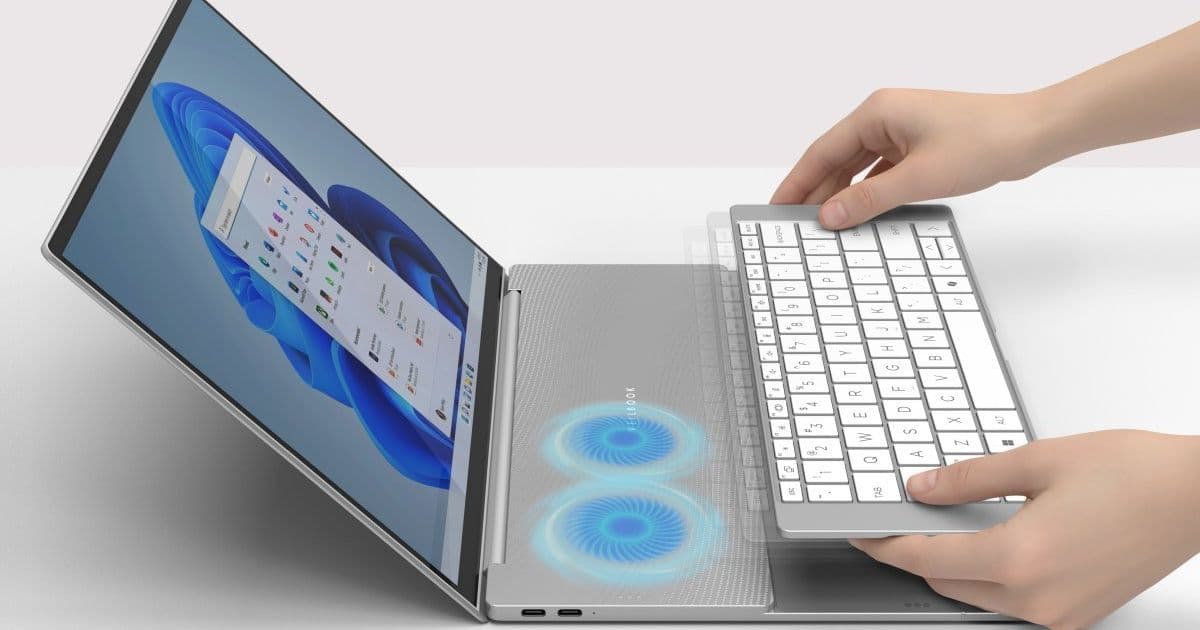
Inventec's VeilBook concept laptop features a detachable keyboard that can be repositioned to improve cooling, but at the cost of blocking the touchpad when performance is prioritized.
Taiwanese PC manufacturer Inventec has unveiled a striking laptop concept that challenges conventional design wisdom. The Inventec VeilBook features a 14-inch display housed in an ultra-slim chassis measuring less than 10mm (0.4 inches) thick, but its most distinctive feature is a detachable keyboard that can be repositioned to optimize cooling performance.
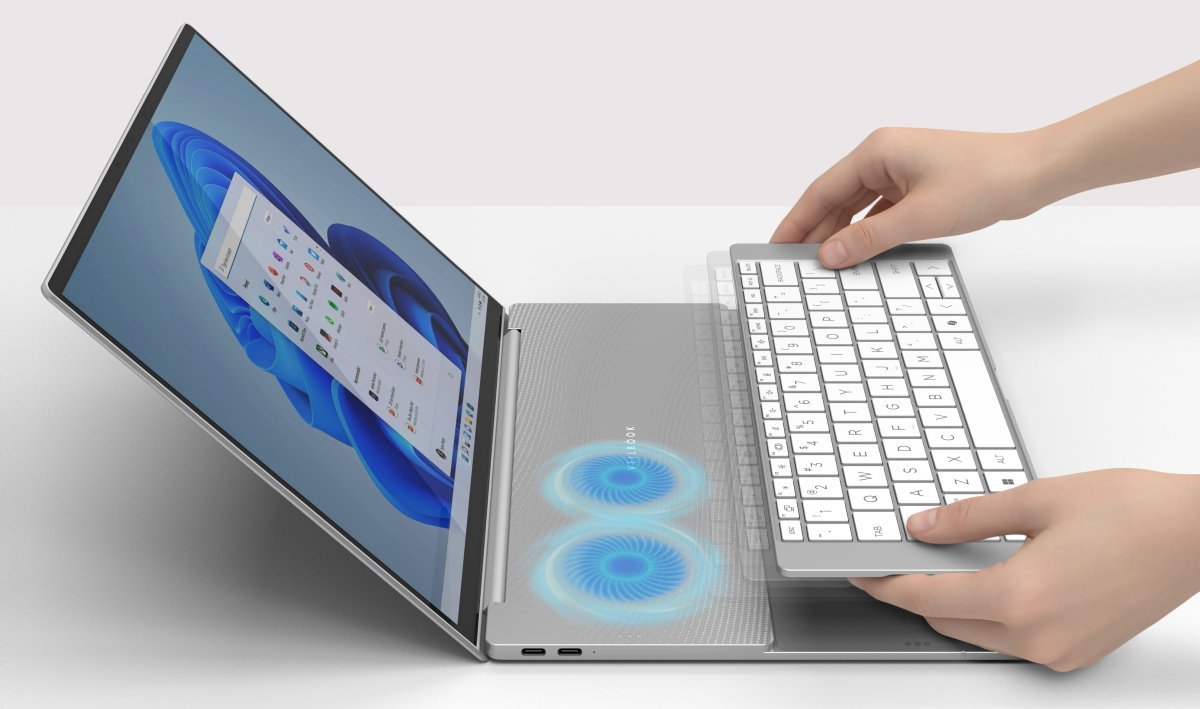
The core innovation behind the VeilBook addresses a fundamental challenge in laptop design: thermal management. Most laptops position cooling fans beneath the keyboard area, where they draw in air to dissipate heat from the processor, memory, and other components. When these vents become blocked—whether by palms resting on the palm rest or by the keyboard itself—airflow decreases and temperatures rise, potentially causing performance throttling.
Inventec's solution is elegantly simple yet unconventional: make the keyboard detachable and repositionable. Users can slide the keyboard forward to cover the touchpad and palm rest area, effectively opening up the cooling vents beneath. This configuration maximizes airflow when the laptop is under heavy load, helping maintain optimal performance during demanding tasks.

The trade-off is immediately apparent. When the keyboard is positioned for maximum cooling, the touchpad becomes completely inaccessible. Users must rely on keyboard shortcuts or an external mouse for navigation during these high-performance scenarios. When touchpad access is needed, the keyboard can be slid back to its traditional position, though this partially blocks the cooling vents.
This design raises interesting questions about user behavior and priorities. For users who primarily navigate with keyboard shortcuts or external peripherals, the compromise may feel minimal. Power users running intensive applications like video rendering, 3D modeling, or gaming might appreciate the ability to maximize cooling when performance matters most.
However, for users accustomed to resting their palms on the palm rest area while typing, or those who frequently use the touchpad for navigation, the VeilBook's design could require significant adjustment. The constant repositioning of the keyboard based on current needs adds a new dimension to laptop interaction that many users may find cumbersome.

The VeilBook's design philosophy reflects a broader trend in computing where thermal constraints increasingly limit performance in thin-and-light devices. As processors become more powerful and generate more heat in smaller packages, manufacturers are exploring creative solutions beyond traditional cooling approaches. Some have experimented with vapor chambers, liquid cooling, or even external GPU docks, but Inventec's approach of physically reconfiguring the input area represents a more radical departure.
It's worth noting that the VeilBook remains a concept design at this stage. Inventec, primarily known as an Original Design Manufacturer (ODM) that produces devices for other brands, recently received an IF Design Guide award for the concept. However, there's no indication that any company has committed to manufacturing a laptop based on this design.
The concept's viability in the real world would depend on several factors. Manufacturing costs for the sliding mechanism and ensuring durability over thousands of repositioning cycles would be significant considerations. Additionally, the market would need to demonstrate demand for a laptop that requires this level of user interaction with its fundamental input methods.
For now, the VeilBook serves as an intriguing exploration of how laptop design might evolve to address thermal challenges in increasingly thin devices. Whether this particular solution gains traction or inspires other innovations remains to be seen, but it highlights the creative thinking manufacturers are applying to the persistent challenge of balancing performance with portability in laptop design.
As laptops continue to push the boundaries of what's possible in thin-and-light computing, concepts like the VeilBook remind us that sometimes the most innovative solutions require rethinking our assumptions about how we interact with our devices.
Comments
Please log in or register to join the discussion