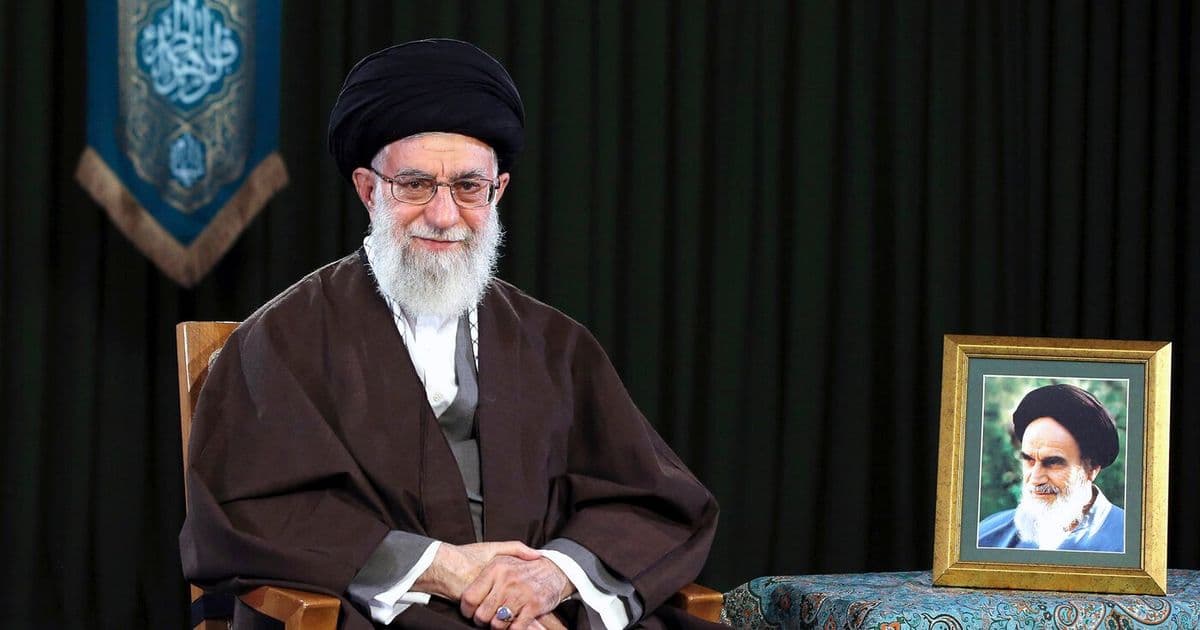
Ayatollah Ali Khamenei, Iran's supreme leader for 36 years, was killed in an Israeli airstrike with U.S. support, ending his long reign marked by nuclear ambitions, proxy conflicts, and repression of domestic dissent.
Ayatollah Ali Khamenei, Iran's supreme leader for the past 36 years, was killed in an Israeli airstrike with U.S. support on Saturday, according to multiple sources briefed on the U.S.-Israeli attacks. He was 86 years old.
The death of Khamenei marks a dramatic end to one of the longest reigns in the Middle East and comes amid escalating tensions between Iran and Israel that have defined regional politics for decades.
The Attack and Immediate Aftermath
President Trump announced Khamenei's death on social media, stating that the Iranian leader could not avoid U.S. intelligence and surveillance. A source briefed on the attacks told NPR that an Israeli airstrike was responsible for Khamenei's death.
Iran's supreme leader held absolute power over the country's political, military, and religious affairs. His death creates an immediate power vacuum in Tehran at a time when Iran faces unprecedented external pressure and internal unrest.
Early Life and Rise to Power
Born in July 1939 into a religious family in Mashhad, Iran's Shia Muslim holy city, Khamenei attended theological school and became an outspoken opponent of the U.S.-backed Shah Mohammad Reza Pahlavi. He was arrested multiple times during the Shah's regime.
Khamenei was part of the revolutionary movement alongside Ayatollah Ruhollah Khomeini, who became Iran's first supreme leader after the 1979 Islamic Revolution. Khamenei survived an assassination attempt in 1981 that cost him the use of his right arm.
He served as Iran's president before succeeding Khomeini as supreme leader in 1989. Alex Vatanka, a senior fellow at the Middle East Institute, notes that Khamenei was an unlikely candidate for the role, lacking the religious credentials of his predecessor.
"He knew himself. He didn't have the prestige, the gravitas to be the successor to the founder of the Islamic Republic, Ayatollah Khomeini," Vatanka says.
Consolidating Power
Initially insecure in his position, Khamenei spent his early years as supreme leader "being very nervous" and feeling vulnerable to challenges from other senior political figures. However, he proved cunning and able to outmaneuver rivals.
With the help of the Islamic Revolutionary Guard Corps (IRGC), Khamenei built a formidable power base. Ali Vaez, director of the Iran Project at the International Crisis Group, explains that Khamenei "appropriated all the levers of power in his hands and sidelined everyone else."
This consolidation allowed Iran's military to develop a vast commercial empire controlling many parts of the economy, while ordinary Iranians struggled with economic hardship.
Nuclear Program and Regional Strategy
Khamenei had the final word on Iran's nuclear program throughout his rule. As supreme leader, he increasingly injected himself into politics, most notably in 2009 when he intervened to ensure his favored candidate, Mahmoud Ahmadinejad, won a controversial presidential election.
Iranians took to the streets to protest what was widely seen as a fraudulent election. Khamenei brutally crushed those demonstrations, triggering years of protest movements and crackdowns.
Under Khamenei's leadership, Iran developed a strategy of building proxy militias across the Middle East. Vaez notes that Khamenei began building up Iran's defensive policies by developing groups like Hezbollah in Lebanon and Hamas in the Gaza Strip to deter direct attacks on Iranian soil.
"And then also becoming self-reliant in developing a viable conventional deterrence, which took the form of Iran's ballistic missile program," Vaez says.
Domestic Repression
Human rights groups estimate that Iran killed thousands of its citizens under Khamenei's rule. According to the Human Rights Activists News Agency, more than 7,000 people were killed during weeks of mass protests that started in late December 2025.
Sanam Vakil, an Iran expert at Chatham House, says Khamenei consistently supported repressive government crackdowns, recognizing that protests damaged the stability and legitimacy of the state.
However, Vatanka argues that Khamenei was unconcerned about addressing the root causes of protests and remained stuck in an Islamic revolutionary mindset against the West.
"He on so many occasions refused point-blank to accept the basic reality that where he was in terms of his worldview was not where the rest of his people were," Vatanka says.
Approximately 75% of Iran's 90 million people were born after the 1979 revolution and have watched other countries in the region modernize and integrate with the international community.
Nuclear Deal and Escalating Tensions
After the Arab Spring uprisings in 2011, Khamenei began worrying about the survival of his regime as Iran's economy crumbled under Western sanctions. In 2013, he agreed to secret negotiations with the U.S. about Iran's nuclear program, which eventually led to the 2015 Joint Comprehensive Plan of Action (JCPOA) nuclear agreement.
Vaez says Khamenei deeply distrusted the U.S. and was skeptical about the deal. "His argument has always been that the U.S. is always looking for pretexts, for putting pressure on Iran," he says.
President Trump's withdrawal from the nuclear deal during his first term in office gave credence to Khamenei's cynicism. Analysts say Iran increased its nuclear enrichment after that to a point where it was close to being able to build a bomb.
In early 2025, when Trump reached out to Iran about a new deal, Khamenei dragged out negotiations until they began in mid-April. But time ran out.
The Final Months
In June 2025, Israel launched strikes on key Iranian nuclear facilities and killed scientists and generals. Iran retaliated, and the two sides exchanged several days of missile strikes.
On June 21, 2025, the U.S. launched major airstrikes on three of Iran's nuclear enrichment sites. Trump said the facilities had been "completely and totally obliterated," although there was debate among the White House and nuclear experts about how seriously Iran's nuclear program had been set back.
Vakil says Khamenei underestimated what Israel and the U.S. would do. "I think that Khamenei always assumed that he could play for time, and what he really didn't understand is that the world around Iran had very much changed," she says.
The Path to Downfall
Iran's use of proxy militias across the region ultimately led to Khamenei's downfall. When Hamas—the Palestinian Islamist group backed by Iran—attacked Israel on October 7, 2023, killing nearly 1,200 people and kidnapping 251 others, it triggered a cascade of events that led to Israel's attack on Iran.
The day after the Hamas-led attack, Iran-backed Hezbollah in Lebanon started firing rockets into Israel, triggering a conflict that led to the Shia militia's top brass being decimated—including top leader Hassan Nasrallah.
Israel and Iran traded direct airstrikes for the first time in 2024 as part of that conflict. Israel's bombing of Iranian weapons shipments in Syria also helped weaken the regime of Syria's then-dictator, Bashar al-Assad, an important ally of Iran. Assad fell in December 2024 and fled to Russia in early January 2025.
By the time Khamenei died, his legacy was in tatters. Israel had hobbled two key proxies, Hamas and Hezbollah, and had wiped out Iran's air defenses. With U.S. help, it left Iran's nuclear program in shambles.
What remains is a robust ballistic missile program, the brainchild of Khamenei. It's unclear who will replace him to lead a now weakened and vulnerable Iran.
Khamenei's 36-year rule was marked by unwavering antipathy to the U.S. and Israel, efforts to prevent reform and modernization, and a strategy of building regional influence through proxy forces. His death represents a potential turning point for Iran and the broader Middle East, though the ultimate consequences remain to be seen.
Comments
Please log in or register to join the discussion