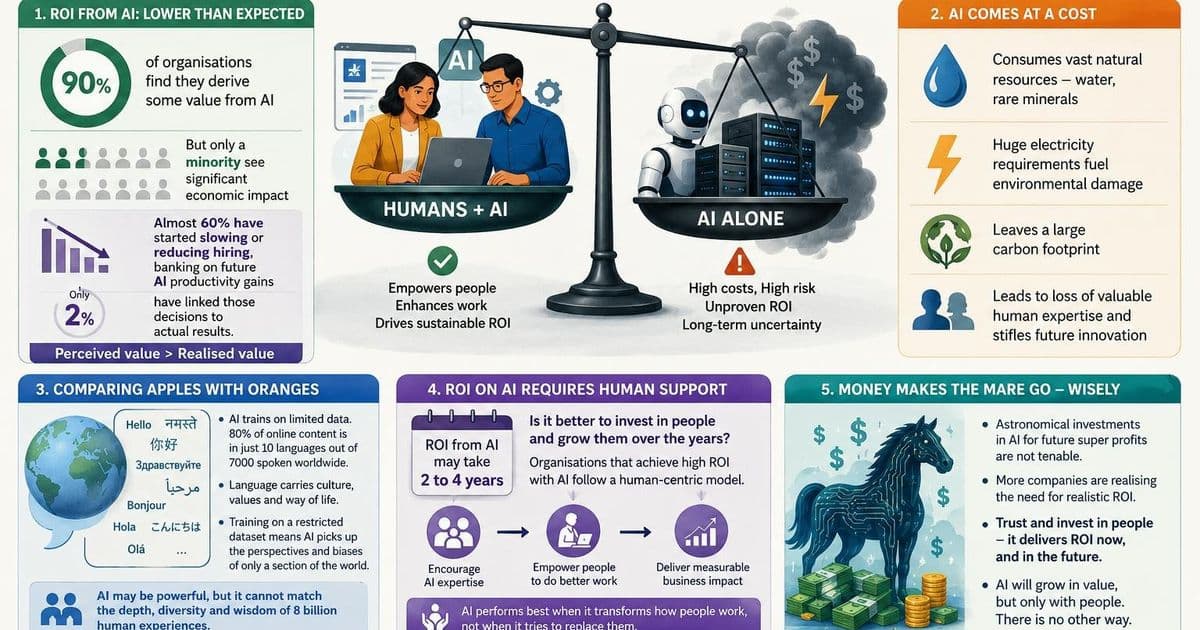
New research reveals a stark gap between AI investment expectations and actual returns, with only 2% of companies linking hiring reductions to measurable AI outcomes. The analysis argues that sustainable ROI requires treating AI as a tool to augment human expertise rather than replace it, especially given hidden costs and data limitations.
The promise of AI-driven productivity gains has fueled massive corporate investment, yet emerging data suggests the reality falls far short of the hype. According to research from Scaled Agile’s partner, the Return on AI Institute, while 90% of organizations report deriving some value from AI initiatives, only a minority are achieving the significant economic impact that justified the initial spending spree. More tellingly, nearly 60% of companies have begun slowing or reducing hiring based on anticipated AI efficiencies—but a mere 2% have actually connected those workforce decisions to demonstrable results. This disconnect reveals a critical perception gap: businesses are betting on future returns that remain largely unproven in the present.
The costs of this AI transition extend far beyond licensing fees. Training and running large models consumes staggering amounts of electricity and water, contributing to measurable environmental strain. Simultaneously, companies risk eroding the very human expertise that drives innovation—expertise built through years of contextual problem-solving that AI, trained on historical data, cannot replicate. When AI learns primarily from a narrow slice of global knowledge (approximately 80% of online content exists in just 10 of the world’s 7,000 languages), its outputs inevitably reflect embedded biases and miss the nuanced cultural frameworks that shape human decision-making. This isn’t merely a technical limitation; it fundamentally constrains AI’s ability to deliver broadly applicable value across diverse markets.
Yet the path forward isn’t abandonment of AI—it’s recalibration. Organizations reporting the strongest returns share a common trait: they’ve adopted human-centric models where AI handles routine tasks while elevating human workers to focus on strategy, creativity, and complex judgment. In these cases, AI functions as a force multiplier for existing talent rather than a replacement, creating a virtuous cycle where improved human performance generates better data for AI refinement. This approach also mitigates the long-term risk of skill atrophy that pure replacement strategies invite.
For enterprises chasing near-term ROI, the evidence points toward investing in people as the more reliable strategy. While AI will undoubtedly find its niche in specific, well-defined applications, treating it as a wholesale substitute for human labor ignores both its current limitations and the irreplaceable role of human adaptability in uncertain markets. The most prudent investments now aren’t in larger AI models, but in the workforce capable of guiding those tools wisely—proving that sometimes, the best return comes not from chasing technological promises, but from strengthening the humans who will ultimately determine how those tools are used.
{{IMAGE:2}}
Comments
Please log in or register to join the discussion