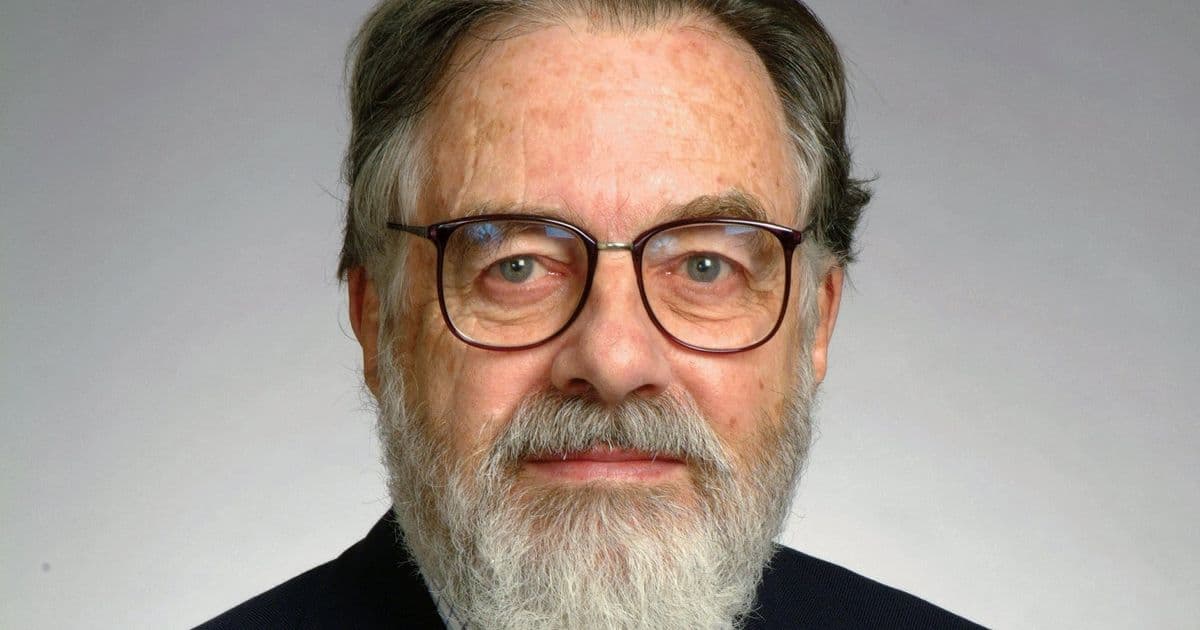
MIT Professor Emeritus Jack Dennis, who revolutionized computer architecture through dataflow models and asynchronous computing, has died at 94. His work bridged hardware and software, influencing generations of computer scientists.
Jack Dennis, an MIT professor emeritus whose groundbreaking work on dataflow models of computation helped shape modern computer architecture, died on March 14 at the age of 94. As the founding leader of MIT's Computation Structures Group, Dennis pioneered approaches that bridged the gap between hardware and software, influencing how computers process information to this day.
Dennis's journey began in Connecticut, where he showed early promise in both engineering and music. As a teenager, he played piano with the Norwalk Symphony Orchestra while building a canoe with his father. This blend of technical and artistic pursuits would characterize his career. At MIT, where he earned his BS (1953), MS (1954), and ScD (1958), Dennis joined the VI-A Cooperative Program in Electrical Engineering, worked at the Air Force Cambridge Research Laboratories on speech processing and radar systems, participated in the model railroad club, and played in the MIT Symphony Orchestra, where he met his first wife, Jane Hodgson.
His doctoral thesis, "Mathematical Programming and electrical networks," explored analogies between electric circuit theory and quadratic programming problems. This work evolved into his influential 1964 paper, "Distributed solution of network programming problems," which created an important early class of digital distributed optimization solvers.
Dennis's most significant contribution came through his development of dataflow models of computation. Unlike traditional von Neumann architectures that execute instructions sequentially, dataflow architectures execute operations as soon as their input data becomes available. This approach maximizes parallelism and efficiency, particularly for complex computational tasks.
"I formed the Computation Structures Group and focused on architectural concepts that could narrow the acknowledged gap between programming concepts and the organization of computer hardware," Dennis explained in a 2003 reflection. "I found myself dismayed that people would consider themselves to be either hardware or software experts, but paid little heed to how joint advances in programming and architecture could lead to a synergistic outcome that might revolutionize computing practice."
His emphasis on synergy between hardware and software proved prescient. Gerald Sussman, the Panasonic Professor of Electrical Engineering, noted that "the relationship of [Dennis'] dataflow architecture to single-assignment programs, and thus to pure functional programs. This coupled the virtue of referential transparency in programming to the effective use of hardware parallelism. Dennis also pioneered the use of self-timed circuits in digital systems."
Dennis's influence extended beyond academia into major computing projects. As a collaborator with the teams behind Project MAC and Multics—the earliest attempts at time-shared operating systems—he helped specify the unique segment addressing and paging mechanisms that became fundamental to the General Electric Model 645 computer. His work demonstrated that architectural innovations could have immediate practical impact.
The Computation Structures Group he founded attracted numerous scholars interested in asynchronous computing and dataflow architecture. Among his collaborators were Peter Denning, with whom he co-authored the textbook "Machines, Languages, and Computation" (1978); Arvind, who became faculty head of computer science for EECS; and Guang R. Gao, who became distinguished professor at the University of Delaware.
Dennis's contributions earned him numerous honors throughout his career. He was elected fellow of the Institute of Electrical and Electronics Engineers (IEEE) for his work on Multics, received the Association for Computing Machinery (ACM)/IEEE Eckert-Mauchly Award in 1984, was inducted as a fellow of the ACM in 1994, named to the National Academy of Engineering in 2009, elected to the ACM Special Interest Group on Operating Systems (SIGOPS) Hall of Fame in 2012, and awarded the IEEE John von Neumann Medal in 2013.
Perhaps equally influential was Dennis's impact on computer science education at MIT. He developed six subjects that remain foundational to the curriculum: Theoretical Models for Computation; Computation Structures; Structure of Computer Systems; Semantic Theory for Computer Systems; Semantics of Parallel Computation; and Computer System Architecture (taught in collaboration with Arvind). Several of these courses continue to be taught in updated form today.
After retiring from teaching in 1987, Dennis remained active as a consultant on parallel computer hardware and software projects for NASA, Boeing Aerospace, McGill University, Carlstedt Elektronik in Sweden, and Acorn Networks. His collaboration with former student Guang Gao continued with a lecture tour through China and co-authorship of a book, "Dataflow Architecture," currently in progress at MIT Press.
A lifelong learner who once quoted a friend's observation that "a scholar is just a book's way of making another book," Dennis maintained his intellectual curiosity throughout retirement. He continued composing music, performing as a tenor with Chorus Pro Musica at Tanglewood, playing piano at the marriage of Guang Gao's son Nick, and singing with the chorus at the First Church in Belmont, Massachusetts.
Dennis is survived by his wife Therese Smith '75; children David Hodgson Dennis of North Miami, Florida; Randall Dennis of Connecticut; and Galen Dennis, a resident of Australia. His celebration of life will be held on Monday, June 8, at 2 p.m. at the First Church in Belmont, with concurrent livestreaming.
Jack Dennis's legacy lives on not only in the architectures and systems he helped create but in the generations of computer scientists he taught and inspired. His vision of computing as a unified discipline—where hardware and software innovations work together synergistically—continues to influence how we think about and build computers today.
Comments
Please log in or register to join the discussion