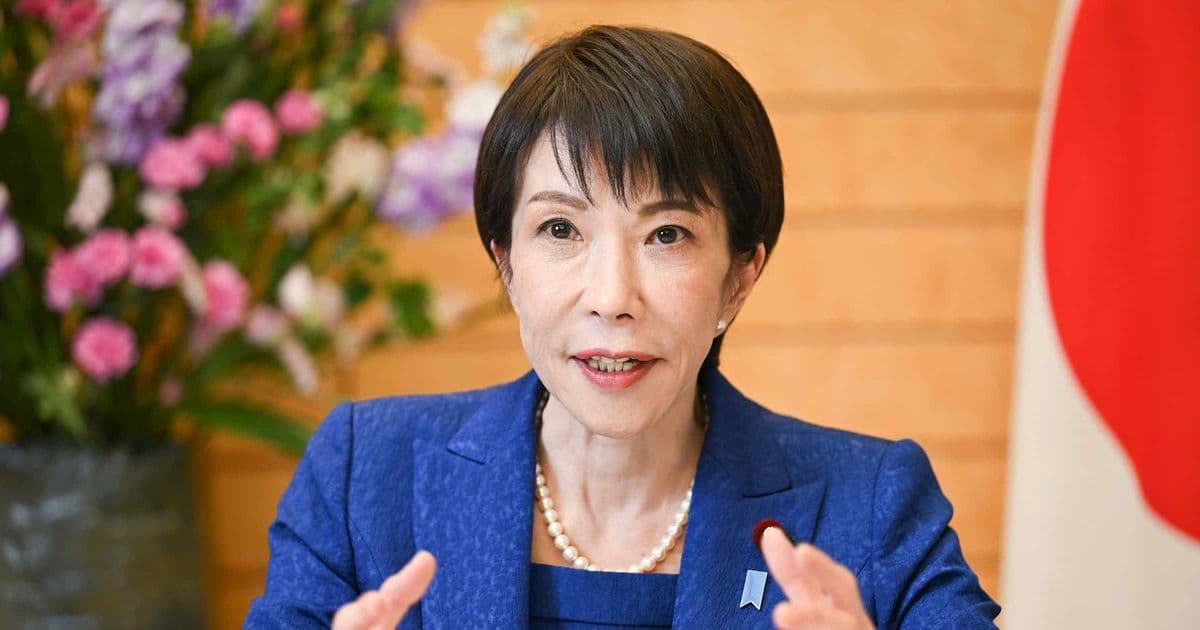
Prime Minister Sanae Takaichi has drawn a clear line on fiscal policy, committing to fund her proposed two-year consumption tax cut on food items without issuing deficit-financing bonds, a move that positions her LDP election pledge as more fiscally disciplined than opposition proposals.
Japanese Prime Minister Sanae Takaichi has established a firm fiscal boundary ahead of next month's lower house election, stating in a Nikkei interview that her proposed two-year consumption tax cut on food items "would not rely on deficit-financing bonds." This commitment marks a significant policy distinction as Japan's political parties debate tax relief measures amid persistent economic pressures.
The consumption tax cut proposal, which would temporarily reduce the tax rate on food items, represents a central plank of Takaichi's election platform. However, her insistence on avoiding deficit bonds places a clear constraint on the policy's fiscal impact. Japan's government debt already stands at over 260% of GDP, among the highest in the developed world, making deficit financing a politically sensitive issue. By ruling out bond issuance, Takaichi signals that any revenue shortfall from the tax cut would need to be offset through other budgetary adjustments or revenue measures.
This approach contrasts with opposition party proposals, which may include more expansive tax cuts or spending programs potentially requiring debt financing. The distinction highlights a broader debate about Japan's fiscal trajectory as the country grapples with deflationary pressures, an aging population, and the need for economic stimulus. Takaichi's position suggests a balancing act between providing immediate economic relief to households and maintaining long-term fiscal sustainability.
Market analysts have been closely watching Japan's fiscal policy direction. S&P Global analysts have noted that while government spending poses risks, these are offset by solid revenue performance. Similarly, Moody's analysts have observed that Takaichi has found a "balance" on fiscal policy, suggesting her approach may be viewed favorably by credit rating agencies concerned about Japan's debt trajectory.
The timing of this policy announcement is crucial. With the lower house election approaching, consumption tax policy has become a key battleground. The debate reflects broader economic challenges: Japan has struggled with weak domestic consumption, and reducing taxes on food items could provide immediate relief to households facing rising costs. However, without deficit financing, the government must find alternative ways to fund the revenue gap, potentially through spending cuts elsewhere or increased revenue from other sources.
Takaichi's fiscal discipline may appeal to investors concerned about Japan's debt sustainability. Foreign players have been stepping into Japan's government bond market as domestic investors retreat from ultralong JGBs, indicating ongoing market scrutiny of Japan's fiscal health. By avoiding deficit bonds for the consumption tax cut, Takaichi may be attempting to signal fiscal responsibility to both domestic voters and international markets.
The policy's implementation details remain to be seen. A two-year consumption tax cut on food items would provide temporary relief but requires careful planning to ensure it doesn't create fiscal cliffs or economic distortions. The government will need to consider how to manage the revenue impact while maintaining essential public services and investment.
This fiscal approach also reflects the broader economic strategy of Japan's current administration. As the country continues to navigate post-pandemic recovery and structural economic challenges, the balance between stimulus and fiscal prudence will remain critical. Takaichi's commitment to deficit-free tax cuts represents one approach to this balance, prioritizing immediate economic relief while maintaining long-term fiscal constraints.
The election outcome will determine whether this fiscal approach gains broader political support and how it might be implemented. Regardless of the election results, Takaichi's clear stance on deficit financing has set a marker for fiscal policy discussions in Japan, emphasizing the need to balance economic stimulus with debt sustainability in one of the world's most indebted economies.
Comments
Please log in or register to join the discussion