
Khadas is developing the Mind Go, a modular system that combines a fanless tablet, attachable keyboard, and an actively cooled desktop stand into one cohesive computing platform, aiming to replace three separate devices with a single, adaptable unit.
The personal computing market is saturated with attempts to bridge the gap between portability and power, but most compromises result in a device that does neither particularly well. Khadas, known for its enthusiast-oriented single-board computers and compact devices, is throwing its hat into the ring with the Mind Go. This isn't just another 2-in-1 laptop; it is a three-part modular system designed to physically transform based on the user's immediate needs. The core concept is simple but ambitious: a single computing core that can be a tablet, a laptop, or a full-fledged desktop workstation depending on which accessories you snap it into.
The Core: The Mind Go Tablet
At the heart of the system is an 11.6-inch tablet. The current prototype is impressively thin and light, measuring just 0.24 inches (approximately 6mm) thick and weighing around 600 grams. This makes it highly portable for presentations or mobile work. Khadas has designed the rear edge with a slight ergonomic raise, which might seem minor, but it significantly improves grip when holding the device for handwriting or reading.

Connectivity on the tablet itself is minimal, as is typical for this form factor, but it supports the Mind Pencil for handwriting and sketching. The built-in speakers and front-facing camera handle the basics for video calls. Khadas is also considering an OLED panel option, which would not only improve contrast and color accuracy but also potentially shave the thickness down to 0.22 inches and reduce weight further.
Under the hood, the tablet runs on a fanless, efficient platform. The specific chipset hasn't been finalized yet, but the goal is to provide enough power for productivity tasks without generating heat that requires active cooling in the tablet form. To keep the tablet chassis light, Khadas has split the battery design. Part of the battery is housed inside the tablet, while the rest is located in the keyboard attachment. This prevents the tablet from becoming too bulky while ensuring decent standalone runtime.
Laptop Mode: The Keyboard Base
When the tablet is connected to the keyboard base via pogo-pin connectors, the Mind Go enters laptop mode. This is where the system becomes a true mobile workstation. The combined battery capacity jumps to 45Wh, which Khadas claims is good for up to nine hours of local video playback.
One of the more clever engineering decisions here is the ability to attach or detach the tablet from the keyboard at will without interrupting workflows. If you are typing at your desk and need to quickly grab the tablet for a meeting or a sketch session, you can pull it off, and the system seamlessly transitions back to tablet mode. When you return, snapping it back into the keyboard resumes your session. This fluidity is designed to eliminate the friction often associated with switching devices.
Desktop Mode: The Mind Go Stand
The third component is the Mind Go Stand. This is where the "Go" in the name becomes literal, as the tablet transforms into a desktop powerhouse. The stand is an actively cooled base that solves the thermal constraints inherent to the fanless tablet design. Khadas claims that the active cooling in the stand allows the system to run at almost double the performance compared to when it is in tablet mode.
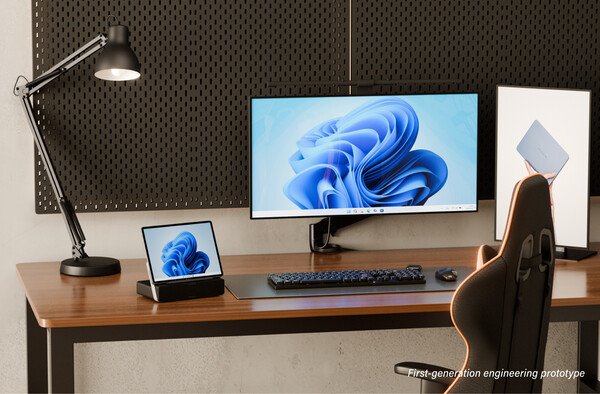
The Mind Go Stand functions as a full desktop dock. It adds a comprehensive array of connectivity options that are usually missing from tablets, including USB-C, USB-A, HDMI, Ethernet, and a headphone jack. It also includes integrated speakers, turning the setup into a multi-display workstation. By connecting external monitors and peripherals, the Mind Go effectively becomes a standard desktop computer, capable of handling heavier workloads that would throttle a passive tablet.
The Trade-offs and Future
The Mind Go is still in active development, and Khadas is openly stating that key decisions—specifically the choice between LCD and OLED displays and the final expansion options—will be shaped by user feedback. This community-driven approach is typical for Khadas, but it also means the final product might differ from the current prototype.
The main challenge for the Mind Go will be the execution of the modular concept. While the idea of a 3-in-1 is compelling, the success depends on the seamless integration of the three parts. The performance gap between the tablet and the stand needs to be significant enough to justify owning the stand, but the tablet needs to be good enough on its own to warrant the purchase.
For users who constantly switch between couch, desk, and meeting room, the Mind Go offers a unified ecosystem that could reduce the need to sync files between a tablet, laptop, and desktop. It prioritizes adaptable workflows over a single fixed form factor, challenging the traditional notion that a computer must choose between mobility and raw power.
For more details on the specifications and to provide feedback on the development, you can visit the official Khadas Mind Go website.
Comments
Please log in or register to join the discussion