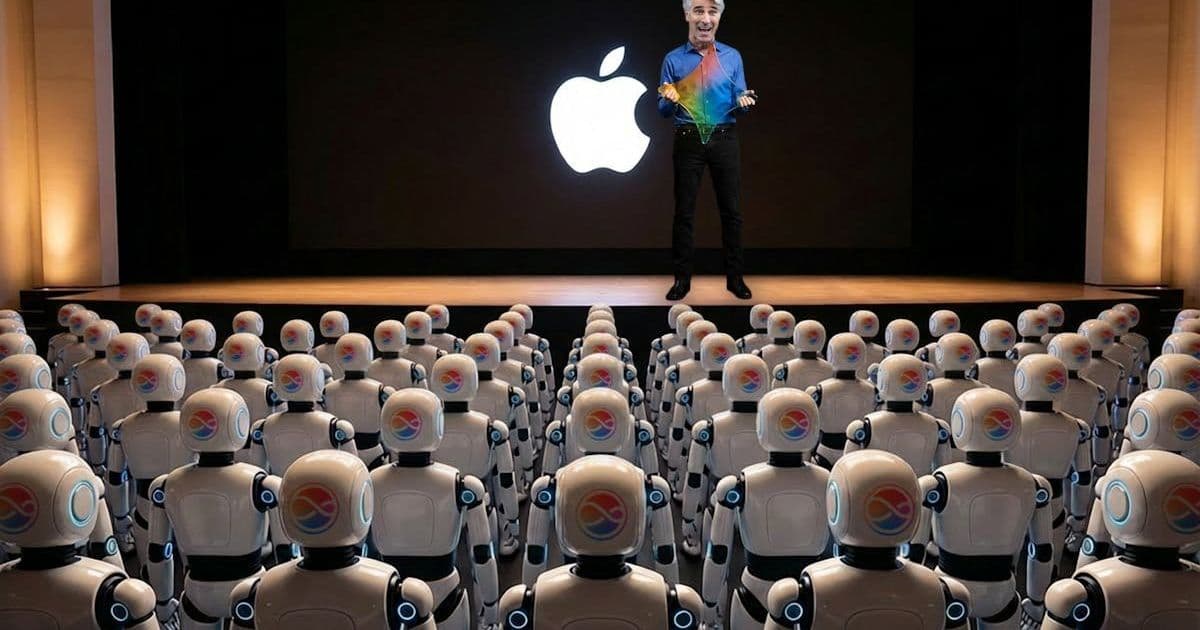
Apple's decision to integrate Google's AI technology into its devices reveals a strategic shift in the company's approach to artificial intelligence, prioritizing user privacy and controlled integration over the rapid, open-ended deployment seen elsewhere in the tech industry.
The recent announcement that Apple will integrate Google's Gemini AI models into iOS has sent ripples through the developer community, not because of the technology itself, but because of what it signals about Apple's evolving philosophy on artificial intelligence. For years, Apple has positioned itself as the privacy-first alternative to the data-hungry models from Google and Meta. Now, by bringing Google's AI directly into its ecosystem, the company is walking a tightrope between innovation and its long-standing principles.
The Strategic Calculus
Craig Federighi, Apple's senior vice president of Software Engineering, has long been the architect of the company's software philosophy. His approach has always been characterized by deliberate, measured rollouts. The decision to partner with Google rather than develop a homegrown large language model (LLM) from scratch speaks volumes about Apple's current priorities.
Unlike Microsoft's aggressive push with Copilot or Google's own integration of Gemini across its product suite, Apple is taking what Federighi describes as a "cautious" approach. This isn't just about technical capability—it's about maintaining the company's core identity. Apple's ecosystem thrives on user trust, and that trust is built on the promise that your data stays yours.
The technical implementation will likely follow Apple's established patterns. Rather than sending all queries to Google's servers, the integration will probably use a hybrid model. Some processing will happen on-device using Apple's Neural Engine, while more complex queries will be routed to Google's cloud infrastructure. This mirrors Apple's approach with features like Siri, where basic commands are handled locally, but more complex requests require server-side processing.
The Privacy Paradox
Here's where the tension becomes palpable. Google's business model fundamentally relies on data collection and analysis. Apple's business model relies on selling hardware at premium prices, partly justified by its privacy stance. When these two philosophies merge, the result is inherently complex.
The partnership likely includes strict data handling agreements. Google probably won't have direct access to user data in the way it does with its own products. Instead, Apple will act as a gatekeeper, anonymizing queries and stripping identifying information before sending them to Google's servers. This creates a technical challenge: how do you provide personalized AI assistance while maintaining anonymity?
Developers in the Apple ecosystem are already speculating about the implementation details. Will there be a new API for accessing Gemini's capabilities? How will this affect existing third-party AI integrations? The answers will determine whether this becomes a seamless enhancement or a fragmented experience.
The Competitive Landscape
Apple's move comes as the AI race accelerates. Microsoft has embedded Copilot into Windows and Office, Google has Gemini across its products, and Meta is pushing AI assistants in Instagram and WhatsApp. Apple has been conspicuously absent from this race, with Siri remaining largely unchanged for years while competitors advanced rapidly.
This partnership suggests Apple recognizes it can't remain on the sidelines indefinitely. However, rather than trying to outpace competitors on raw capability, Apple is betting on integration quality and user experience. The question is whether this cautious approach will be enough to satisfy users who see what competitors are offering.
Early adopters and power users are already expressing mixed reactions. Some appreciate the privacy-preserving approach, while others feel Apple is falling behind. The developer community is watching closely, wondering how this will affect app development and whether third-party AI services will face new restrictions.
Technical Implementation Questions
For developers, the practical questions are immediate. Will there be new frameworks for integrating AI features? How will existing apps that use other AI services be affected? Apple's history suggests they'll provide clear guidelines, but the transition period could be rocky.
The on-device processing component is particularly interesting. Apple's Neural Engine has been steadily improving, but running sophisticated LLMs locally remains challenging. The company may use a technique called model distillation, where a smaller, more efficient model runs on-device while handling more complex queries through Google's infrastructure.
This hybrid approach has trade-offs. It reduces latency for simple queries and maintains privacy for sensitive data, but it also means the AI's capabilities are limited by what can run locally. Users might notice inconsistency—some questions answered instantly, others requiring a network connection.
The Broader Pattern
This partnership reflects a broader trend in tech: specialization. Companies are increasingly recognizing that they can't excel at everything. Apple's strength lies in hardware design, user experience, and ecosystem integration. Google's strength lies in AI research and data processing. By combining these strengths, both companies hope to create something better than either could achieve alone.
However, this trend also raises questions about competition and innovation. When the biggest players in tech start partnering rather than competing directly, does that slow down innovation? Or does it allow each company to focus on what they do best?
The answer likely depends on execution. If the integration is seamless and genuinely useful, it could set a new standard for how AI should be implemented in consumer devices. If it's clunky or raises privacy concerns, it could backfire spectacularly.
What Comes Next
The partnership will likely roll out in stages. Initial features might include enhanced Siri capabilities, AI-powered photo editing, or smarter text prediction. Over time, we could see more sophisticated integrations, like real-time translation or advanced content generation.
For developers, this means staying adaptable. The AI landscape is shifting rapidly, and Apple's approach—while cautious—is still a significant shift from their previous stance. Understanding how to work with these new capabilities will be crucial for building competitive apps in the Apple ecosystem.
The real test will come when users get their hands on these features. Will they notice the difference? Will they appreciate the privacy-preserving approach, or will they feel Apple is playing catch-up? The answers will shape not just Apple's AI strategy, but the broader conversation about how AI should be integrated into our daily lives.
This partnership represents more than just a business deal—it's a statement about the future of AI in consumer technology. Apple is betting that users value privacy and integration over raw capability. That bet, more than any technical specification, will determine whether this cautious course pays off.
Comments
Please log in or register to join the discussion