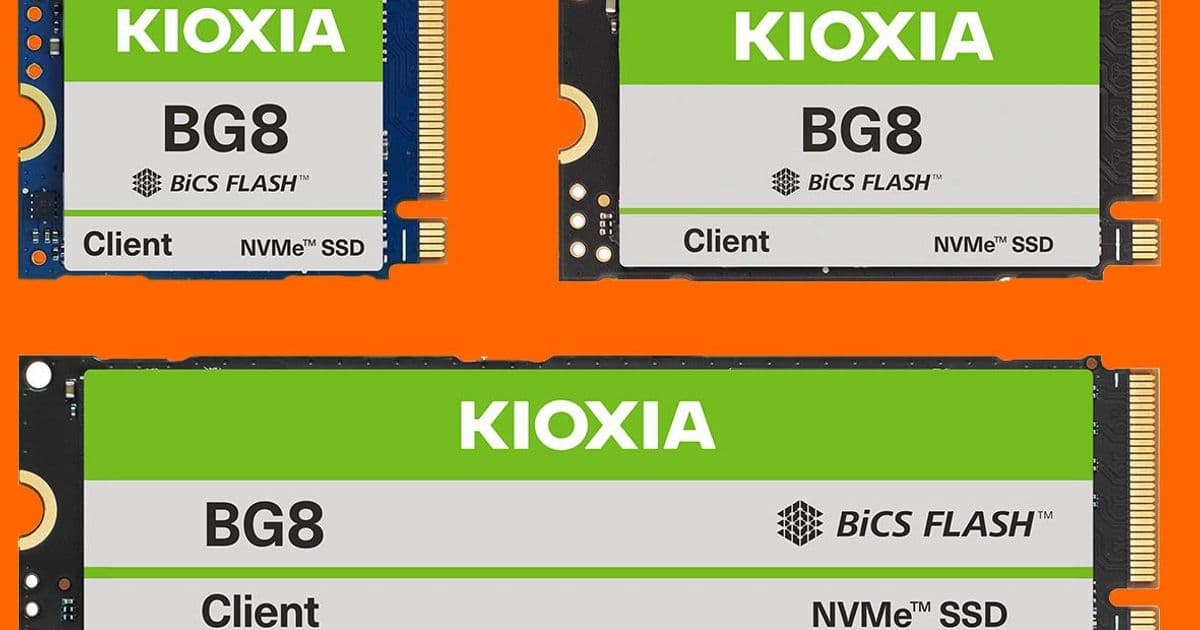
Kioxia's latest BG8 SSD series brings PCIe 5.0 connectivity to mainstream client devices with significant performance gains while maintaining a cost-effective DRAM-less architecture.
Kioxia BG8 Series Brings PCIe 5.0 to Mainstream Client SSDs
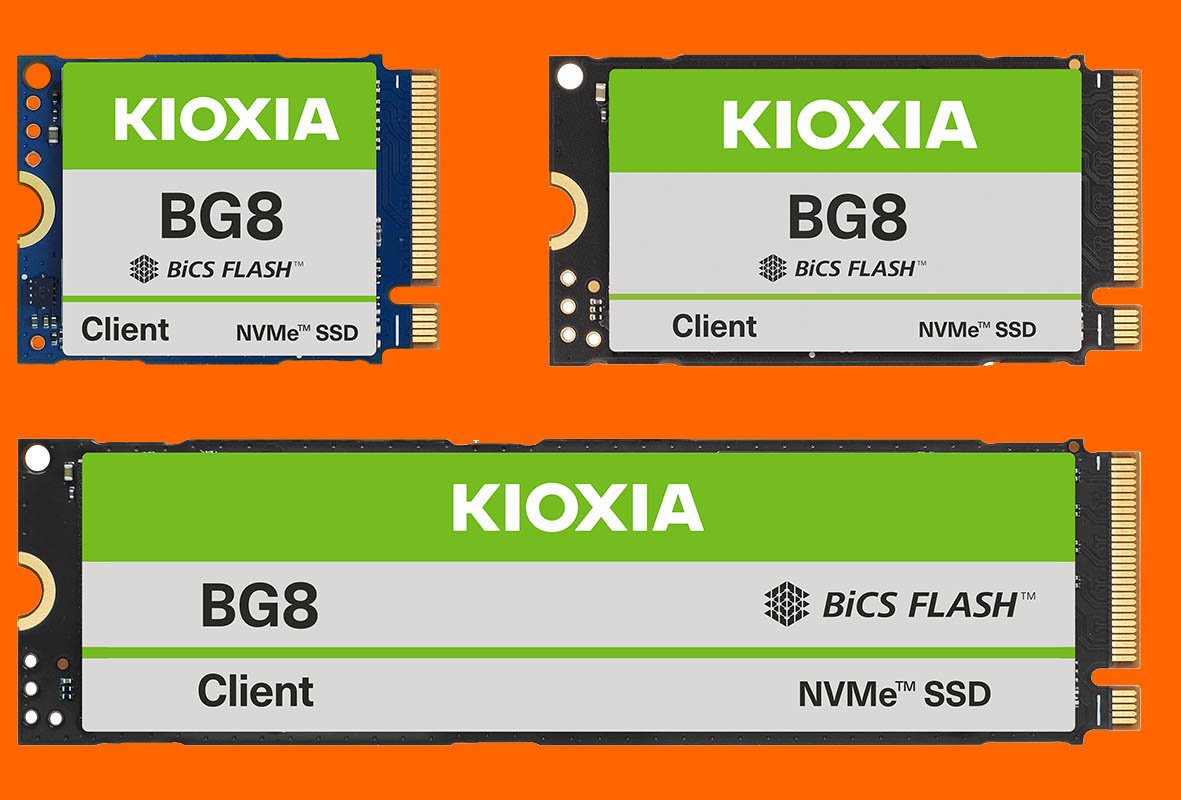
The storage landscape continues to evolve with Kioxia's announcement of the BG8 series of SSDs, arriving approximately one year after its predecessor, the BG7. This new generation marks a significant leap forward by bringing PCIe 5.0 connectivity to the mainstream client SSD segment. Like its predecessor, the BG8 is designed primarily for OEM deployments in laptops and desktops rather than retail channels, making it a crucial component for system builders and OEMs looking to balance performance with cost efficiency.
Performance Evolution: From PCIe 4 to 5
The headline improvement with the BG8 is the transition from a PCIe Gen4 to PCIe Gen5 x4 interface, effectively doubling the theoretical bandwidth between the host and the drive controller. This architectural shift enables Kioxia to claim impressive performance figures:
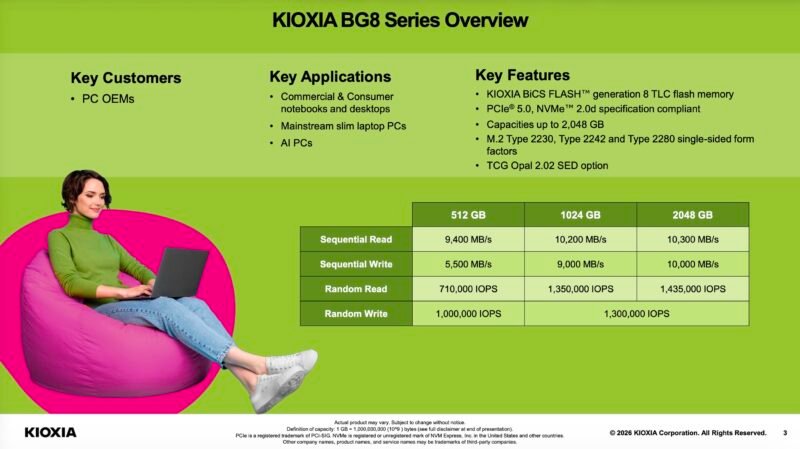
- Sequential Read: 10,300 MB/s (47% improvement over BG7)
- Sequential Write: 10,000 MB/s (67% improvement over BG7)
- Random Read: 1.4 million IOPS (44% higher than BG7)
- Random Write: 1.3 million IOPS (30% higher than BG7)
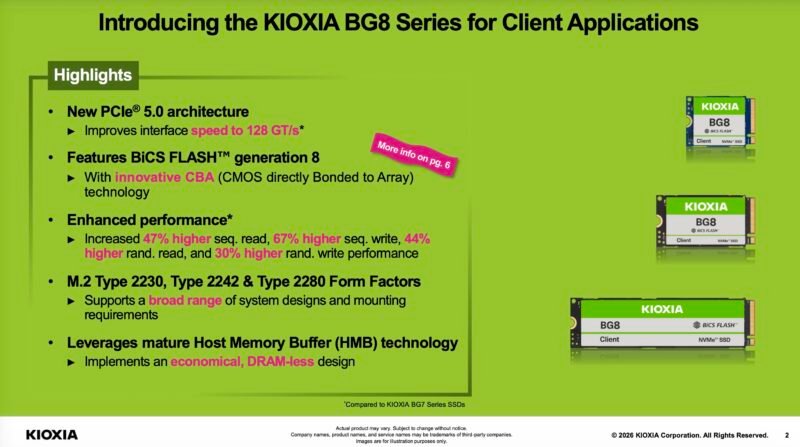
These gains are particularly noteworthy in the write performance category, where the BG8 achieves a 67% improvement over its predecessor. For users frequently transferring large files or working with media creation workloads, this could translate to tangible time savings in real-world scenarios.
Architecture: Maintaining DRAM-less Design with HMB
A key aspect of the BG8 series is its continuation of the DRAM-less architecture that characterized previous generations. Instead of dedicated DRAM for mapping tables, the BG8 leverages Host Memory Buffer (HMB) technology to utilize a portion of the host system's memory. This approach offers several advantages:
- Reduced component costs: Eliminating the DRAM chip lowers the Bill of Materials (BOM)
- Lower power consumption: Critical for battery-powered devices
- Sufficient performance for mainstream workloads: HMB has proven adequate for typical client usage
The trade-off, as with all DRAM-less designs, is some performance headroom compared to DRAM-equipped SSDs, particularly under sustained heavy workloads. However, for the target market—mainstream laptops and desktops—this represents an optimal balance between cost, power efficiency, and performance.
Form Factor Flexibility
Kioxia has maintained form factor flexibility with the BG8 series, shipping in three M.2 variants:
- M.2 2230: For compact handhelds and ultraportables
- M.2 2242: Addresses devices like the Xsight Labs E1 DPU and other embedded systems
- M.2 2280: For mainstream laptops and desktops
This comprehensive coverage ensures the BG8 can be deployed across a wide range of device form factors, from space-constrained ultraportables to full-sized desktop systems. The inclusion of the 2242 form factor is particularly noteworthy, as it addresses a niche but important segment of embedded and specialty systems that require this intermediate length.
Technology Foundation: BiCS 8 TLC NAND with CBA
The BG8 series utilizes Kioxia's BiCS FLASH Generation 8 TLC NAND with CBA (CMOS directly Bonded to Array) technology. This bonding process connects the CMOS logic layer directly to the memory array, resulting in higher bit density. Importantly, this is the same generation of NAND flash memory used in the BG7 series, meaning that Kioxia has primarily upgraded the controller while keeping the storage technology consistent.
This approach explains why the performance gains are most pronounced in scenarios where the NAND is not the bottleneck, particularly when writing against the pseudo-SLC (pSLC) cache. The controller upgrade allows the drive to better leverage the existing NAND technology, extracting more performance without changing the fundamental storage medium.
BG8 vs. EG7: Positioning in Kioxia's Portfolio
This week marks Kioxia's introduction of two new drives based on BiCS 8 technology: the TLC-based BG8 and the QLC-based EG7 series. The two drives represent different market positions within Kioxia's client SSD portfolio:
| Specification | Kioxia BG8 | Kioxia EG7 |
|---|---|---|
| NAND Type | BiCS 8 TLC | BiCS 8 QLC |
| Max Sequential Read | 10,300 MB/s | 7,000 MB/s |
| Max Sequential Write | 10,000 MB/s | 6,200 MB/s |
| Max Random Read | 1.4M IOPS | 1.0M IOPS |
| Max Random Write | 1.3M IOPS | 1.0M IOPS |
| Endurance (1TB) | 1,200 TBW | 600 TBW |
| Encryption | TCG Opal 2.0 SED | Optional |
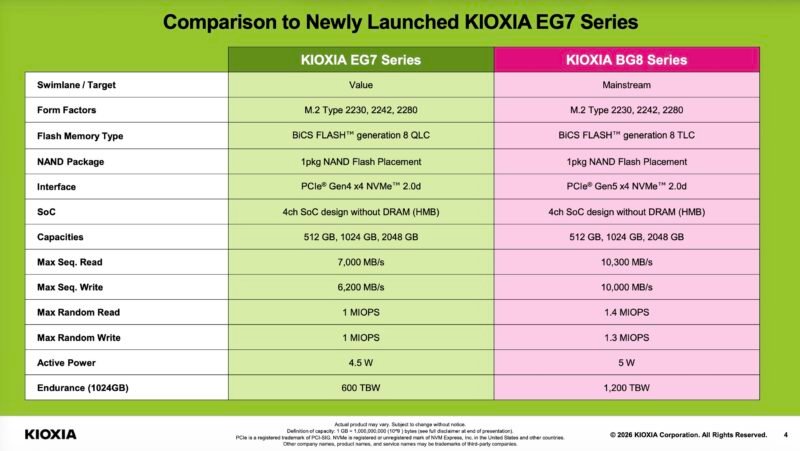
The BG8 clearly outperforms the EG7 across virtually all metrics, making it suitable for mainstream systems that benefit from PCIe 5.0 bandwidth and higher write endurance. The EG7, in contrast, is positioned as a value option where cost per gigabyte takes precedence over peak performance. This dual-product strategy allows Kioxia to address different segments of the mainstream market with tailored solutions.
Power and Efficiency Considerations
The BG8 series maintains a rated active power draw of 5W, consistent with mainstream client SSDs. While this figure provides a baseline for comparison, real-world efficiency will vary significantly based on workload patterns. DRAM-less designs typically exhibit greater performance variance under sustained heavy loads compared to DRAM-equipped counterparts, but for typical client usage patterns—booting, application launches, light multitasking—the HMB approach has proven adequate in previous generations.
For power-sensitive applications like ultraportable laptops, the BG8's power efficiency represents a key advantage over higher-performance drives that might require more power to operate. This efficiency becomes particularly important in devices where battery life is a primary concern.
Market Positioning and Target Applications
Kioxia explicitly positions the BG8 for PC OEM customers in both commercial and consumer notebooks, as well as desktop systems. The DRAM-less architecture with mature HMB implementation is designed to balance three critical factors for high-volume OEM deployments:
- Performance: Sufficient for mainstream client workloads
- Power consumption: Optimized for battery life
- Cost: Reduced BOM through DRAM-less design
The timing of the BG8's release is strategically important. With Kioxia currently sampling to OEMs and shipments expected from Q2 2026, the BG8 arrives as PCIe 5.0 platforms become more mainstream in both Intel and AMD ecosystems. This positions Kioxia to capitalize on the growing adoption of Gen5 connectivity in the consumer and commercial markets.
Security Features
For security-conscious deployments, the BG8 offers Self-Encrypting Drive (SED) models compliant with TCG Opal 2.0 standards. This hardware-level encryption provides enhanced data protection without significant performance penalties. However, availability of these SED models may vary by region and OEM configuration, as is common with enterprise-focused features in mainstream drives.
Real-World Performance Considerations
While the BG8's specifications are impressive on paper, the real-world benefits will depend heavily on workload characteristics. The BG7 was already competent for typical client usage scenarios like boot times, application launches, and file transfers. The BG8's advantages will likely be most noticeable in:
- Sustained sequential transfers (large file copies, video editing)
- Mixed random workloads (database operations, certain gaming scenarios)
- Systems with PCIe 5.0 controllers that can fully utilize the increased bandwidth
For everyday computing tasks, the performance differences between BG7 and BG8 might be less noticeable, though the improved write endurance could provide longer-term reliability benefits.
Competitive Landscape
The BG8 enters a market with increasing competition in the PCIe 5.0 space. While Kioxia is targeting the mainstream segment with its DRAM-less approach, other manufacturers are focusing on different strategies:
- High-end enthusiast drives with DRAM and premium controllers
- Value-oriented PCIe 4.0 drives for cost-sensitive markets
- PCIe 5.0 drives with DRAM for performance-critical applications
Kioxia's strategy with the BG8 appears to be about bringing Gen5 connectivity to the volume market, where cost and power efficiency drive purchasing decisions rather than absolute performance metrics. This approach could help accelerate the adoption of PCIe 5.0 technology across the broader PC market.
Conclusion
The Kioxia BG8 represents a logical and calculated evolution of the company's mainstream client SSD line. By moving to PCIe Gen5 while maintaining the DRAM-less architecture, Kioxia is betting that OEMs will value the interface bandwidth even in cost-sensitive segments. The performance improvements over BG7 are meaningful on paper, particularly the 67% sequential write gain and 30-44% random I/O improvements.
As with any new technology, the true test will come in real-world implementations. When we encounter BG8 drives in review units, we'll be able to benchmark actual performance against Kioxia's claims and compare it to both the BG7 and competing Gen5 offerings in the mainstream segment. For now, the BG8 appears to be a well-positioned offering that could help drive the adoption of PCIe 5.0 technology in mainstream systems throughout 2026.
Comments
Please log in or register to join the discussion