The open-source GPU management tool LACT receives a major 0.9 update with a libadwaita-based UI redesign, long-awaited NVIDIA voltage-frequency curve editing capabilities, and enhanced AMD hardware support, bringing Linux GPU management closer to Windows-level functionality.
LACT 0.9 Delivers Professional GPU Management to Linux with NVIDIA VF Curve Editor
For Linux users seeking advanced graphics card control options, the LACT (Linux Advanced Control Tool) project has reached a significant milestone with the release of version 0.9. This major update introduces a complete UI overhaul, a highly-requested NVIDIA Voltage-Frequency curve editor, and expanded hardware support that positions LACT as the premier cross-vendor GPU management solution for Linux systems.
What is LACT?
LACT has emerged as one of the leading open-source solutions for GPU management on Linux, addressing a critical gap in the Linux ecosystem. Unlike Windows users who have access to manufacturer-specific tools like NVIDIA's GeForce Experience, AMD's Adrenalin Software, and Intel's Arc Control, Linux users have historically been limited to command-line tools or basic configuration options.
The project fills this void by providing a unified interface that works across AMD, NVIDIA, and Intel graphics hardware, regardless of whether you're using proprietary or open-source drivers. This includes support for NVIDIA's proprietary driver, Nouveau/Nova for NVIDIA GPUs, AMD's proprietary driver, and AMDGPU for AMD GPUs.
Major UI Overhaul with libadwaita
The most immediately noticeable change in LACT 0.9 is the complete rework of the user interface. The application has transitioned from using GTK4 to libadwaita, the modern UI library designed for GNOME applications. This change brings several benefits:
- Improved visual consistency with the GNOME desktop environment
- Better accessibility features
- More responsive interface
- Enhanced theming support
- Better integration with system-wide dark/light mode settings
The new layout makes it significantly easier to view and manage graphics hardware information, overclocking controls, thermal monitoring, and software information all in one place. The interface has been reorganized to present data more logically, with clearer sections for monitoring, controls, and settings.
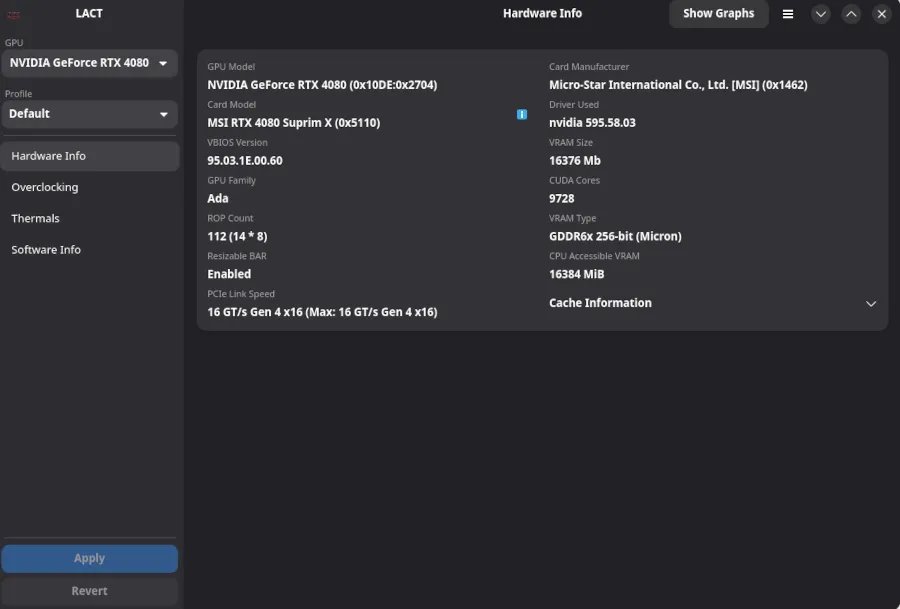 The new LACT 0.9 UI with improved layout and organization
NVIDIA Voltage-Frequency Curve Editor
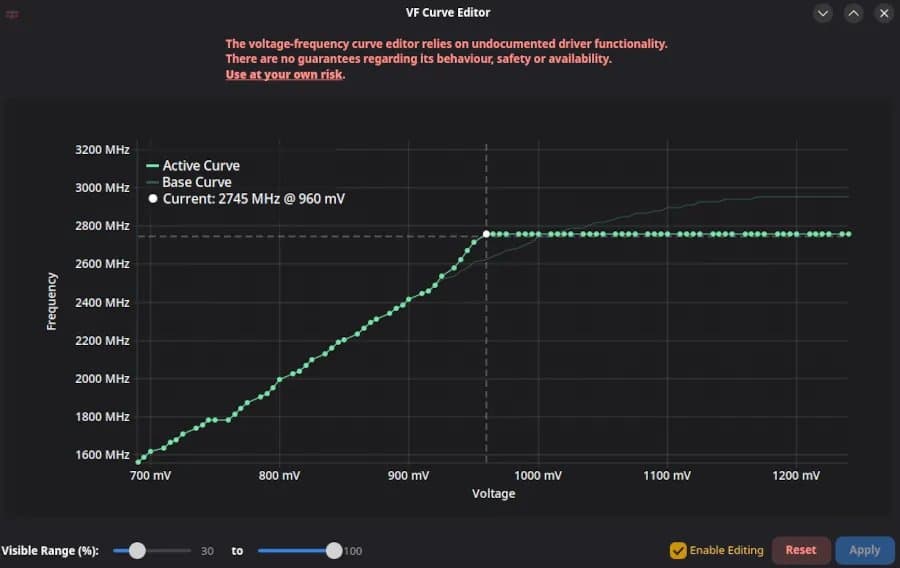
Perhaps the most significant new feature in LACT 0.9 is the implementation of a Voltage-Frequency (VF) curve editor specifically for NVIDIA graphics cards. This feature has been long-requested by the Linux GPU enthusiast community and brings functionality previously only available on Windows through tools like MSI Afterburner.
The VF curve editor allows users to:
- Fine-tune the relationship between clock speed and voltage for each GPU clock domain
- Create custom power profiles optimized for specific workloads
- Potentially achieve better performance-per-watt ratios than the manufacturer's curves
- Adjust voltage limits independently of frequency limits
This level of control is particularly valuable for:
- Overclockers looking to push their hardware to its limits
- Power users who want to optimize for specific workloads
- System builders focused on efficiency
- Enthusiasts who want to understand their GPU's behavior
The implementation mirrors the functionality found in Windows overclocking tools, giving Linux users parity with the control options available in other operating systems.
Enhanced AMD Support
While the NVIDIA VF curve editor has received the most attention, LACT 0.9 also includes significant improvements for AMD GPU owners:
- Hardware Quirks Handling: The application now addresses additional hardware-specific behaviors and limitations that were previously causing issues with certain AMD GPU models.
- Hardware Block IP Version Reporting: Users can now view detailed information about the IP versions used in various hardware blocks of their AMD GPUs, providing valuable information for debugging and optimization.
- Target Temperature Setting: Similar to the NVIDIA implementation, AMD users now have access to target temperature controls that allow for more precise thermal management.
These improvements make LACT an even more comprehensive solution for Linux users with AMD hardware, addressing some of the previous limitations and providing more detailed hardware information.
Improved Flatpak Integration
LACT 0.9 brings enhanced Flatpak integration, making it easier to install and run the application in sandboxed environments. This is particularly valuable for:
- Users running immutable distributions like Fedora Silverblue or Kinoite
- Those concerned about security and application isolation
- Users who prefer to manage applications through Flatpak
The improved integration includes better handling of permissions, smoother updates, and improved compatibility with the Flatpak ecosystem.
Performance and Compatibility Considerations
For users considering LACT 0.9 for their systems, it's important to understand the performance implications and compatibility considerations:
- Driver Support: LACT works with both open-source and proprietary drivers for all three major GPU vendors. However, certain features may be limited depending on your driver choice.
- Performance Impact: The application itself has minimal performance impact when not actively adjusting settings, though some monitoring features may consume additional resources.
- Hardware Compatibility: The application supports a wide range of hardware from all three major GPU vendors, though some newer models may require updates to fully support all features.
Practical Applications and Use Cases
LACT 0.9 opens up numerous possibilities for Linux users:
Content Creators
For video editors, 3D artists, and other content creators, LACT provides the ability to:
- Optimize GPU performance for specific rendering workloads
- Monitor thermal performance during intensive tasks
- Create custom power profiles that balance performance and noise
Gamers
Linux gamers can benefit from:
- Improved frame stability through better thermal management
- Custom performance profiles optimized for different games
- Enhanced monitoring capabilities to identify performance bottlenecks
System Administrators
For those managing multiple Linux workstations or servers:
- Centralized GPU monitoring across systems
- Consistent overclocking profiles across hardware
- Better power management capabilities
Installation and Getting Started
LACT 0.9 can be installed through several methods:
- From GitHub: The source code and binaries are available on the official GitHub repository
- Flatpak: For distributions that support Flatpak, a flatpak package is available
- Distribution Repositories: Some distributions may have packages available in their repositories
After installation, users will find the interface significantly more intuitive than previous versions, with clear sections for monitoring, controls, and settings. The NVIDIA VF curve editor is accessible through the overclocking section, while AMD users will find additional information and controls in the hardware information section.
Future Development
The LACT project continues to evolve, with potential future improvements including:
- Support for Intel Arc GPUs
- Additional monitoring metrics
- More advanced overclocking features
- Improved integration with desktop environments beyond GNOME
Conclusion
LACT 0.9 represents a significant step forward for GPU management on Linux, bringing professional-level control options previously only available on Windows. The combination of a modern UI, the long-awaited NVIDIA VF curve editor, and enhanced AMD support makes this release a must-have for Linux users who want to get the most out of their graphics hardware.
For Linux enthusiasts, content creators, gamers, and system administrators, LACT 0.9 provides the tools needed to monitor, control, and optimize GPU performance in a way that was previously impossible on the Linux platform. The open-source nature of the project ensures that it will continue to evolve with community input and support.
The FREE SOFTWARE category on Phoronix, where LACT development is documented
For those interested in the technical details or want to contribute to the project, the LACT GitHub repository provides access to the source code, issue tracker, and development roadmap.
Comments
Please log in or register to join the discussion