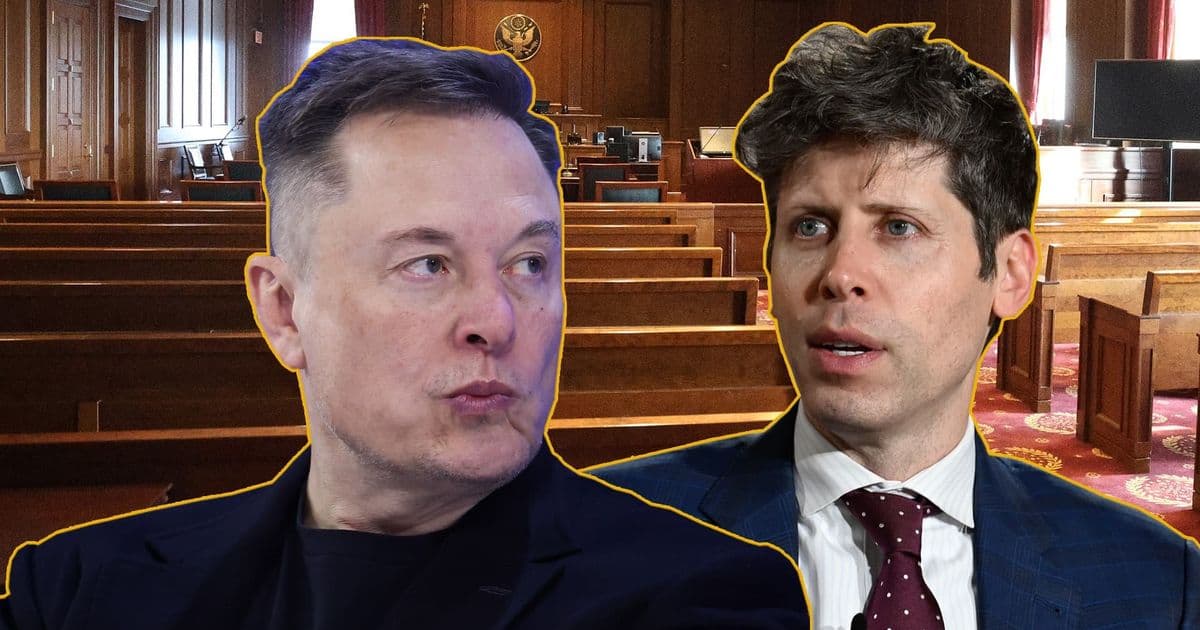
The upcoming trial between Elon Musk and Sam Altman centers on allegations that OpenAI abandoned its nonprofit commitment, potentially reshaping the AI industry's governance models.
Elon Musk's $134 billion lawsuit against OpenAI CEO Sam Altman is set to begin Monday in Northern California, marking a pivotal moment in the ongoing legal battle between two of technology's most influential figures. The lawsuit accuses Altman of reneging on a foundational promise to maintain OpenAI as a nonprofit organization, potentially setting a precedent for AI governance and corporate accountability.
The legal confrontation stems from OpenAI's transition from a nonprofit research lab to a capped-profit entity in 2019, a move that allowed the organization to secure substantial funding while ostensibly maintaining its mission to benefit humanity. Musk, who was an early investor and board member before departing in 2018, alleges this transformation violated the original agreement that established OpenAI's nonprofit structure.
OpenAI's evolution reflects the broader tension in the AI industry between idealistic missions and commercial realities. The organization initially positioned itself as a counterbalance to Google and other tech giants pursuing AI development without sufficient safeguards. "OpenAI was created to ensure that artificial general intelligence benefits all of humanity," stated in its original charter. "We are concerned about increasingly powerful AI systems developed in the absence of safety research."
The financial stakes in this case are substantial. Musk's $134 billion claim represents a significant portion of OpenAI's current valuation, which has soared to approximately $80-90 billion following its partnership with Microsoft. The lawsuit specifically targets OpenAI's transition to a capped-profit model in 2019, when the company established a new structure with a for-profit subsidiary while maintaining a parent nonprofit organization.
Legal experts note that the case hinges on several key questions:
- Whether Musk and OpenAI had a binding agreement to maintain nonprofit status
- The extent of Musk's influence in OpenAI's early governance structure
- Whether the 2019 transition violated fiduciary duties to the nonprofit's mission
"This case represents a clash between two visions of AI development," explains Dr. Evelyn Reed, a technology ethics professor at Stanford University. "Musk's position reflects a concern that commercial interests inevitably compromise safety and accessibility, while Altman's approach argues that substantial resources are necessary to develop beneficial AI at scale."
The legal battle has already seen significant procedural developments. Earlier this year, a U.S. judge dismissed Musk's fraud claims at his request to streamline the case, but ruled that other claims would proceed to trial. This strategic move suggests Musk's legal team is focusing on specific allegations rather than pursuing a broad-based legal challenge.
OpenAI's response has emphasized its continued commitment to safety and accessibility. "We maintain our core mission to ensure AGI benefits all of humanity," stated OpenAI in court filings. "Our structure has evolved to enable us to attract the resources necessary to develop safe AI while maintaining our commitment to our principles."
The timing of the trial coincides with increasing scrutiny of AI governance models. As AI systems become more powerful, questions about whether nonprofit or for-profit structures better serve the public interest have gained prominence. The case may influence how future AI organizations structure themselves and the legal frameworks governing AI development.
For investors, the trial carries significant implications. OpenAI's valuation has skyrocketed, with Microsoft's $13 billion investment representing a substantial stake in the organization. A ruling against OpenAI could potentially disrupt these financial arrangements, though experts suggest the organization's existing contracts with Microsoft likely include provisions for such contingencies.
The broader AI industry watches closely as this case unfolds. "This isn't just about two billionaires fighting," notes Sarah Jenkins, a tech industry analyst with Gartner Research. "It's about establishing the legal and governance framework for AI development for decades to come. The outcome may determine whether AI development follows a more open, accessible model or becomes increasingly concentrated in the hands of a few large corporations."
Musk's history with OpenAI adds complexity to the case. He was an early supporter and board member before departing in 2018 over concerns about the organization's direction and potential conflicts of interest. His departure preceded the 2019 transition to a capped-profit model, though he has maintained that the organization had already begun moving away from its nonprofit commitments.
The trial's outcome could have far-reaching implications beyond the immediate parties. It may establish precedents for:
- The enforceability of verbal agreements in technology startups
- The legal responsibilities of nonprofit boards when transitioning to for-profit models
- The extent to which founders can be held accountable to original mission statements
As the trial approaches, both parties have signaled their willingness to pursue the case vigorously. Musk has previously described OpenAI's transformation as a "betrayal of its mission," while Altman has positioned the organization's evolution as necessary to achieve its ambitious goals.
The case highlights a fundamental tension in the technology sector: the balance between idealistic missions and the practical realities of development and deployment. As AI systems become increasingly powerful and integrated into critical infrastructure, questions about governance, accountability, and public benefit will only grow more urgent.
Legal observers note that the case may ultimately hinge on evidence of specific agreements between Musk and OpenAI's founders. While the organization's original charter emphasized its nonprofit status, proving whether Musk had a binding personal agreement with Altman and other founders may present challenges.
Whatever the outcome, this trial represents a defining moment in the governance of artificial intelligence. The case will likely shape how future AI organizations structure themselves and the legal frameworks that will govern AI development in the coming decades.
Comments
Please log in or register to join the discussion