AI-assisted 'vibe coding' promises speed but delivers redundancy and drift, driving demand for structured alternatives like LeanSpec, a new SDD toolset reaching v0.2.7 in weeks. Prioritizing 'context economy' and AI integration, it offers validation, Kanban UIs, and semantic search to align human intent with machine output. As developers scale AI workflows, LeanSpec's methodology could prevent technical debt from derailing productivity gains.
LeanSpec: A Lightweight Spec-Driven Framework to Fix AI Coding's Context Crisis
The initial thrill of AI-driven coding—guiding models like Claude 3.7 Sonnet through conversational 'vibe coding'—fades fast for many developers. Redundant code, misaligned features, and session-to-session amnesia demand a fix. Enter LeanSpec, a Spec-Driven Development (SDD) framework that launched to v0.2.7 in under three weeks, blending lightweight tooling with first-principles methodology to restore structure without sacrificing speed.
From Vibe Coding Euphoria to Reality Check
AI tools excel at generating plausible code, but absent persistent context, they accumulate technical debt. Developers report familiar pitfalls:
| Symptom | Root Cause | Impact |
|---|---|---|
| Code redundancy | Forgotten prior implementations | Duplicates across files |
| Intention drift | Lost session context | Features straying from vision |
| Increased rework | No single source of truth | Repetitive explanations |
| Inconsistent architecture | Lack of guidance | Misaligned components |
SDD counters this by mandating specs before code, creating a durable reference. Yet tools like Amazon's Kiro (IDE lock-in), Spec Kit (high cognitive load), and OpenSpec (weak project tracking) fall short for agile solo or small-team use. LeanSpec targets these gaps with a philosophy echoing Agile: principles over rigid tools.
Its five first principles guide design and enforcement:
- Context Economy: Specs under 300 lines, consumable in 10 minutes by humans or AI.
- Signal-to-Noise Maximization: Zero fluff—every line drives decisions.
- Intent Over Implementation: Prioritize purpose; details evolve.
- Bridge the Gap: Equally parseable by people and models.
- Progressive Disclosure: Scale complexity with need.
The CLI's validate command automates compliance, flagging bloat early.
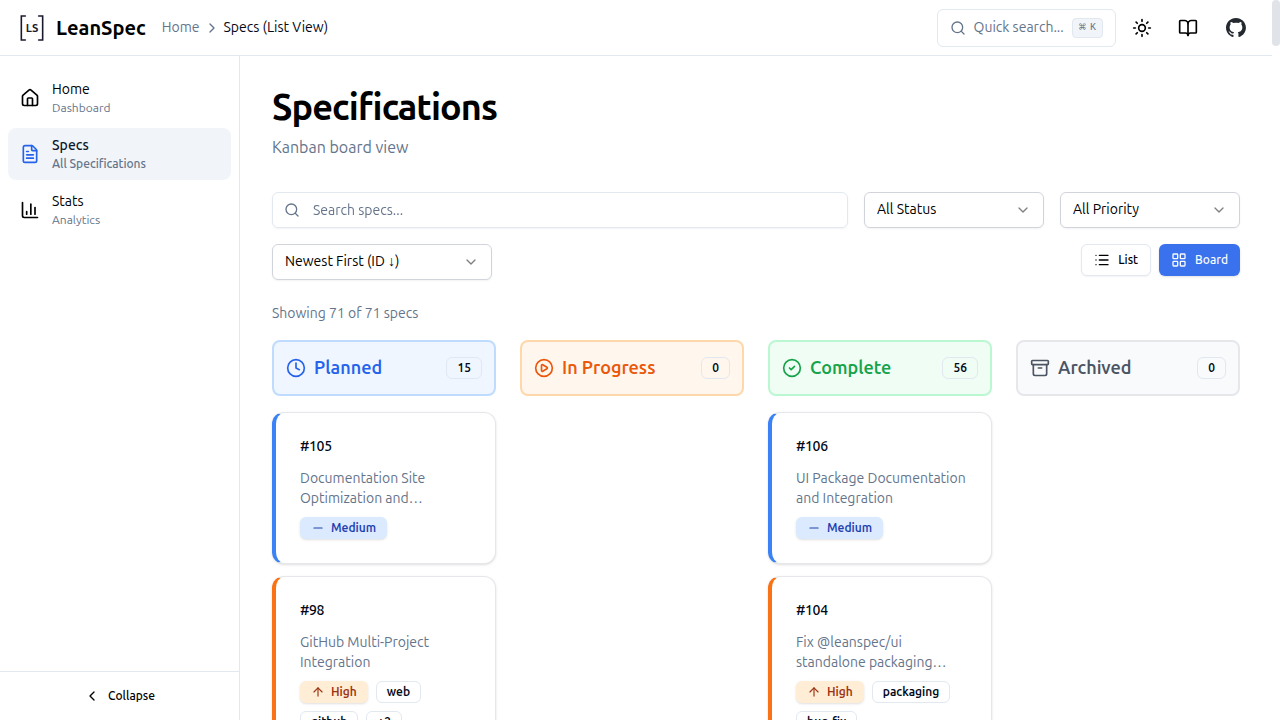
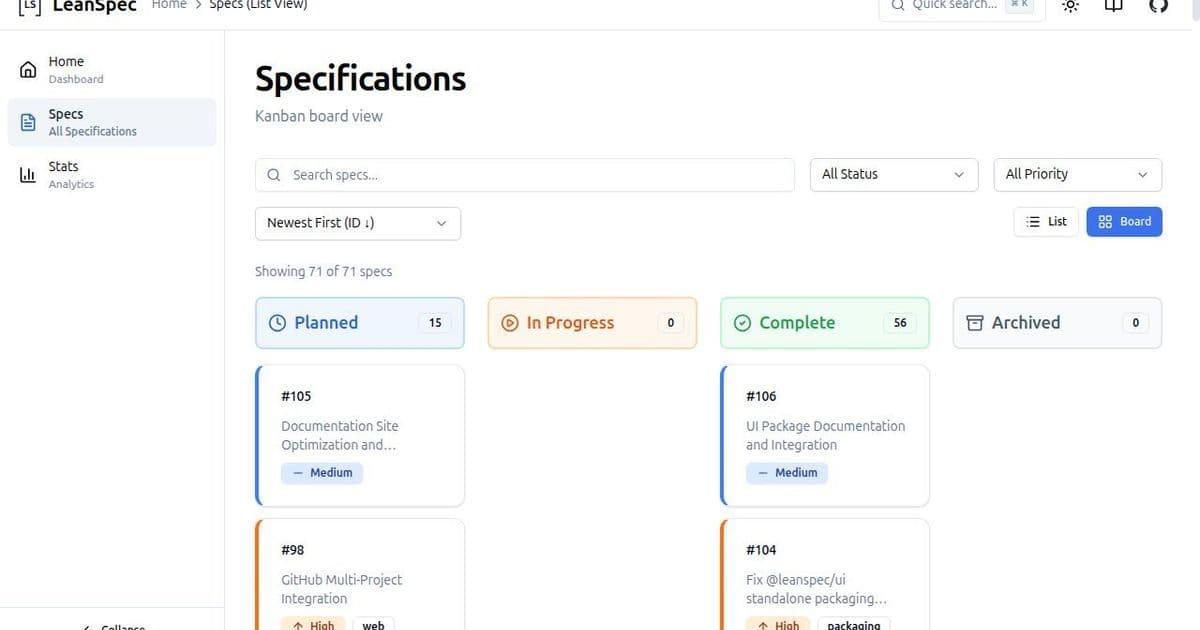
LeanSpec's Kanban board tracks specs from 'Planned' to 'Complete,' offering at-a-glance project oversight.
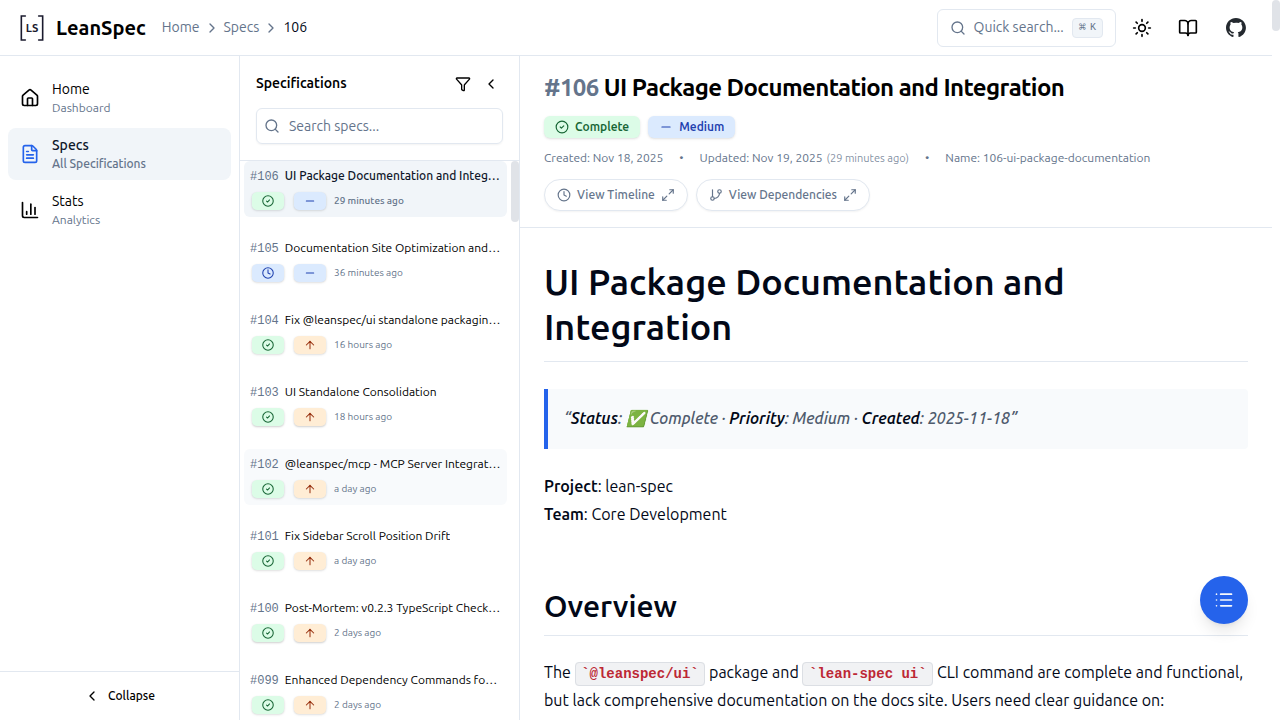
Spec details render Mermaid diagrams for intuitive visualization.
Standout Features for Real-World AI Workflows
LeanSpec packs punchy, integrated capabilities:
Web UI:
npx lean-spec uispins up a browser app with Kanban views, Mermaid rendering, and dependency maps—no IDE switch required.Validation in Action:
lean-spec validate
# specs/045-user-auth/README.md
#   ⚠️  warning  Spec exceeds 300 lines (342)  context-economy
#   ⚠️  warning  Missing overview section      structure
# ✖ 2 warnings in 1 spec
Smart Search:
lean-spec search "authentication flow"or filtered queries likelean-spec search "status:in-progress tag:api". Theboardcommand visualizes progress:lean-spec board # 📋 LeanSpec Board # ───────────────────────────────────── # 📅 Planned (12) 🚧 In Progress (3) ✅ Complete (47) # ─────────────────────────────────────AI-Native MCP Server: Configures for Claude Code, Cursor, or Copilot, letting agents query/update specs via Model Context Protocol.
Quickstarts include npx lean-spec init --example dark-theme for hands-on SDD patterns.
Bootstrapped by Its Own Medicine
LeanSpec developed itself via SDD: 120+ specs fueled 10 releases from October 23 to November 26, 2025. This self-application extends to projects like the 12k-star Crawlab crawler platform and personal sites, sustaining AI alignment over time.
| Aspect | Heavyweight SDD Tools | LeanSpec |
|---|---|---|
| Learning Curve | Days-Weeks | Minutes |
| Spec Overhead | Upfront-heavy | Progressive |
| Token Cost | >2k/spec | <300 lines |
| Flexibility | Rigid | Workflow-agnostic |
Reshaping AI-Augmented Development
LeanSpec arrives as SDD tools multiply, addressing a critical pivot: AI thrives with constraints. By enforcing lean specs, it curbs debt while enabling seamless human-AI collaboration—vital for scaling complex features. Upcoming VS Code extensions, AI chat UIs, and GitHub integrations hint at broader adoption, potentially standardizing lightweight SDD in dev workflows.
For teams battling AI-induced chaos, LeanSpec proves structure need not slow you down; it propels you further.
Source: Introducing LeanSpec by Marvin Zhang. Related: Spec-Driven Development intro, 2025 SDD Landscape.
Comments
Please log in or register to join the discussion