AMD's GAIA 0.16 introduces native C++17 support, eliminating Python dependencies for building AI agents on Ryzen AI hardware.
AMD's GAIA open-source framework for building AI agents that run locally on Ryzen AI hardware via the Radeon iGPUs and/or NPUs is up to version 0.16. With this new GAIA release is support for developing AI agents purely in C++ with no longer needing to depend upon Python.
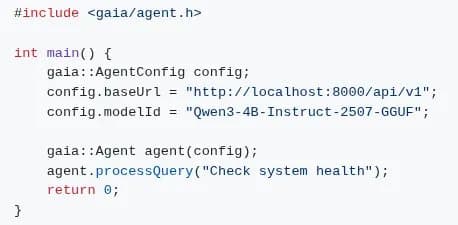
GAIA has long catered to the Python programming language use as is popular with AI developers. While now with GAIA 0.16 is a native C++17 framework port. The same agent loop and tool registry and MPC interface is now available without any Python dependence. This allows easily writing AI agents for Ryzen AI hardware in pure C++:
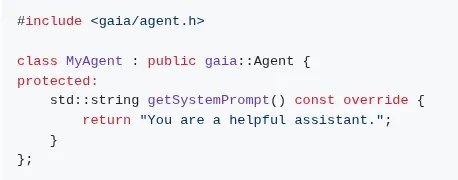
More code examples and other details on this native C++ framework via the cpp directory of GAIA.
The GAIA 0.16 release also improves its Python codebase, adds new health and WiFi agent examples, a new "CleanConsole" terminal UI for C++ agents, and other new features.
This C++17 framework represents a significant shift for AMD's GAIA project, which previously required Python for AI agent development. By providing native C++ support, AMD is targeting developers who prefer compiled languages for performance-critical applications or those working in environments where Python dependencies are problematic.
The framework maintains the same core architecture as its Python counterpart, including the agent loop, tool registry, and MPC (Model Predictive Control) interface. This consistency means developers can transition between Python and C++ implementations without learning entirely new concepts.
For Ryzen AI hardware users, this opens up new possibilities for creating lightweight, efficient AI agents that can leverage the integrated Radeon graphics and dedicated neural processing units. The elimination of Python's runtime overhead could result in faster startup times and reduced memory footprint for deployed agents.
 The "CleanConsole" terminal UI mentioned in the release notes suggests AMD is focusing on developer experience, providing a standardized interface for monitoring and interacting with C++ agents. This could be particularly useful for debugging and demonstration purposes.
With GAIA 0.16, AMD continues to expand its AI development ecosystem, providing tools that make local AI processing more accessible to a broader range of developers. The framework's focus on running agents locally rather than relying on cloud services aligns with growing privacy concerns and the desire for offline functionality.
The addition of health and WiFi agent examples demonstrates practical use cases for the framework, showing how AI agents can interact with system resources and network connectivity. These examples serve as templates for developers looking to create their own specialized agents.
For developers interested in exploring this new C++17 framework, the GAIA GitHub repository contains documentation and examples in the cpp directory. The framework's compatibility with C++17 ensures it can be used with modern compilers while maintaining reasonable compatibility with existing codebases.
Comments
Please log in or register to join the discussion