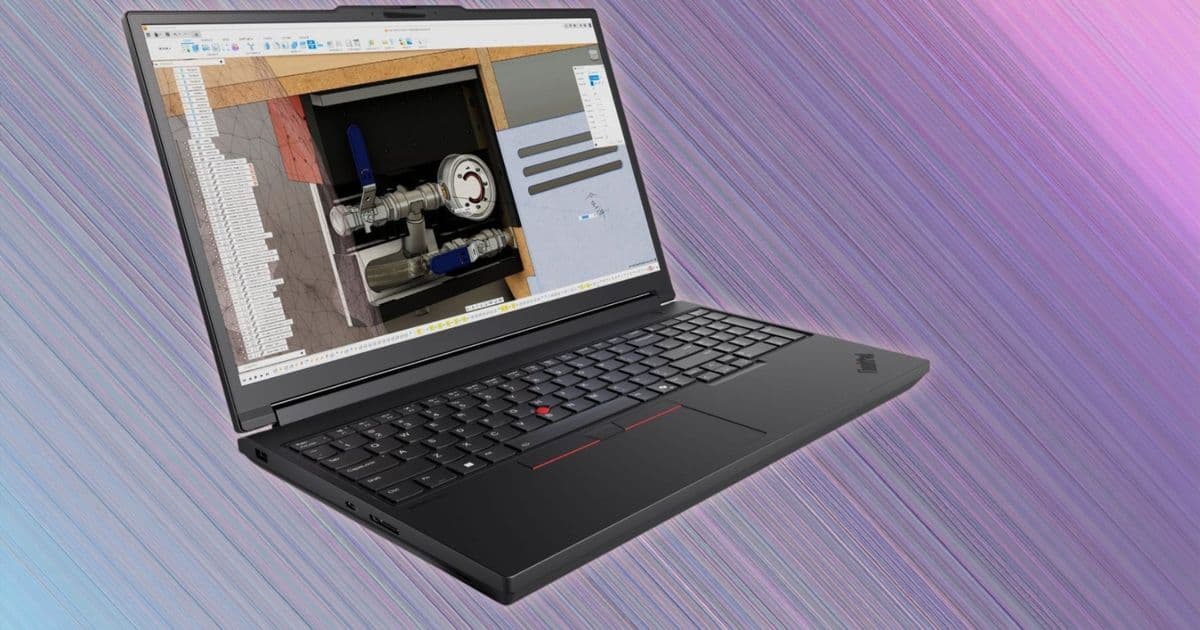
Lenovo's decision to remove the magnesium subframe from the ThinkPad P16 Gen 3 laptop marks a significant change in mobile workstation manufacturing, potentially affecting thermal management and chip protection in high-performance systems.
In a significant design shift with implications for laptop manufacturing and chip integration, Lenovo has abandoned the magnesium subframe, or "roll cage," in its latest ThinkPad P16 Gen 3 laptop. This change, first spotted by Notebookcheck, ends a 20-year tradition that began with the ThinkPad T60 in 2006 and represents a fundamental departure from the design philosophy that has defined Lenovo's premium mobile workstation line.
The magnesium roll cage has been more than just a structural element—it played a crucial role in thermal management and chip protection in high-performance systems. Unlike most premium laptops that use magnesium alloy primarily for external chassis construction, Lenovo implemented magnesium as an internal subframe that provided direct thermal pathways away from sensitive components. This approach added approximately 1-2 millimeters to each dimension (X, Y, and Z axes) but delivered unparalleled rigidity and thermal dissipation for processors like the Intel Core Ultra series and Nvidia RTX Pro Blackwell GPUs featured in the P16 Gen 3.
The P16 Gen 3 represents a significant investment in high-performance computing, with configurations featuring Intel's latest Core Ultra 5 245HX and Core Ultra 9 275HX processors paired with Nvidia's RTX Pro 1000 and RTX Pro 5000 Blackwell GPUs. These components generate substantial heat, particularly under sustained workloads, and the traditional magnesium roll cage served as both a structural element and an integral part of the thermal management system. For more details on Intel's Core Ultra architecture, you can refer to Intel's official documentation.
According to Lenovo's own design philosophy, as articulated by Al Makley, Executive Director of Workstation Development, the roll cage addressed critical stress points that users might experience. "People will hold their machines in one corner of the keyboard, or the palm rest area, and that becomes a stress area," Makley explained. "So, we have to understand how is that area flexing, what is it in contact with on the motherboard, are you going to stress components? So, we look at the amount of flex in that area."
The integration of magnesium extended beyond the base chassis to include the display assembly. With 16-inch displays being particularly susceptible to flex, the magnesium subframe at the back of the display prevented the kind of bending that could lead to image distortion or damage to the display controller board—a critical component that interfaces with the system's GPU.
The decision to remove this feature appears to be primarily driven by Lenovo's pursuit of a thinner profile, but it also comes amid ongoing supply chain challenges in the semiconductor industry. The memory chip shortage that has affected production across the computing sector may have influenced Lenovo's decision to simplify the manufacturing process. By integrating what remains of the magnesium reinforcement directly into the outer shell rather than as a separate subframe, Lenovo reduces both material usage and assembly complexity.
The ThinkPad P16 Gen 3 represents a premium product line with significant price points. The base model starts at approximately $3,000, featuring an Intel Core Ultra 5 245HX processor, Nvidia RTX Pro 1000 Blackwell GPU, 16GB of DDR5-4400 RAM, and a 512GB PCIe 4.0 SSD. The top configuration reaches $9,500, with an Intel Core Ultra 9 275HX, Nvidia RTX Pro 5000 Blackwell GPU, 128GB of DDR5-4000 RAM, and a 4TB PCIe 5.0 SSD. For more information on the specific configurations, you can visit Lenovo's official product page.
For professionals in fields like engineering, construction, and scientific research who rely on these workstations for computationally intensive tasks, the structural integrity and thermal management provided by the magnesium roll cage have been key differentiators. These users often run applications that push processors and GPUs to their thermal limits, and the traditional ThinkPad P series delivered consistent performance through its robust construction and efficient heat dissipation.
The removal of the magnesium subframe raises questions about Lenovo's approach to thermal management in high-performance systems. Without the dedicated roll cage, the company may have developed alternative cooling solutions, but the integration of magnesium into the outer shell may not provide the same direct thermal pathways away from sensitive components. This could potentially impact sustained performance under heavy workloads—a critical consideration for professionals who depend on consistent performance. For more insights into thermal management challenges in mobile workstations, Nvidia's enterprise solutions provide technical resources on GPU thermal design.
As the laptop market continues to evolve, manufacturers face constant tension between portability, performance, and thermal efficiency. Lenovo's decision to prioritize a thinner profile over the magnesium roll cage reflects broader industry trends, but it also highlights the challenges of maintaining product differentiation in an increasingly competitive market where chip performance continues to advance.
For professionals who require the utmost performance and reliability in their mobile workstations, this change may necessitate a reevaluation of their options. Lenovo still offers other ThinkPad models with traditional magnesium chassis construction, though the P series has been the flagship for mobile workstation performance and durability.
As semiconductor technology continues to advance with more powerful processors and GPUs in increasingly compact form factors, thermal management becomes an even more critical design consideration. Lenovo's removal of the magnesium roll cage from the ThinkPad P16 Gen 3 marks a significant turning point in the product's evolution, and only time will tell whether this change will impact its reputation for performance consistency in professional environments.
Comments
Please log in or register to join the discussion