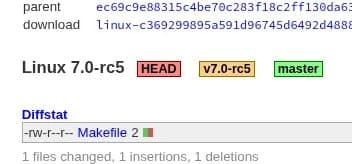
Linus Torvalds has released Linux 7.0-rc5, showing signs of stabilization as the kernel moves toward its April stable release with bug fixes and regression fixes across drivers and core subsystems.
Linux kernel development has reached another milestone with the release of Linux 7.0-rc5, marking steady progress toward the stable 7.0 release scheduled for April. Linus Torvalds announced the fifth release candidate today, noting encouraging signs that development is beginning to stabilize after the merge window.
Development Progress and Release Timeline
The latest release candidate shows a positive trend, with Torvalds observing that "rc5 is smaller than the previous rc's this merge window, although it still tracks a bit larger than rc5s historically do." This pattern suggests that while the development cycle has been slightly more active than usual, the kernel is following a normal trajectory toward stabilization.
Torvalds expressed optimism about the current state: "I'll still take it as a good sign overall." The development team is now in the critical phase where bug fixes and regression corrections take precedence over new feature development.
Key Changes in Linux 7.0-rc5
The fifth release candidate includes several notable fixes and improvements:
Graphics Driver Updates: A significant workaround has been implemented for Radeon and AMDGPU drivers to address issues with older GCN 1.0 era Hainan GPUs. This fix ensures continued support for legacy hardware that might otherwise be left behind in the new kernel version.
Input Device Support: Enhanced compatibility for the Logitech MX Master 4 Bluetooth mouse has been added, improving the out-of-the-box experience for users of this popular peripheral.
Driver Changes: The diffstat shows approximately half of the changes concentrated in drivers, with GPU and networking drivers seeing the most updates. Interestingly, there are also some serial driver updates, which Torvalds noted as unusual.
Core System Updates: Beyond drivers, the release includes core networking improvements, filesystem updates, BPF (Berkeley Packet Filter) enhancements, selftest additions, and architecture-specific fixes. Most commits are described as "small few-liners," indicating focused, targeted improvements rather than major overhauls.
Development Statistics and Quality Indicators
The current state of Linux 7.0 development shows a healthy balance between activity and stability. Torvalds described the overall changes as "fairly innocuous," which is exactly what developers want to see as they approach the final release.
The distribution of changes across different subsystems suggests comprehensive testing and refinement:
- Driver subsystem: 50% of changes (GPU, networking, serial)
- Core networking: Various protocol and stack improvements
- Filesystem layer: Updates and optimizations
- BPF subsystem: Enhancements to the extended Berkeley Packet Filter
- Selftests: New and updated test cases
- Architecture support: CPU-specific fixes and improvements
Testing and Community Involvement
With the stabilization phase underway, community testing becomes crucial. Torvalds explicitly called for continued testing efforts: "Please keep testing." This invitation to the broader Linux community underscores the importance of real-world validation before the final release.
Users and developers are encouraged to test Linux 7.0-rc5 in various environments, particularly focusing on:
- Hardware compatibility with their specific devices
- Performance characteristics under load
- Stability during extended uptime
- Any regressions from previous kernel versions
Looking Ahead to Linux 7.0 Stable
The April release of Linux 7.0 represents the next major stable kernel version, bringing with it all the features and improvements that have been developed throughout this cycle. For those interested in understanding the full scope of changes coming in this release, our comprehensive Linux 7.0 feature overview provides detailed analysis of all the major improvements and new capabilities.
As development continues through the remaining release candidates, the focus will remain on polishing existing features, fixing discovered bugs, and ensuring maximum compatibility across the vast hardware ecosystem that Linux supports. The trend toward smaller, more focused release candidates suggests that the development team is successfully transitioning from feature development to quality assurance and stabilization.
The Linux kernel development process continues to demonstrate its effectiveness, with each release candidate bringing the software closer to a stable, production-ready state while maintaining the high standards of quality and compatibility that the Linux community expects.
Comments
Please log in or register to join the discussion