Lume leverages Apple's Virtualization Framework to create lightweight macOS VMs for development automation, AI agent environments, and secure testing
Developers working with macOS automation face persistent challenges: maintaining multiple physical machines for version testing, securing risky operations, and creating reproducible environments for CI/CD pipelines. Lume addresses these needs through Apple Silicon-native virtualization.
Core Technology
Lume builds directly on Apple's Virtualization Framework, enabling near-native performance for macOS and Linux VMs. This foundation provides:
- Hardware-accelerated execution via ARMv8 extensions
- Paravirtualized graphics using Apple's Metal-based virtualization (limited to GPU Family 5)
- Sparse disk management where disk files consume only actual used space
- Rosetta 2 translation for running x86 Linux binaries on ARM
- Automated provisioning converting Apple's IPSW files to fully configured VMs
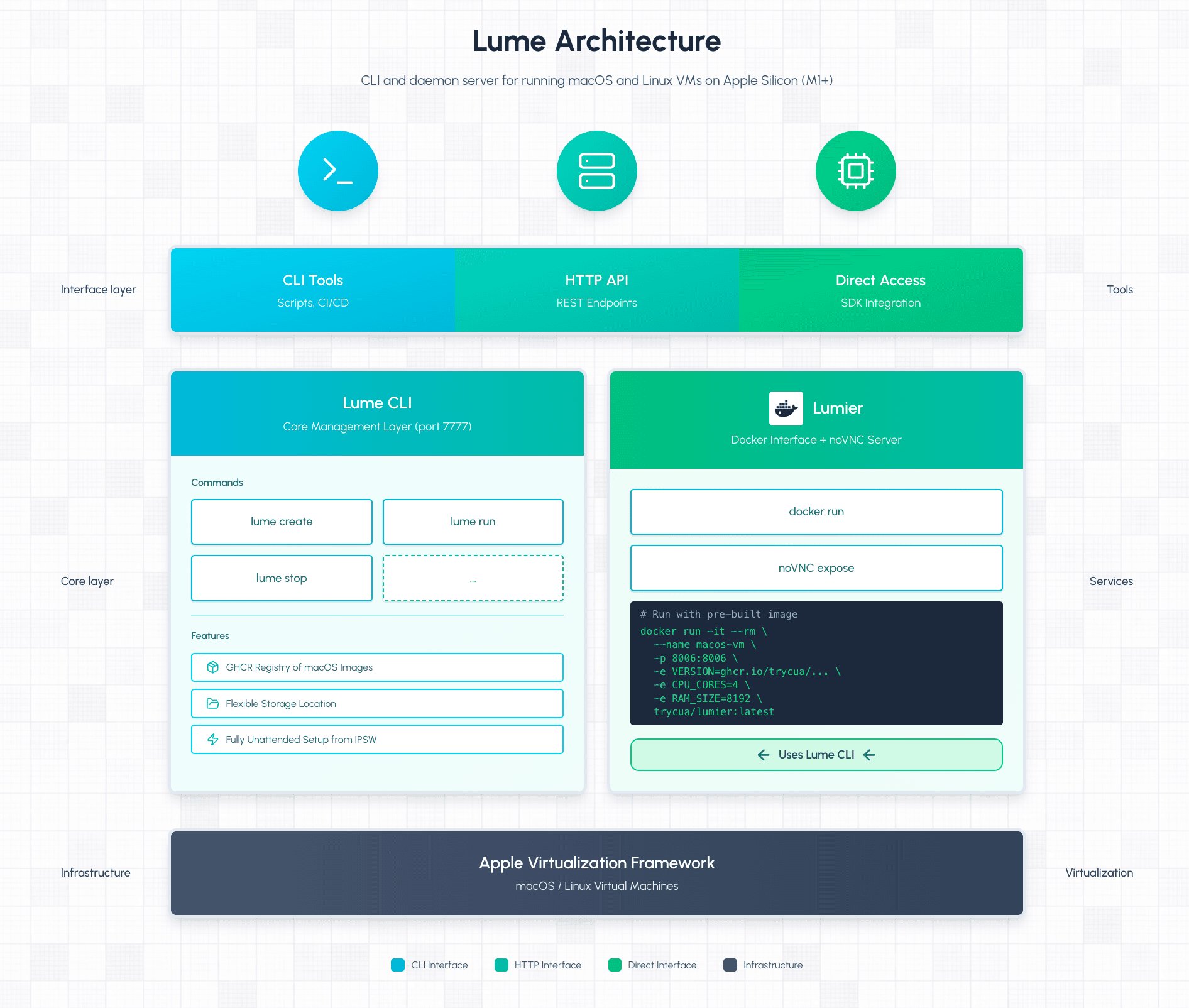 Lume's architecture layers a CLI and HTTP API atop Apple's virtualization stack
Practical Applications
Cross-Version Testing
Spin up ephemeral macOS VMs (Ventura, Sonoma, etc.) for compatibility validation without physical hardwareCI/CD Automation
Execute build pipelines in isolated environments usinglume run --no-displayfor headless operationAI Agent Environments
Powering tools like Anthropic's Claude Code with OCR-enabled automation through VNCSecurity Sandboxing
Test untrusted software or destructive scripts in disposable VMs cloned from golden images
Deployment Models
- Open-Source CLI (MIT Licensed)
Local installation via Homebrew:brew install cuahq/lume/lume - Cloud Sandboxes (Pilot Program)
Managed macOS instances for CI/CD workloads via Cua's cloud service
Registry integration allows pulling VM images from GHCR/GCS, while the HTTP API enables programmatic control. Unlike solutions requiring Intel compatibility layers, Lume exclusively targets Apple Silicon for optimal performance. Initial setup employs automated unattended installation scripting to bypass manual configuration.
Developers can explore the quickstart to create their first VM:lume create test-vm --os macos --ipsw latest
Comments
Please log in or register to join the discussion