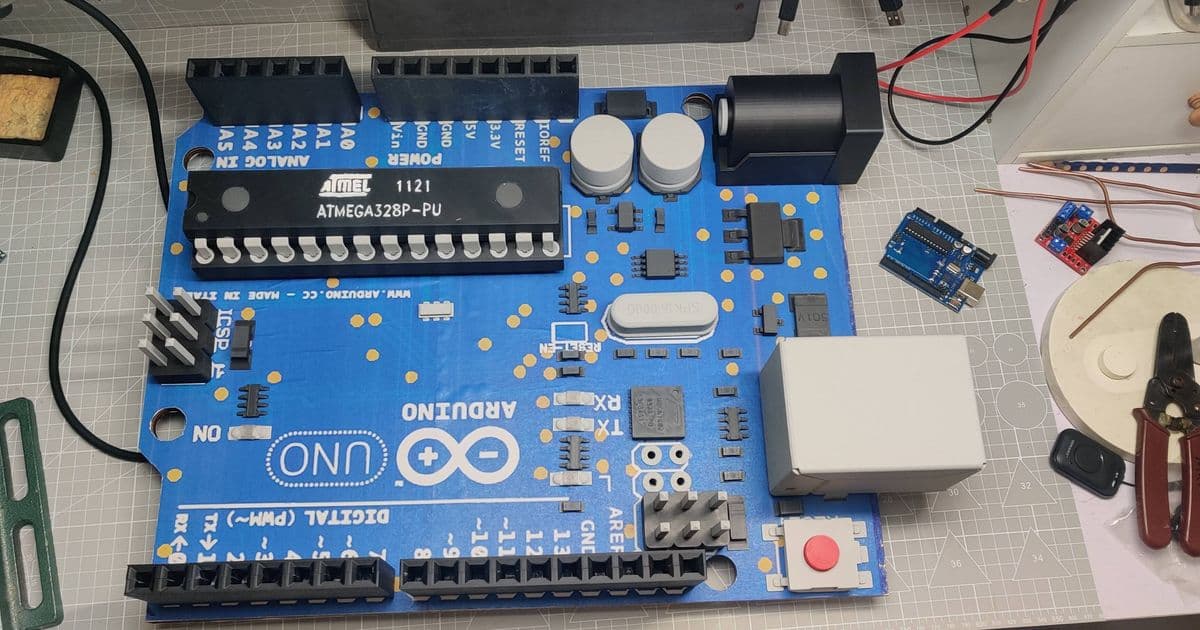
A YouTuber has created a fully functional Arduino Uno that's 7x larger than the original, using 3D printed parts and a hidden Arduino Nano to make electronics education more accessible.
A maker has built a supersized Arduino Uno that's seven times larger than the original board, creating what could be the ultimate teaching tool for electronics education or simply an impressive conversation piece for any maker's workshop.
From micro to macro: The engineering challenge
The project, created by YouTuber UncleStem, transforms the compact Arduino Uno into a massive learning aid that addresses a common classroom challenge: students struggling to see and understand the tiny components on standard microcontroller boards.
"If you've ever tried teaching Arduino to a class, you know the struggle. Everyone's hunched over these tiny boards, trying to see where the pins are," UncleStem explains in the video. "With this? No problem. Hold it up, point to the pins, and boom - everyone gets it."
Building the behemoth
The construction process involved several innovative approaches to maintain functionality while scaling up the design:
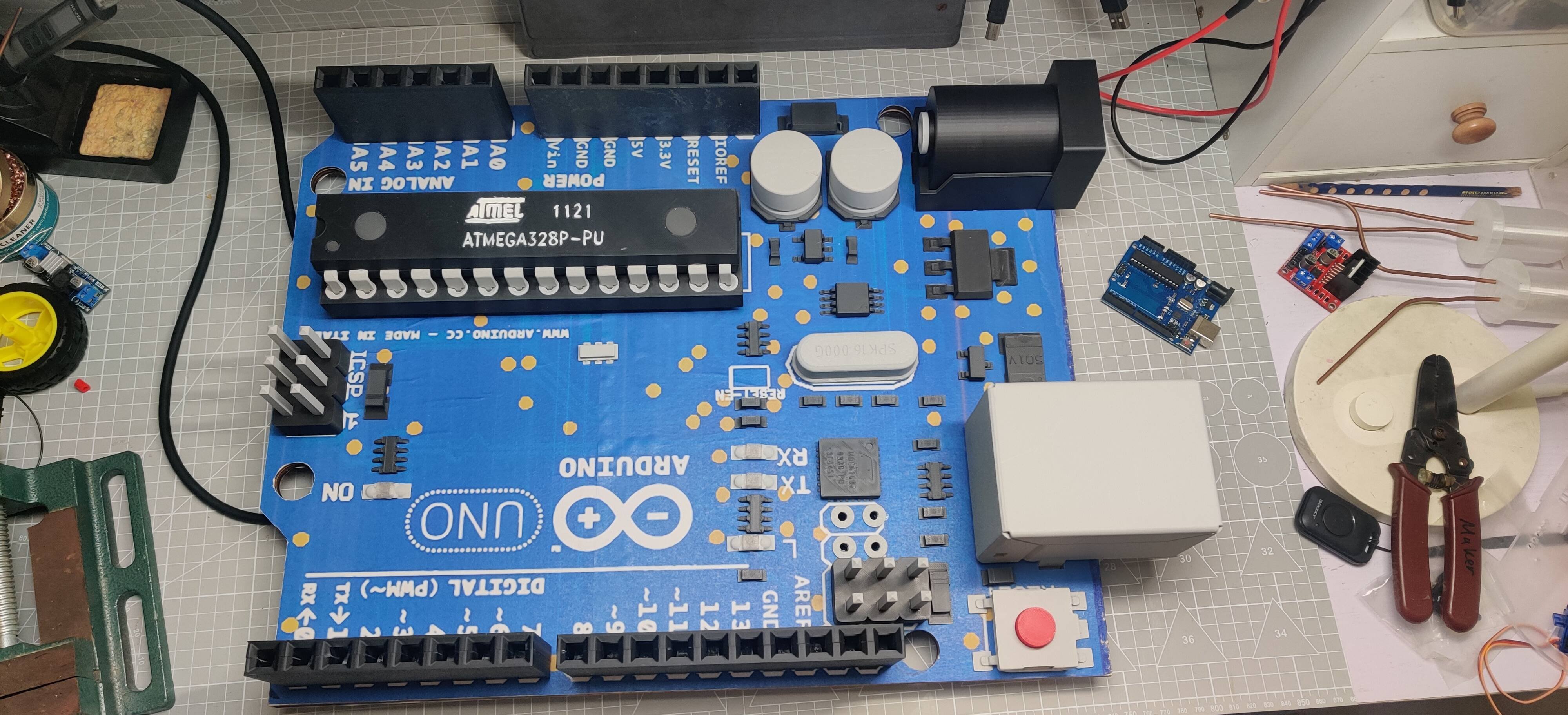
- 3D printed exterior components: All the visible parts like the ATmega chip, resistors, capacitors, and power adapter are 3D printed for appearance
- Multi-layer construction: Three layers of plywood mimic the PCB and hide the internal wiring
- Hidden computing power: An Arduino Nano is concealed inside the board layers, chosen for its slimmer profile compared to the Uno
- Functional interfaces: LEDs, reset button, and GPIO pins all work despite their enlarged scale
For the GPIO pins, UncleStem sourced large spring contacts, wired each of the 32 pins to the internal Arduino Nano, and verified functionality with a multimeter. The LEDs use 3D printed clear enclosures housing regular-scale LEDs, while the reset switch features a large external enclosure containing a smaller button.
Fully functional giant electronics
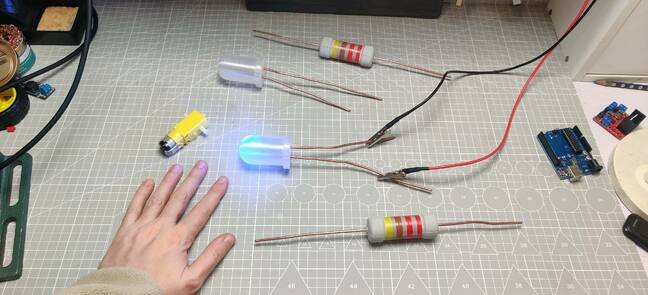
What makes this project particularly impressive is that it's not just a static display - it's a working Arduino board. UncleStem tested the completed board using custom-made giant LEDs and resistors that fit directly onto the oversized GPIO pins without requiring shims or adapters.
The testing process involved writing code on a laptop and uploading it to the Arduino Nano inside the giant board, with everything working "like a charm" according to the maker.
Educational applications and future plans
Beyond being an impressive technical achievement, UncleStem sees practical applications for the giant Arduino in educational settings. The enlarged scale makes it easier for instructors to demonstrate concepts to entire classrooms without students having to crowd around tiny boards.
The project took approximately one month of evening work to complete, though UncleStem hasn't stopped there. He's already planning additional giant components to complement the board:
"Maybe building giant sensors, motors, buttons, LCD displays - who knows? The possibilities are pretty endless," he notes in the video.
Compatibility considerations
While the giant Arduino can technically work with standard-sized components, UncleStem points out that it doesn't make practical sense due to the scale mismatch. He's developing appropriately sized components like the giant LED and resistor shown in the project.
For makers interested in building their own giant Arduino, UncleStem has published all his 3D printed component plans on Google Drive. The remaining components and technical knowledge required to assemble and program the board are left to the individual builder.
The project represents an innovative approach to electronics education, proving that sometimes thinking big can make complex concepts more accessible. Whether used as a teaching aid or simply as an impressive display piece, this giant Arduino Uno demonstrates how creative engineering can transform familiar technology into something extraordinary.
For those interested in the technical details or wanting to build their own, the 3D printed component files are available through UncleStem's Google Drive repository, though the project requires significant time, materials, and electronics knowledge to complete successfully.
Comments
Please log in or register to join the discussion