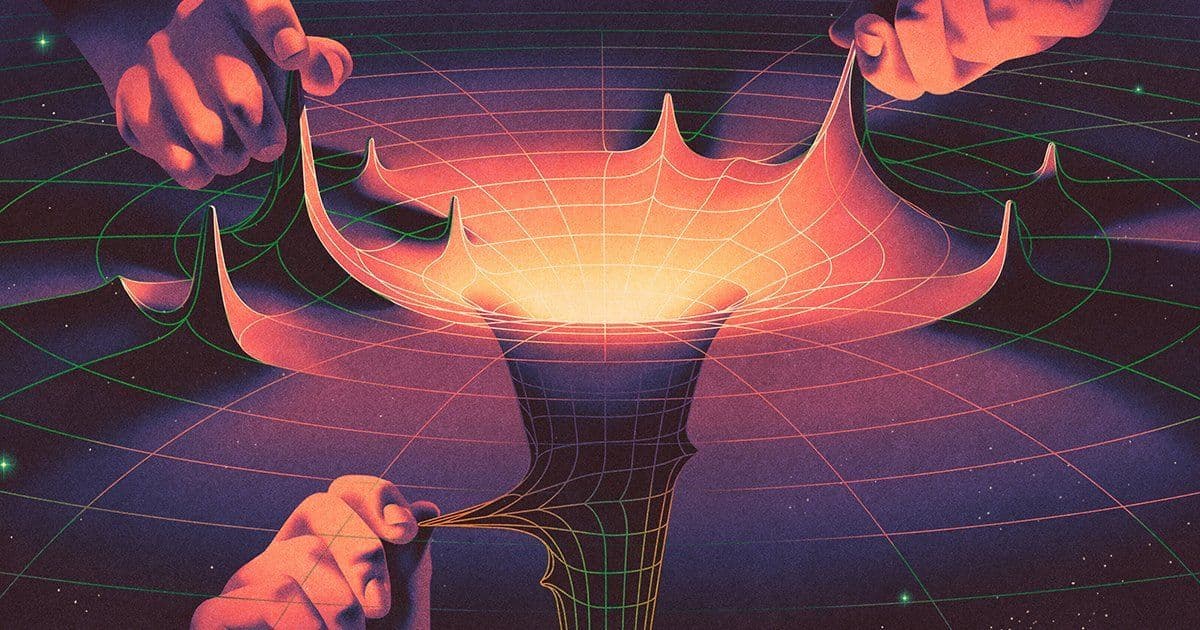
Vienna researchers develop calculus-free methods to handle singularities and non-smooth space-times, strengthening foundational theorems about black holes and the Big Bang while paving the way for quantum gravity.
Breaking Einstein's Smoothness Barrier
Einstein's general relativity has dominated gravitational physics since 1915, describing cosmic phenomena from black holes to the expanding universe through 10 elegant differential equations. Yet these equations hit a wall when space-time becomes non-smooth—at black hole singularities where curvature becomes infinite, or in hypothetical pixelated space-times where continuity breaks down at quantum scales. Differentiation, the calculus engine powering relativity, fails catastrophically in these regimes.
"Standard general relativity talks about geometric objects only if they behave nicely enough. With this new framework, we can handle very edgy objects, very badly behaved objects," says Roland Steinbauer, leader of the University of Vienna's 7-million-euro research initiative.
The Triangle Strategy: Curvature Without Calculus
Mathematicians Clemens Sämann and Michael Kunzinger pioneered a radical approach using triangle comparisons—a technique previously limited to smooth Riemannian geometry. Their innovation? Redefining distance via time separation:
Distance = Maximum time elapsed along causal paths (under light-speed constraint)
This inversion flips intuition: "Here, detours are shorter," Kunzinger notes. By comparing triangles in target space-times against reference models:
- Construct geodesic triangles using maximal time-separation paths
- Contrast angles/midpoint distances with flat or highly curved reference spaces
- Derive sectional curvature bounds from geometric discrepancies
- Key breakthrough: Works for space-times with "corners, edges and folds" where differentiation fails
- Validated by proving infinite sectional curvature inside black holes
Singularity Theorems Reborn
The team attacked physics' most consequential predictions:
Hawking's Big Bang Theorem (Non-Smooth Edition)
In 2019, Sämann, Kunzinger, Stephanie Alexander, and Melanie Graf proved that traced-back light rays must terminate finitely—indicating a primordial singularity—even in non-smooth space-times. Their sectional curvature approach provided the first extension beyond Hawking's original smoothness assumption.
Ricci Curvature Revolution
Sectional curvature's detail proved restrictive. Enter optimal transport—an 18th-century resource-allocation technique revitalized by Robert McCann and adapted by Andrea Mondino/Stefan Suhr:
Measure volume changes along particle flows to infer Ricci curvature
Mondino and Fabio Cavalletti leveraged this in 2020 to prove Hawking's theorem under broader conditions. This June, Cavalletti, Mondino, and Davide Manini conquered Penrose's black hole singularity theorem—confirming inevitable singularities without smoothness.
"Major results in general relativity extend to weaker settings where smoothness isn't necessary. The ideas involved are quite remarkable," observes University of Alberta mathematician Eric Woolgar.
Toward Quantum Gravity
The Vienna group's "new calculus" project aims to:
- Develop generalized derivative concepts for jagged geometries
- Formalize curvature in discrete/pixelated space-times
- Provide mathematical foundations for quantum gravity theories
"Our framework can still speak about curvature in discrete situations," Steinbauer emphasizes, hinting at applications to loop quantum gravity and causal set theory. With recent funding and collaborators expanding, Sämann confirms: "This project is really just starting."
Source: Quanta Magazine (July 16, 2025)
Comments
Please log in or register to join the discussion