
Soaring memory prices have transformed spare RAM modules into valuable commodities, with technologists discovering their home lab components and unused DIMMs now command premium resale values.

The relentless climb in memory prices has triggered an unexpected phenomenon across tech communities: spare RAM modules gathering dust in home labs and bottom drawers are suddenly being viewed as potential gold mines. With secondary market prices reportedly surging 700% or more over the past year, technologists are realizing their unused hardware might hold serious financial value.
Broadcom staffer Tyson Then captured the sentiment perfectly, declaring: "Forget Crypto or Gold. In 2026 VMware Cloud Foundation Home Labbers making bank. Awwww yeahhh." His enthusiasm stems from tangible evidence – enterprise-grade DDR4 modules that cost $50-75 per 16GB stick in 2024 now regularly sell for $400-500 on secondary markets.
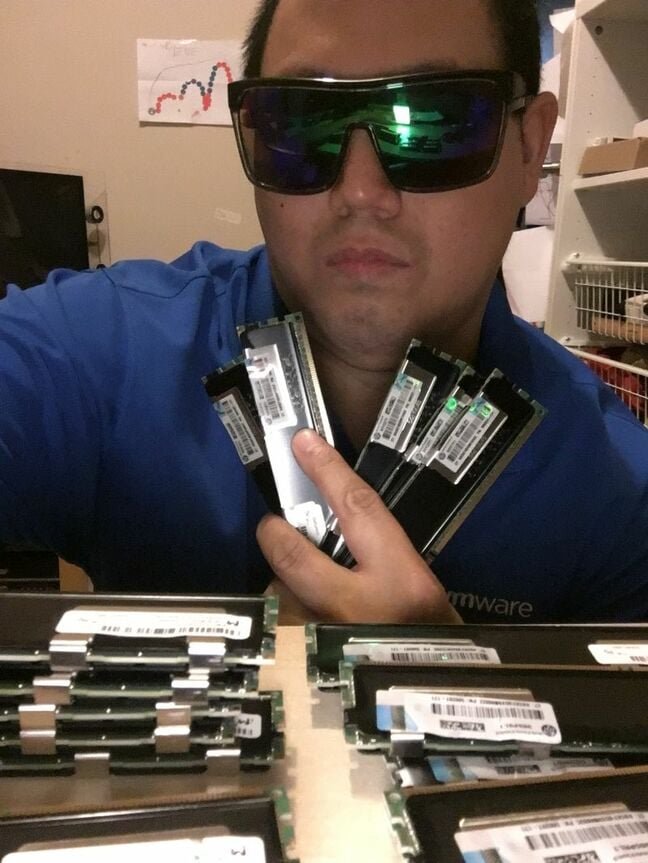
Tyson Then showcases memory modules whose value has surged dramatically. Photo: Supplied
The economics become compelling when considering modern home lab requirements. As VMware specialist William Lam notes, even a minimal single-host VMware Cloud Foundation configuration requires 194GB of RAM. Multi-host setups common among developers and IT professionals can easily consume 0.5-1TB of memory. Suddenly, what was once a technical necessity looks like a shrewd investment.
Reddit communities showcase this trend in action. User gpot97 recently accepted payment for contract work in hardware rather than cash, receiving 34 sticks of 16GB DDR4 and enterprise SSDs. "It ain't fast but with prices the way they are right now I'm not complaining," he posted, adding "Can't say I've ever been paid in gold bars before." Another user pondered whether their cache of ~100 DIMMs could pay off a mortgage.
Several factors drive this surge:
- AI Infrastructure Demand: Massive GPU clusters require supporting memory infrastructure
- Supply Constraints: Major manufacturers shifted capacity toward high-margin HBM production
- Legacy System Maintenance: Enterprises extending hardware lifecycles amid economic pressures
- Home Lab Growth: VMware's Broadcom acquisition created renewed interest in lab environments
Counterintuitively, some argue this represents market inefficiency rather than pure scarcity. "While DDR4 supply is tight, the secondary market spike feels disproportionate," notes hardware analyst Lisa Chen. "We're seeing opportunistic resellers capitalize on panic buying from labs needing compatibility matches for existing systems."
Others warn of volatility. Memory markets historically experience boom-bust cycles, and today's $500 DIMM could become tomorrow's $100 component. There are also reliability concerns with aging modules and warranty limitations on used hardware.
Yet the trend underscores computing's evolving economics. As Then observed: "Self Development ALWAYS pays off. Often in unpredictable ways." For technologists who invested in hands-on learning through home labs, those terabytes of RAM now yield dividends beyond technical expertise – transforming VMware Cloud Foundation testbeds into unlikely asset portfolios.
Comments
Please log in or register to join the discussion