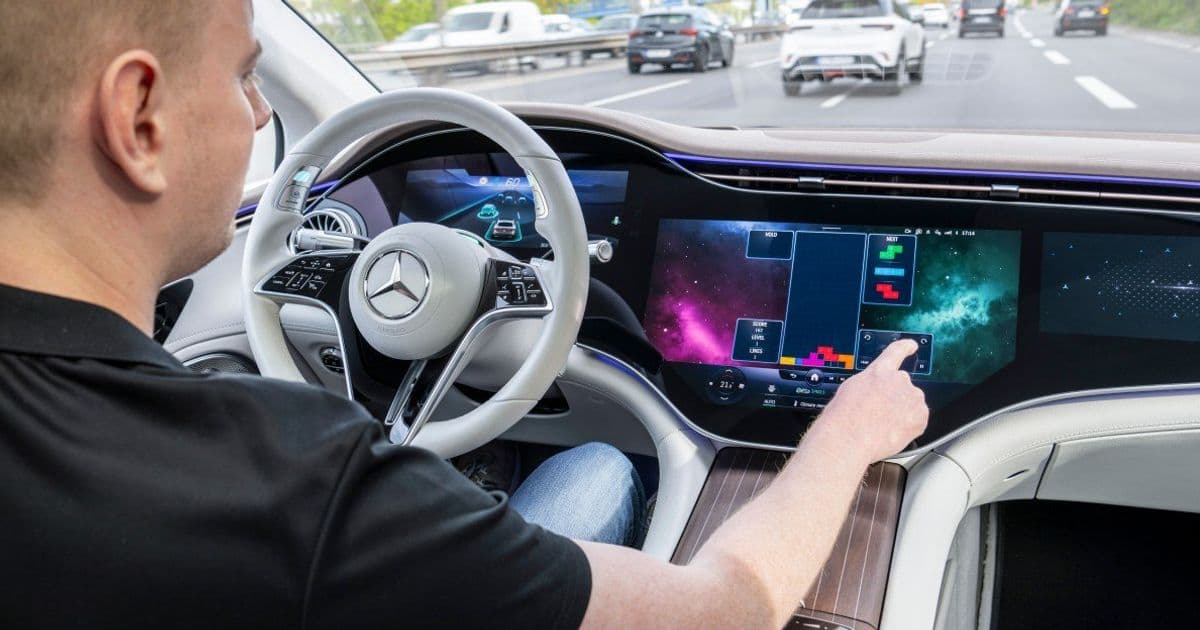
Mercedes-Benz has paused the rollout of its Drive Pilot system, a Level 3 autonomous feature that allows drivers to take their eyes off the road, citing weak consumer demand and prohibitive production costs. The decision highlights the widening gap between technological capability and commercial viability in the autonomous vehicle sector.
Mercedes-Benz has halted the expansion of its Drive Pilot system, a Level 3 autonomous driving feature that represents one of the most ambitious attempts to offer true "eyes-off" driving capability to consumers. The automaker cited two primary factors for the pause: surprisingly low customer demand and production costs that made the system economically unsustainable.
Drive Pilot, which received regulatory approval for use in specific conditions across parts of Europe and the United States, represented a significant milestone in autonomous vehicle development. Unlike Level 2 systems that require constant driver attention, Level 3 autonomy permits drivers to disengage completely from the driving task under certain circumstances, such as on highways with mapped environments and within specific speed limits.
The technology relies on an extensive sensor array including lidar, radar, cameras, and ultrasonic sensors, combined with high-precision GPS and detailed 3D mapping data. This sensor fusion creates a redundant safety system capable of handling complex driving scenarios without human intervention. Mercedes had positioned this as a premium feature for its S-Class and EQS vehicles, commanding prices in the six-figure range.
However, the market response has been underwhelming. Consumer surveys consistently show that while drivers express interest in autonomous features, they remain hesitant about the technology's reliability and safety. This skepticism appears to have translated into actual purchasing behavior, with far fewer buyers opting for the Drive Pilot option than Mercedes anticipated.
The production cost issue compounds the demand problem. The sensor suite and computing hardware required for Level 3 autonomy add substantial expense to each vehicle. For Mercedes, this creates a difficult value proposition: the technology costs a fortune to implement, but customers aren't willing to pay enough to make it profitable.
Mercedes is not abandoning autonomous driving entirely. Instead, the company is shifting focus toward Level 2 systems that provide advanced driver assistance while keeping the driver in the loop. These systems, similar to Tesla's Full Self-Driving capability, offer navigation assistance and automated driving features but legally require the driver to remain attentive and ready to take control at any moment.
This pivot reflects a broader pattern in the automotive industry. Several manufacturers have scaled back their autonomous driving ambitions in recent years. Ford and GM's Cruise division have faced setbacks, while other companies have quietly reduced investment in fully autonomous systems. The consensus emerging across the industry suggests that the path to true autonomy is longer and more complex than initially projected.
The regulatory landscape also remains uncertain. While Mercedes secured approval for Drive Pilot in certain jurisdictions, the framework for liability, insurance, and operational parameters for Level 3 systems is still evolving. This uncertainty creates additional risk for automakers investing heavily in the technology.
From a technical perspective, the pause raises questions about the readiness of infrastructure to support advanced autonomous systems. Drive Pilot requires detailed, constantly updated maps of operating areas, along with reliable connectivity and standardized road conditions. The patchwork nature of these requirements across different regions creates operational limitations that reduce the feature's practical utility.
The decision also reflects changing priorities within Mercedes. The automaker faces pressure to invest in electric vehicle development, battery technology, and software-defined vehicle platforms—areas that may offer more immediate returns than pursuing full autonomy. Resource allocation in the automotive sector is always a balancing act, and autonomous driving appears to be losing out to other strategic initiatives.
Consumer behavior patterns suggest that the appeal of autonomous features may be more theoretical than practical. Many drivers who express enthusiasm for self-driving technology in surveys have never experienced it in real-world conditions. Once faced with the actual prospect of relinquishing control, psychological barriers emerge that suppress demand.
The automotive industry's experience with autonomous driving mirrors patterns seen in other technology sectors. Early enthusiasm for revolutionary capabilities often gives way to pragmatic assessments of cost, utility, and user acceptance. The gap between what is technically possible and what makes economic sense can be substantial.
Mercedes' decision to pause rather than cancel Drive Pilot suggests the company believes the technology may become viable in the future, perhaps as costs decrease or consumer confidence increases. However, the current market conditions indicate that the era of widespread Level 3 autonomous driving in consumer vehicles remains distant.
For now, the industry appears to be converging on a more incremental approach: refining Level 2 systems that enhance rather than replace human drivers. This strategy offers immediate benefits while avoiding the regulatory, technical, and commercial risks associated with full autonomy. The dream of reading a book or checking emails during a commute will have to wait.
The broader implications extend beyond Mercedes. If a premium automaker with substantial resources and engineering expertise struggles to make Level 3 autonomy commercially viable, it casts doubt on the near-term prospects for the entire sector. This could affect investment in autonomous technology, both from automakers and venture capital, potentially slowing innovation in what remains a fundamentally important area of transportation technology.
The pause also highlights the importance of realistic expectations in technology development. Autonomous driving has been "just around the corner" for years, but practical implementation continues to face significant hurdles. Each setback provides valuable data about what works, what doesn't, and what consumers actually want—information that will ultimately guide the technology toward more sustainable implementation.
Mercedes' experience may ultimately prove to be a necessary detour rather than a dead end. The company has gained valuable insights into autonomous systems, sensor integration, and regulatory navigation. These capabilities will likely prove useful as the technology matures and market conditions evolve. For now, though, the road to fully autonomous vehicles appears longer than many had hoped.
Comments
Please log in or register to join the discussion