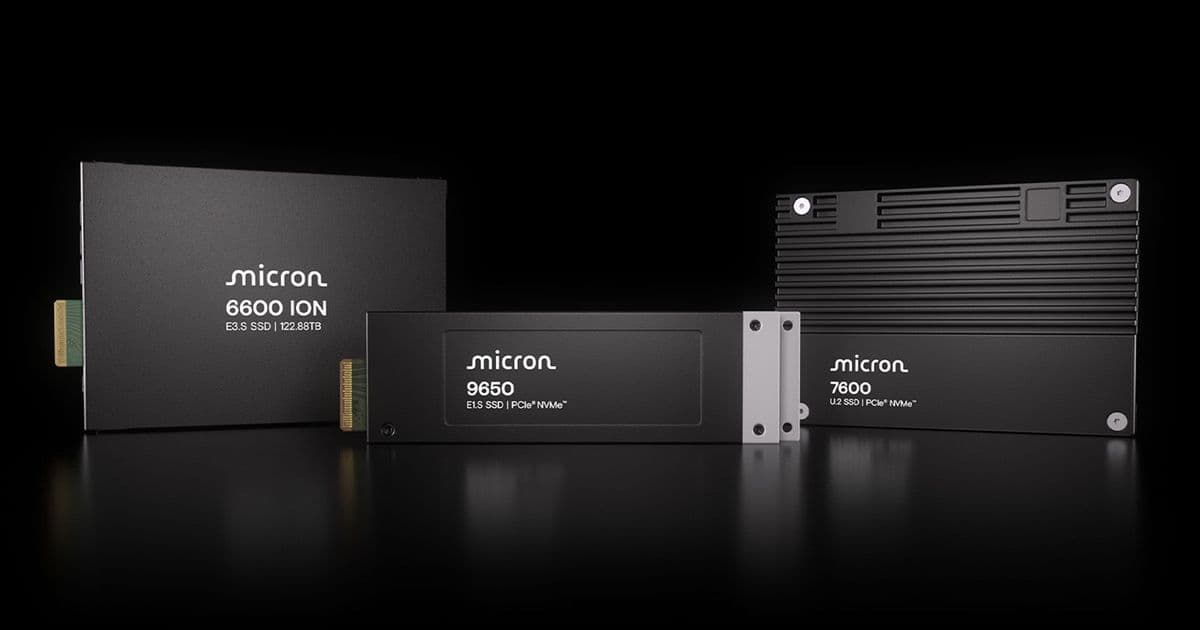
Micron has begun mass production of the 9650 Series PCIe 6.0 SSDs, achieving 28GB/s read speeds and 5.5 million IOPS while introducing liquid cooling support for enterprise AI workloads.
Micron has officially entered mass production of the world's first PCIe 6.0 solid-state drive, marking a significant milestone in storage technology advancement. The Micron 9650 Series represents the cutting edge of enterprise storage, delivering unprecedented performance levels that double the capabilities of current PCIe 5.0 solutions while maintaining comparable power consumption.
Unprecedented Performance Metrics
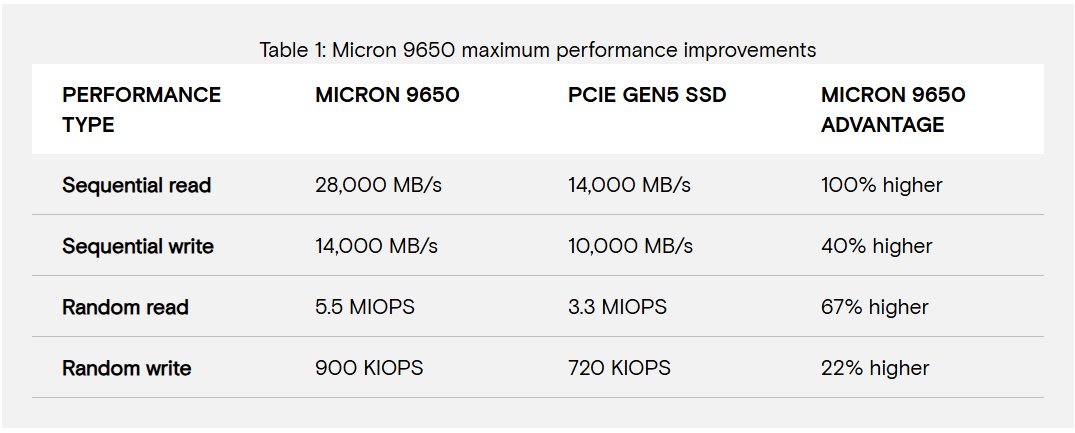
The 9650 Series achieves sequential read speeds of up to 28 GB/s and sequential write speeds of 14 GB/s, representing a substantial leap forward from existing PCIe 5.0 drives that typically max out around 10-13 GB/s. The drives also deliver exceptional random performance with up to 5.5 million IOPS for random reads and 500,000 IOPS for random writes.
Micron's internal testing indicates the 9650 is 40% faster in write speeds, 67% faster in random read speeds, and 22% faster in random write speeds compared to PCIe Gen 5 SSDs. However, the company did not specify which exact PCIe 5.0 model served as the comparison baseline.
Dual Cooling Architecture
Perhaps the most notable innovation is the 9650's support for both air and liquid cooling systems. This marks Micron's first SSD to offer liquid cooling capabilities, specifically available on the E1.S form factor version. While the drive's power consumption remains at 25 watts—identical to the most power-hungry enterprise PCIe 5.0 SSDs—the introduction of liquid cooling addresses thermal management challenges in dense server environments.
Liquid cooling support may seem excessive for a 25-watt device, but the thermal dynamics become significantly more complex when multiple drives operate in close proximity within server racks. Solidigm pioneered liquid-cooled enterprise SSDs, and Micron's adoption of this technology signals its growing importance in high-density data center deployments.
Product Variants and Capacities
The 9650 Series comes in two distinct variants: Pro and Max. The Pro models offer higher capacities with 7.68TB, 15.36TB, and 30.72TB options, while the Max variants provide 6.4TB, 12.8TB, and 25.6TB capacities respectively.
Performance differs notably between variants under mixed workload conditions. In a 70/30 random read/write split, the Pro drive delivers up to 1,100 KIOPS, while the Max version achieves 400 KIOPS more at 1,500 KIOPS. Endurance ratings also favor the Max models, with the 25.6TB Max version rated for 140,160 TBW compared to the 30.72TB Pro's 56,064 TBW.
AI and Data Center Focus
The 9650 Series is specifically optimized for AI and data center deployments, available in E1.S and E3.S form factors designed for enterprise environments. The drives target the growing demand for high-speed storage in AI server infrastructure, where large language models and other AI workloads require rapid data movement across massive datasets.
AI servers, much like GPU clusters, will leverage as much high-speed storage as modern PCIe standards permit. The 9650's capabilities position it perfectly for these demanding applications, where storage performance directly impacts AI training and inference speeds.
Market Implications and Timeline
Pricing details remain undisclosed, which is typical for enterprise-focused storage solutions. The drives will be sold directly to data center operators and OEMs rather than through traditional retail channels.
Importantly, Micron's announcement does not signal an imminent arrival of consumer PCIe 6.0 SSDs. Several factors delay consumer adoption: the AI industry's voracious consumption of NAND flash capacity, and the fact that consumer platforms won't support PCIe 6.0 until approximately 2030. This makes a consumer variant currently impractical and unnecessary.
Technical Architecture
The drives utilize the PCIe 6.0 x4 interface, which provides the necessary bandwidth for the 28 GB/s performance levels. The E1.S and E3.S form factors represent the latest standards for enterprise SSDs, offering improved thermal management and density compared to previous generations.
The decision to maintain 25-watt power consumption despite doubling performance demonstrates Micron's efficiency improvements in controller design and NAND flash technology. This power profile allows the drives to fit within existing power budgets in data center environments while delivering transformative performance gains.
Industry Context
Micron's move to PCIe 6.0 represents the next evolution in storage technology, following the current PCIe 5.0 generation that has only recently achieved widespread adoption. The rapid progression from PCIe 4.0 to 5.0 to 6.0 reflects the accelerating demands of AI workloads and big data analytics.
The introduction of liquid cooling at the 25-watt level also suggests that thermal management will become increasingly important as storage performance continues to scale. What begins as a niche feature for high-end enterprise drives often trickles down to consumer products over time.
Future Outlook
As AI infrastructure continues expanding, the demand for high-performance storage solutions like the 9650 Series will likely grow exponentially. The combination of PCIe 6.0 speeds, liquid cooling support, and enterprise-grade reliability positions Micron at the forefront of this critical market segment.
While consumers won't see PCIe 6.0 in personal computers for several years, the technology developed for these enterprise drives will eventually filter down to consumer products, bringing unprecedented storage performance to mainstream users in the future.

Comments
Please log in or register to join the discussion