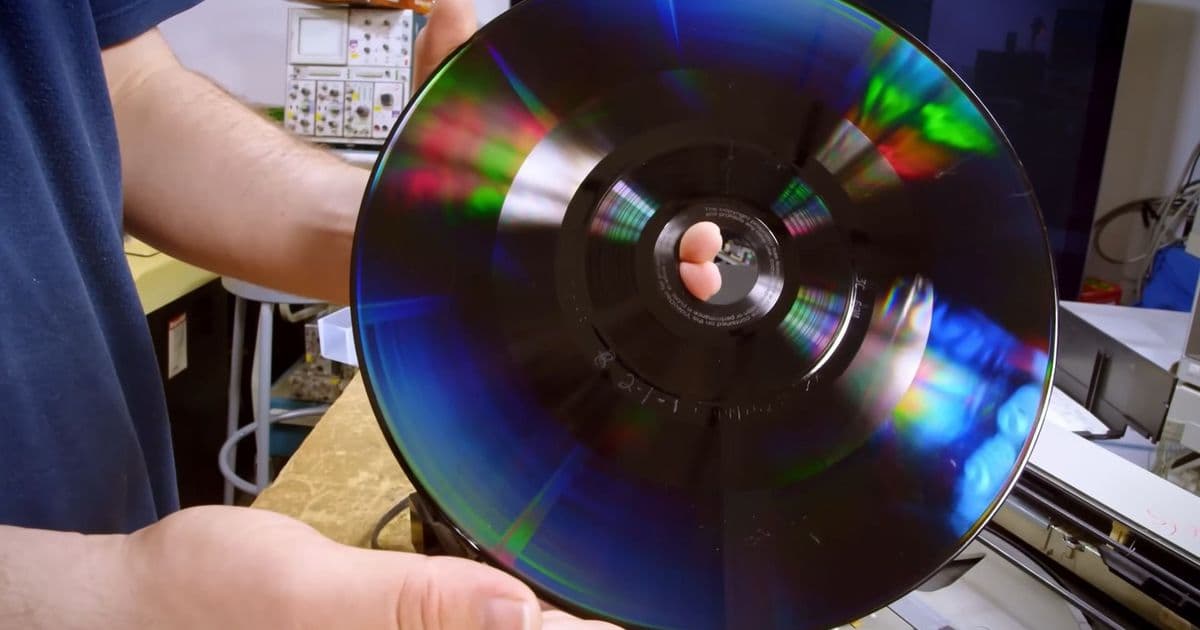
Tech Tangents used a high-powered microscope to examine CED discs and found that the analog video content stored on these vinyl-like discs is visible on the surface, revealing actual imagery including text from the stored video.
Tech Tangents (TT), a popular tech YouTuber, made an unexpected discovery while examining the surface of a CED (Capacitance Electronic Disc) under a microscope - the analog video content stored on these 12-inch vinyl-like discs is actually visible on the disc's surface. This unusual video distribution format, which existed alongside VHS and Betamax during the videotape era, stores standard-definition analog video in a grooved surface that can be read by a needle-loaded cartridge.
What Makes CED Discs Unique
CEDs look remarkably similar to LaserDiscs but function quite differently. While LaserDiscs use a laser pickup to read the surface, CEDs employ a physical needle like traditional vinyl records. The discs came in protective caddies and stored video content in analog form, much like their tape format rivals. This physical storage method is what makes the video content visible under magnification.
The Microscope Setup
To properly examine these discs, TT invested in a new microscope with a built-in screen and HDMI output capabilities. The device used was the Andonstar AD246S model, currently available for $139 on Amazon with a 13% discount. This desktop digital microscope allowed for detailed examination of the disc surfaces with various lighting angles and zoom levels.
What the Microscope Revealed
After introducing the microscope's capabilities, TT began examining actual CED samples around the 14-minute mark in the video. The examination revealed distinct patterns depending on the disc format - CAV (Constant Angular Velocity) discs showed consistent geometric patterns, while CLV (Constant Linear Velocity) discs appeared as colorful streaks under magnification.
The Breakthrough Discovery
The most surprising moment came around 22 minutes and 30 seconds into the video when TT exclaimed, "I found an image!" This discovery was particularly notable because the nature of CED recording allows for meaningful images to appear on the surface when video content slowly pans across the x or y axis. The first evidence showed video text that was clearly discernible.
The main event occurred around the 25-minute mark when a CED disc was placed under the microscope. After careful focusing and light adjustment, TT excitedly announced, "Oh my gosh. We just nailed it. Bang. Right there." The text visible on the CED surface was remarkably clear - almost as clear as a stored video frame on old film.
Technical Explanation
The visibility of video content on CED surfaces occurs because the analog video is physically encoded in the disc's grooves. Unlike digital formats where data appears as random patterns, the analog encoding creates recognizable visual patterns that correspond to the stored video frames. This is particularly evident when the video contains static elements like text or when there's slow camera movement that creates consistent patterns across multiple frames.
Other Microscope Examinations
Following the CED discovery, TT examined several other tech-related artifacts under the microscope, including:
- A mixed-mode audio/data CD surface
- A smartphone screen close-up where OLED subpixels were clearly visible
These additional examinations demonstrated the microscope's versatility and provided interesting comparisons to the CED disc findings.
Historical Context of CED Technology
CED technology represented an interesting middle ground between traditional vinyl records and emerging digital formats. While it never achieved the widespread adoption of VHS, it offered certain advantages including random access to video content (like LaserDiscs) in a more compact format than videotape. The ability to physically see video content on the surface adds another layer of fascination to this largely forgotten format.
Implications for Media Archivists
This discovery has interesting implications for media archivists and collectors. While the primary method for accessing CED content remains the dedicated players, the ability to visually identify content from the disc surface could provide a quick reference method for cataloging large collections. However, the quality and clarity of visible content would vary significantly depending on what video is stored and how it was encoded on the disc.
The Andonstar AD246S microscope used in this examination proves to be a valuable tool for tech enthusiasts interested in examining the physical characteristics of various media formats. Its ability to reveal hidden details in everyday technology objects makes it useful for both educational purposes and satisfying curiosity about how our digital world works at a microscopic level.
Comments
Please log in or register to join the discussion