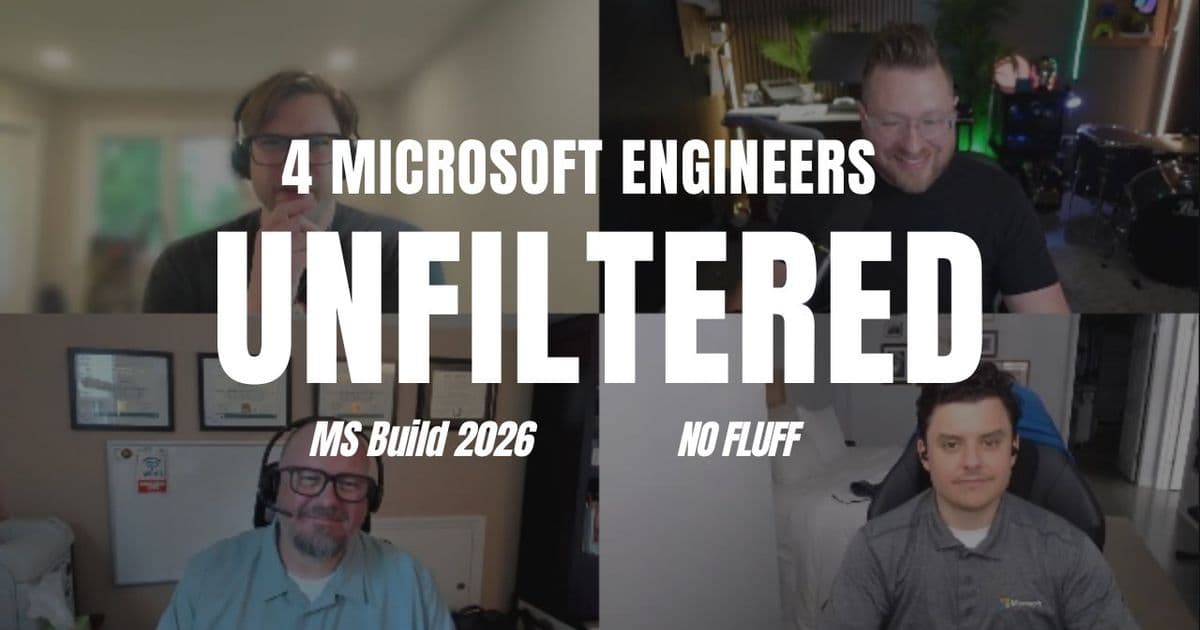
Four Microsoft Solution Engineers sat down to talk through Build 2026, and their takeaway reframes the whole agent conversation. The interesting story isn't a new capability demo. It's that enterprises are spinning up AI agents faster than they can track them, and Microsoft's new tooling around Agent 365, Scout, and Purview in Foundry is aimed squarely at the governance gap that creates.

A candid roundtable from Microsoft's Healthcare and Life Sciences field team is worth more than most keynote recaps, because the people closest to deployment tend to notice what actually changes for customers. That's what makes the Build 2026 debrief from four Microsoft Solution Engineers useful reading for anyone shaping cloud and AI strategy. Their collective view, drawn from daily work with regulated healthcare and enterprise accounts, points to a single shift: the industry has stopped asking what AI agents can do and started asking how to manage the ones already in production.
What changed
A year ago, the agent conversation was aspirational. Teams were prototyping, asking whether an agent could draft a report or answer a support ticket. Build 2026 lands in a different place. The proof of concept phase is over for a lot of organizations, and what they're left with is sprawl.
The number that captures it: one customer had spun up roughly 1,400 agents with no clear inventory of what any of them could access. That isn't a hypothetical risk. It's a live identity and data governance problem sitting inside a production tenant. When agents can read mailboxes, query knowledge bases, and call downstream tools, an untracked fleet of them is functionally a population of unmanaged service accounts with broad reach and no owner.
Microsoft's announcements this year read as a direct response. A few stood out to the field team:
- Agent 365 brings agents into the same management plane IT already uses for people and service accounts. It assigns sponsors and owners, applies governance controls, and gives administrators an actual inventory. The mental model isn't novel, and that's the point. Treating agents like identities that need an accountable human behind them is exactly the discipline most organizations skipped during the prototype rush.
- Microsoft Scout, still in frontier private preview, represents the move from "AI you type at" to "AI that acts while you work on something else." In practice that meant handing Scout a scheduling task, having it reach out to a colleague, monitor the reply, and book the meeting without further prompting. Asynchronous, goal-directed agents change the operational surface area, which loops right back to why governance tooling arrived alongside them.
- Purview SDK in Foundry moves security configuration off individual developers and back onto governance teams. For regulated industries this is a structural fix, not a convenience. Data handling and compliance controls belong with the people accountable for them, not embedded ad hoc in application code.
- Work IQ APIs lower the effort of giving agents access to organizational knowledge without wiring up every tool by hand, which matters as the connection count between agents and internal systems grows.
- In-house model routing in Copilot quietly sends each prompt to an appropriate model, a sign that models are starting to behave like interchangeable infrastructure rather than the headline differentiator.
Provider comparison
The governance-first framing is where Microsoft's position gets interesting against AWS and Google Cloud, because all three hyperscalers are now selling agents and all three face the same sprawl problem. The differentiation is increasingly about the management layer, not the model.
Microsoft's advantage is distribution and identity. Agent 365 plugs agents into Entra ID and the existing Microsoft 365 administrative fabric, which means an organization already running on that stack inherits a familiar control plane rather than standing up a new one. For shops deep in Office, Teams, and Purview, that continuity is the selling point.
AWS approaches the same territory through Bedrock Agents and a more composable, infrastructure-led posture. The strength there is flexibility and IAM-grade access control for teams that want to assemble their own governance from primitives. The cost is that you assemble it yourself; there's less of an opinionated, identity-native fleet view handed to you out of the box.
Google leans on Vertex AI and Agent Builder with strong model performance and data-platform gravity through BigQuery. For organizations whose center of mass is analytics and data, that pull is real. The governance story for large agent populations, though, is less tied to a ubiquitous corporate identity directory than Microsoft's is.
The practical read for a multi-cloud organization: model capability is converging and becoming a commodity, exactly as the routing-as-infrastructure observation suggests. The durable decision criteria are governance, identity integration, and compliance posture. That moves the evaluation away from "whose model scores higher" and toward "whose control plane fits how we already run IT."
Business impact
For leaders setting cloud strategy, a few things follow from this.
First, agent governance is now a procurement requirement, not a phase two cleanup. If your teams have been building agents through the year, you likely already have an inventory problem of your own. The cost of retrofitting ownership, access scoping, and audit onto an existing fleet is higher than building it in, so the platforms that hand you that structure early carry real value.
Second, the Purview-in-Foundry move signals where accountability is heading. Pushing security configuration back to governance teams reduces the chance that a developer's default settings become a compliance incident. In healthcare, finance, and government, "we'll figure out governance later" was never a viable answer, and the tooling finally reflects that.
Third, model commoditization should shape your contracts. If Copilot and its peers route prompts across a lineup of models behind the scenes, betting your architecture on one specific model is a weaker strategy than betting on the orchestration and governance layer that sits above them. Keep model choice loose and invest in the control plane.
The migration consideration that follows is portability. As each provider builds a richer, more proprietary agent management layer, switching costs rise. Organizations that want to preserve leverage should keep agent definitions, knowledge connections, and access policies as documented and externalized as the platform allows, so that an Agent 365 deployment today doesn't become a lock-in you regret when pricing or capability shifts.
The field team's closing note is the right one to sit with. The product is catching up to conversations they've been having with customers for a year. The work now is less about proving agents are useful and more about making sure the useful ones you've already deployed are accounted for, owned, and governed. You can follow the team's perspective on the Healthcare and Life Sciences Blog on Microsoft Community Hub.
Comments
Please log in or register to join the discussion