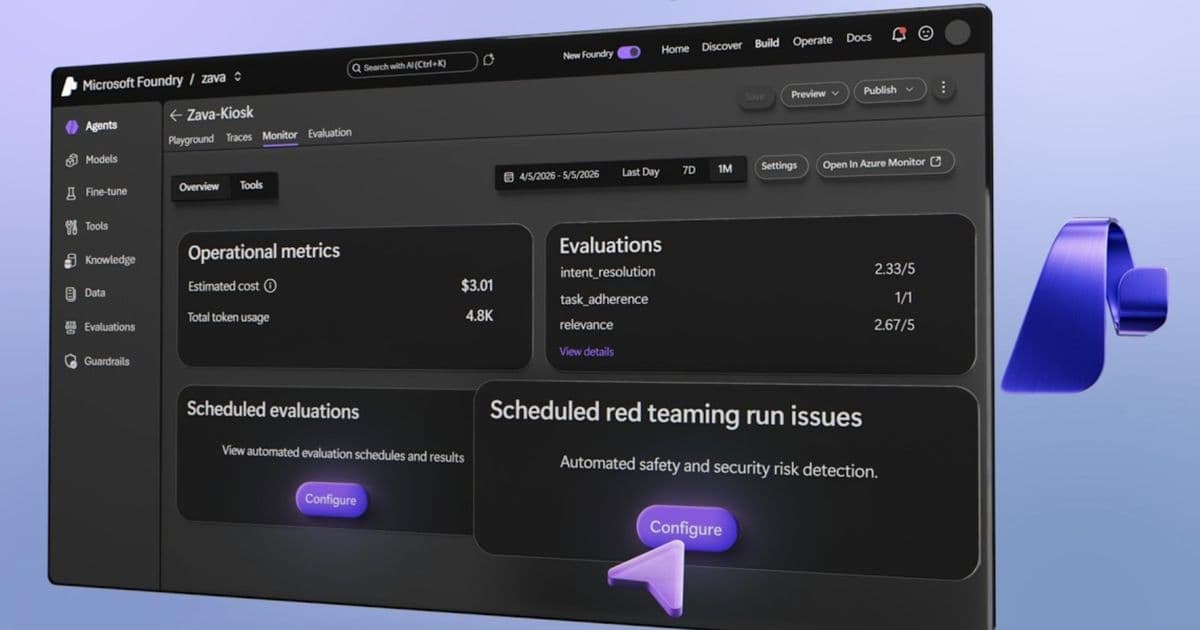
Microsoft Foundry introduces a comprehensive control plane for building and evaluating AI agents with advanced testing capabilities, synthetic data generation, and automated guardrails to ensure production-ready quality, safety, and performance standards.
Microsoft has expanded its AI development ecosystem with Microsoft Foundry, a sophisticated control plane designed to address the critical challenge of ensuring AI agents meet organizational standards for quality, safety, and performance. This platform represents a strategic advancement in the AI development lifecycle, providing tools that go beyond basic model selection to encompass comprehensive testing, evaluation, and behavioral controls.
What Changed: Foundry's Evaluation Capabilities
Microsoft Foundry introduces several significant capabilities that transform how organizations develop and validate AI agents:
End-to-End Tracing and Monitoring Foundry provides complete observability into agent operations through OpenTelemetry-based traces backed by Azure Monitor. Developers can examine every interaction, from system messages to tool outputs, making the debugging process significantly more efficient than parsing traditional logs. The platform also offers operational metrics including cost estimates, token usage, success/failure rates, and tool call patterns.
Synthetic Dataset Generation A standout feature is the on-demand synthetic dataset generator, which automatically creates evaluation datasets based on simple parameters. Users specify the number of rows and provide guidance prompts, and Foundry generates comprehensive test data in seconds. This capability eliminates the bottleneck of manually creating evaluation datasets, allowing developers to quickly scale testing efforts.
Automated Red Team Testing Foundry incorporates automated Red Team capabilities that simulate potential attacks and vulnerabilities. The platform includes predefined attack strategies like AsciiSmuggler, Base64 encoding attempts, jailbreak prompts, and Unicode substitution attacks. Organizations can configure these tests to identify security vulnerabilities before deployment, significantly reducing the risk of malicious exploitation.
AI-Powered Failure Analysis When evaluations fail, Foundry employs AI to cluster similar failures, identify root causes, and recommend specific fixes. This analytical approach transforms raw evaluation data into actionable insights, accelerating the improvement cycle for AI agents.
Provider Comparison: Foundry in the AI Development Landscape
Microsoft Foundry enters a competitive field with several existing approaches to AI agent development and evaluation:
vs. Open-Source Frameworks While frameworks like LangChain or LlamaIndex provide foundational capabilities for building AI agents, they lack the integrated evaluation and monitoring features of Foundry. Open-source solutions typically require significant custom development to achieve comparable observability and testing capabilities.
vs. Specialized AI Evaluation Platforms Dedicated evaluation platforms like Arize or WhyLabs focus primarily on post-deployment monitoring rather than the development lifecycle. Foundry distinguishes itself by integrating evaluation directly into the development process, enabling continuous quality assurance from initial concept through production deployment.
vs. Cloud Provider Alternatives Amazon Bedrock and Google Vertex AI offer similar AI development environments with evaluation capabilities. However, Foundry's integration with Azure services provides a more cohesive experience for organizations already invested in the Microsoft ecosystem. The platform's guardrails system also appears more mature than comparable offerings from other providers.
Business Impact: Strategic Advantages of Adopting Foundry
The implementation of Microsoft Foundry delivers several strategic business benefits:
Accelerated Development Cycles By automating the evaluation process and providing immediate feedback on agent performance, Foundry reduces the time required to develop production-ready AI agents. The synthetic dataset generation feature, in particular, enables rapid iteration without the resource-intensive process of manual test case creation.
Reduced Risk Exposure The automated Red Team testing and guardrails system significantly mitigate security risks before deployment. Organizations can identify potential vulnerabilities early in the development process, reducing the likelihood of costly security incidents post-deployment.
Consistent Quality Assurance Foundry's centralized control plane ensures consistent evaluation standards across all AI agents. This consistency is particularly valuable for organizations developing multiple agents or implementing fleet-wide AI initiatives, as it eliminates the variability that often occurs with disparate development approaches.
Operational Efficiency The platform's comprehensive monitoring and tracing capabilities reduce the time developers spend debugging and troubleshooting. The AI-powered failure analysis further enhances efficiency by automatically identifying patterns and suggesting specific fixes.
Practical Implementation Considerations
Organizations considering Microsoft Foundry should evaluate several practical aspects:
Integration Requirements Foundry requires integration with Azure services for optimal functionality, particularly Azure Monitor for tracing and analytics. Organizations should assess their existing Azure footprint and any necessary infrastructure adjustments to support these dependencies.
Skill Development Needs While Foundry provides a user-friendly interface, maximizing its benefits requires understanding of AI evaluation methodologies and guardrail configuration. Organizations should plan for appropriate training and knowledge transfer to ensure effective utilization.
Scalability Considerations The platform's synthetic data generation and evaluation capabilities enable scaling testing efforts, but organizations should consider computational resource requirements as evaluation volume increases. Cost optimization strategies may be necessary for large-scale deployments.
Migration Path
For organizations already using other AI development frameworks, migration to Foundry should be approached incrementally:
- Initial Assessment: Evaluate existing AI agents against Foundry's evaluation criteria to identify improvement areas
- Pilot Implementation: Select a non-critical agent for initial Foundry implementation and testing
- Process Integration: Incorporate Foundry evaluation workflows into existing development processes
- Scaling: Gradually expand to additional agents and teams as familiarity and confidence grow
Microsoft Foundry represents a significant advancement in AI development tools, providing comprehensive capabilities for building, testing, and securing AI agents. By integrating evaluation directly into the development lifecycle, the platform addresses a critical gap in the AI development process, enabling organizations to deliver more reliable, secure, and effective AI solutions.
For organizations seeking to implement Microsoft Foundry, the platform is accessible through ai.azure.com. Additional resources and technical documentation can be found in the Microsoft Mechanics video series, which provides detailed demonstrations of the platform's capabilities.
Comments
Please log in or register to join the discussion