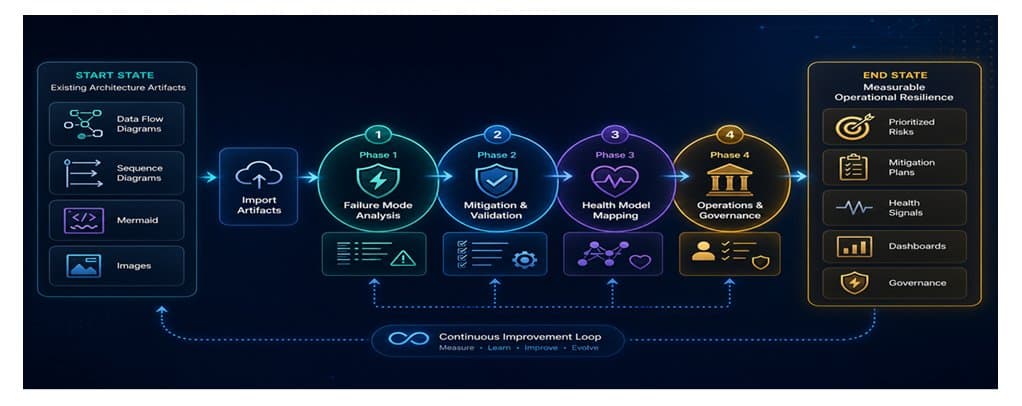
Microsoft has introduced the Application Resilience Framework and a companion tool to help organizations transform existing architecture artifacts into measurable resilience models, addressing a critical gap in connecting architectural documentation with operational resilience practices.
Microsoft has unveiled the Application Resilience Framework, a structured approach to turning existing architecture artifacts into measurable resilience models, addressing a practical gap many teams face when trying to connect architectural documentation with operational resilience practices.
What Changed: From Artifacts to Actionable Resilience
The Application Resilience Framework originated from a practical observation: teams typically possess architecture diagrams, monitoring data, incident history, and runbooks, but lack a consistent method to connect these elements into a measurable resilience model. The framework aims to close this gap by converting architecture context into a structured lifecycle for risk identification, mitigation validation, health modeling, and governance.
The framework aligns closely with the Reliability pillar of the Azure Well-Architected Framework, particularly focusing on identifying critical flows, performing Failure Mode Analysis, defining reliability targets, and building health models. Its implementation is supported by a new tool that accelerates the adoption process by starting with artifacts teams already have.
"The framework is not a replacement for existing guidance like the Well-Architected Framework or Resilience Hub assessments," explains Microsoft in their announcement. "Instead, it provides a practical way to operationalize those concepts at the workload and workflow level, producing prioritized risks, mitigation plans, validation paths, health signals, dashboards, reports, and governance ownership."
The tool supports multiple input formats:
- Data flow diagrams for system, module, data movement, and dependency views
- Sequence diagrams for transaction flow and service interaction views
- Mermaid diagrams maintained as code
- Image files (JPG/PNG) that Azure Foundry Vision models can interpret
Provider Context: Microsoft's Cloud Resilience Ecosystem
This new framework fits within Microsoft's broader cloud resilience strategy, complementing existing Azure services like Azure Resilience Hub, Azure Monitor, and Azure Chaos Studio. While Resilience Hub focuses on high-level workload assessments and Azure Monitor provides observability capabilities, the Application Resilience Framework targets the gap between architecture documentation and operational resilience.
The framework differentiates itself by:
- Starting with existing artifacts rather than requiring new documentation
- Providing a structured, step-by-step approach to resilience modeling
- Creating measurable outputs that connect directly to operational practices
- Incorporating validation through chaos testing and mitigation playbooks
This approach positions Microsoft as addressing a specific pain point in cloud architecture: the disconnect between architectural planning and operational reality. By providing tools that work with existing documentation, Microsoft lowers the barrier to implementing robust resilience practices.
Business Impact: From Reactive to Proactive Resilience
The introduction of the Application Resilience Framework has several significant business implications:
1. Systematic Risk Prioritization
Using the Risk Priority Value (RPV) scoring system, teams can objectively prioritize which failure modes deserve attention first. RPV considers Impact, Likelihood, Detectability, and Outage severity to provide a quantitative basis for resource allocation. This transforms resilience from an all-or-nothing proposition to a risk-based investment strategy.
2. Bridging Architecture and Operations
Perhaps the most significant impact is how the framework connects architectural documentation with operational practices. Teams can import existing diagrams and workflows, then systematically analyze failure modes, define mitigations, map to health signals, and establish governance practices. This creates a living resilience model that evolves with the system.
3. Practical Implementation Path
The framework offers three adoption patterns to match different organizational needs:
- Pattern A: Quick resilience review - For fast architecture reviews or early customer conversations
- Pattern B: Full workload assessment - For structured resilience assessments across multiple workflows
- Pattern C: Operational health model - For continuous operational improvement with integrated monitoring
This flexibility allows organizations to start small and expand their resilience practices as needed.
4. Actionable Outputs
Unlike theoretical frameworks, the Application Resilience Framework produces concrete deliverables:
- Failure Mode catalogs with RPV scores
- Mitigation playbooks and chaos test plans
- Health models mapped to observable signals
- Bicep templates for implementation
- Governance models with assigned ownership
These outputs create a direct path from analysis to implementation, ensuring resilience efforts translate into operational improvements.
5. Continuous Improvement Loop
The framework's governance phase establishes processes to keep the resilience model current as systems evolve. By incorporating feedback from incidents, failed validations, and monitoring gaps, organizations can create a closed-loop system where operational experiences continuously improve the architectural resilience model.
Implementation Considerations
Organizations considering the Application Resilience Framework should evaluate:
- Artifact Quality: The framework effectiveness depends on the quality and completeness of existing architecture artifacts
- Team Expertise: While the tool accelerates adoption, teams still need understanding of resilience concepts and failure mode analysis
- Integration with Existing Practices: The framework works best when integrated with existing DevOps, SRE, and incident management practices
- Tool Adoption Strategy: The three adoption patterns allow teams to match their approach to their maturity and objectives
Microsoft has made the Application Resilience Framework Tool available, along with comprehensive documentation and video walkthroughs. The tool represents Microsoft's continued investment in making cloud resilience practical and accessible for organizations of all sizes.
As cloud systems grow in complexity, the ability to systematically identify, prioritize, and mitigate failures becomes increasingly critical. The Application Resilience Framework provides a structured approach to this challenge, helping organizations move from theoretical resilience to measurable, operational resilience that directly impacts business continuity and customer experience.
Comments
Please log in or register to join the discussion