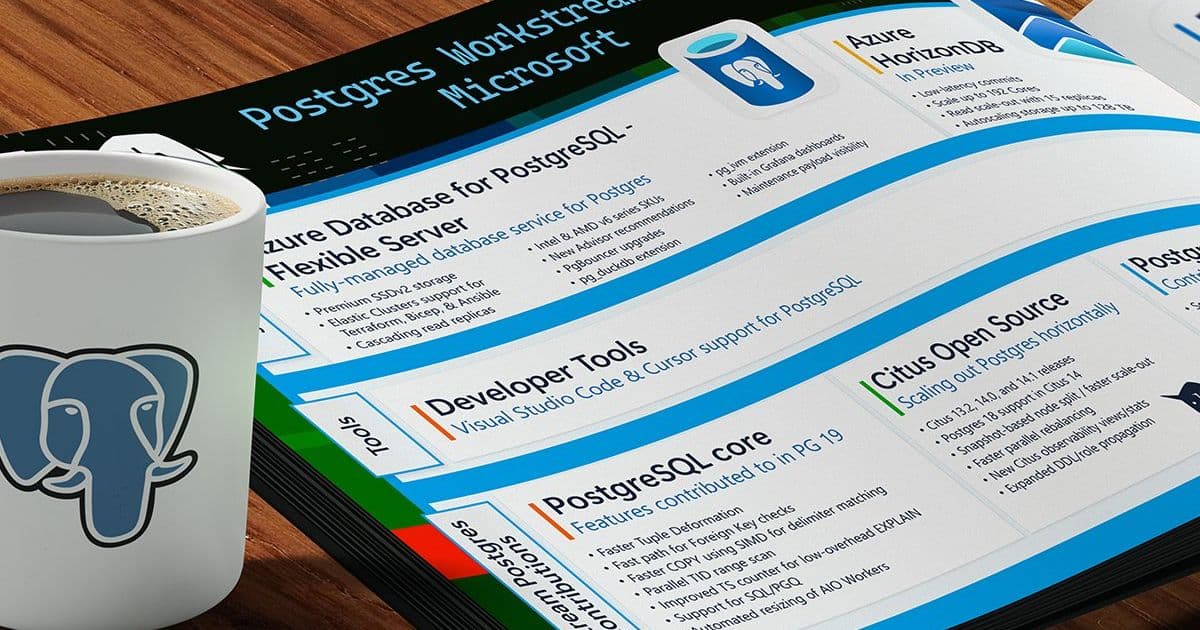
Microsoft just published its annual Postgres update, and buried in the feature list is a strategic shift worth tracking: a new cloud-native database called Azure HorizonDB, deeper AI integration in the managed service, and roughly 14% of Postgres 19 commits authored by Microsoft engineers. For teams weighing where to run Postgres across AWS, Google Cloud, and Azure, these moves change the calculus on lock-in, pricing, and migration paths.
Microsoft's annual Postgres update for 2026 reads like a feature changelog, but underneath the bullet points is a clear strategic posture. The company is doing three things at once: hardening its existing managed service (Azure Database for PostgreSQL flexible server), launching a separate cloud-native engine called Azure HorizonDB, and funding a meaningful share of upstream PostgreSQL development. For anyone making provider decisions across AWS, Google Cloud, and Azure, the interesting question isn't "what shipped," it's "what does this do to my options."
What changed
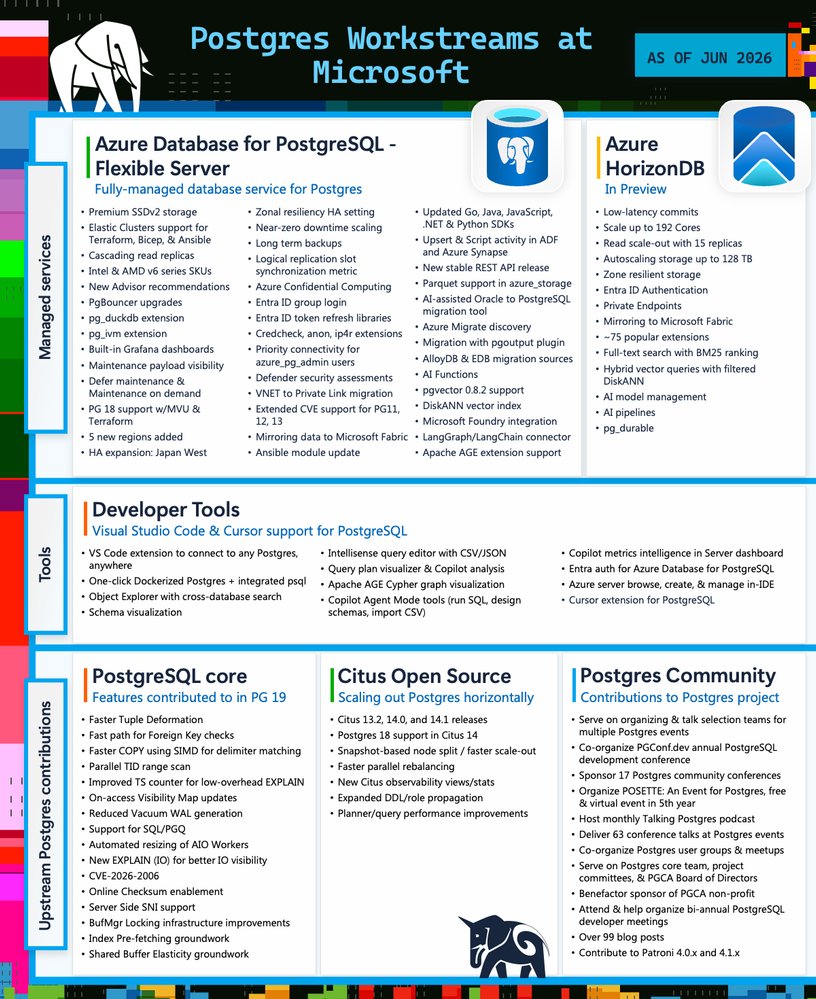
The headline is the bifurcation of Microsoft's managed Postgres offering. Until recently, Azure had one primary answer for Postgres: Flexible Server, a single-node managed service comparable in shape to Amazon RDS for PostgreSQL or Google Cloud SQL. That product kept maturing this year. Premium SSDv2 storage now scales to 64TB with up to 80,000 IOPS and independent scaling of capacity and performance, which mirrors the decoupled storage-and-IOPS model AWS introduced with gp3 volumes. Elastic Clusters, built on the Citus extension, brought row-level and schema-level sharding into the managed service with Terraform, Bicep, and Ansible support. Cascading read replicas now allow up to 30 replicas in tiered topologies.
The more consequential change is Azure HorizonDB, which moved to public preview at Microsoft Build in May 2026. HorizonDB is a separate architecture that separates compute from storage, with shared storage across compute nodes backed by zone-resilient Azure Blob Storage. This is the same architectural pattern that defines Amazon Aurora and Google AlloyDB: a disaggregated storage layer that enables fast scale-out, large storage ceilings, and millisecond commits without traditional replication lag. HorizonDB scales to 192 cores, 15 read replicas, and 128TB of auto-scaling storage.
If you have been tracking the cloud database market, the message is direct. Microsoft now has an Aurora competitor and an AlloyDB competitor, and it is positioning that engine around AI workloads with native vector support, AI model management through Microsoft Foundry, and a BM25 full-text ranking extension (pg_textsearch) for hybrid retrieval.
Provider comparison
The practical way to read this update is against what AWS and Google already offer, because the three hyperscalers are now converging on nearly identical Postgres product structures.
The single-node managed tier. Azure Database for PostgreSQL flexible server competes directly with Amazon RDS for PostgreSQL and Google Cloud SQL for PostgreSQL. All three give you automated backups, high availability, read replicas, and minor-version patching. Where Azure has pulled ahead this year is on a few specific axes. PostgreSQL 18 was available on Azure the same day as the community release, which is faster than the typical lag on competing services. Extended CVE support patches retired versions (PG11, 12, 13) for three years past community end-of-life, which matters for regulated shops that cannot upgrade on the community schedule. And the connection-pooling story is built in via PgBouncer rather than requiring a separate proxy service.
The cloud-native tier. This is where HorizonDB enters against Aurora and AlloyDB. The comparison comes down to where each vendor places its bets. AlloyDB leans on Google's columnar engine and claims analytical acceleration over stock Postgres. Aurora leans on operational maturity and the broadest ecosystem of integrations. HorizonDB's pitch is AI-native primitives baked into the engine: AI model management that provisions embedding and generation models through Foundry and wires up the azure_ai extension automatically, plus declarative AI pipelines built on a durable-functions extension (pg_durable, available on GitHub). Whether that differentiation holds depends on how committed your stack already is to Azure OpenAI and Foundry versus Bedrock or Vertex AI.
The compatibility question. One genuine advantage in Microsoft's approach: HorizonDB claims full PostgreSQL compatibility and supports roughly 75 popular extensions, including pg_stat_statements, pg_duckdb, and pg_diskann. Aurora and AlloyDB are also Postgres-compatible, but every disaggregated-storage engine introduces subtle behavioral differences under load. The extension breadth and the explicit commitment to the open ecosystem are worth verifying against your specific dependency list before you commit, because extension support is frequently where these migrations stall.
The upstream signal that affects all three clouds
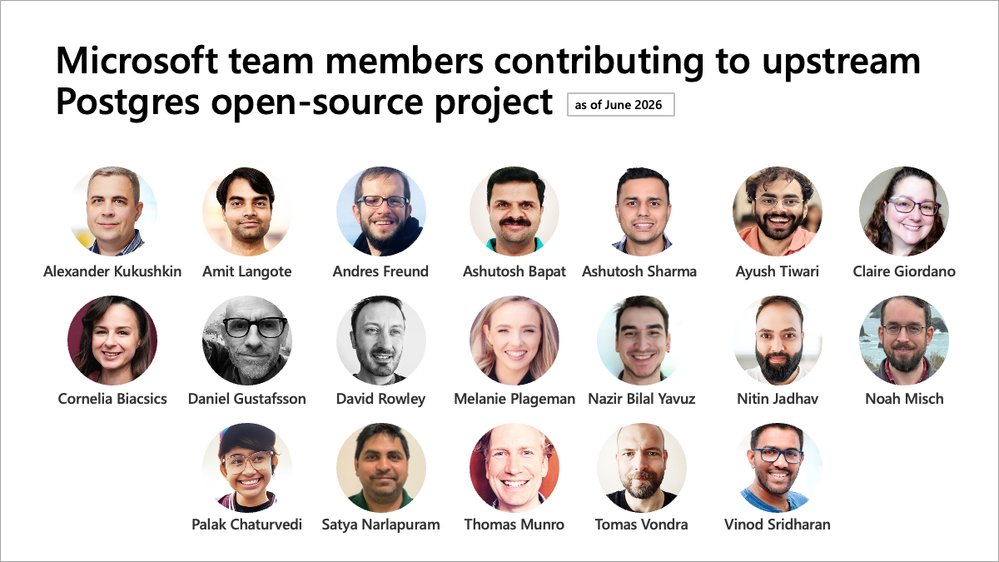
There is a strategic dimension here that goes beyond Azure's own products. Microsoft authored or co-authored roughly 440 of the 3,088 commits in PostgreSQL 19 to date, about 14.2%, and reviewed around 16% of commits. The work is substantive: a SIMD-accelerated COPY parser delivering up to 60% throughput gains, a foreign-key check fast path showing roughly 2.9x speedup on bulk inserts, online checksum enablement without cluster downtime, server-side SNI support, and groundwork for asynchronous I/O on writes.
Why does this matter for a multi-cloud decision? Because community PostgreSQL is the one database you can actually move between providers. Every improvement that lands in the core engine ships to RDS, Cloud SQL, Aurora's Postgres-compatible mode, AlloyDB, self-managed clusters, and Azure alike. A vendor investing heavily upstream is, somewhat counterintuitively, strengthening your exit options even as it tries to win your workload. The features that stay proprietary, HorizonDB's storage layer, the Foundry AI integration, are the lock-in surface. The features that go upstream are portable. Knowing which is which is the core of a sound Postgres strategy.
Migration considerations
Microsoft put real effort into migration tooling this year, and the targets are revealing. The Azure Database Migration Service now supports AlloyDB and EDB Postgres Advanced Server as direct migration sources, with both online and offline modes. Online migration now uses the pgoutput logical replication plugin, which improves compatibility with modern Postgres deployments and supports table-level filtering through publications. There is also an AI-assisted Oracle-to-Postgres tool in the VS Code extension that uses GitHub Copilot and Foundry to convert Oracle schema and application code, validating each change against a running instance.
Read the source list carefully. Supporting AlloyDB as a migration source is a competitive move aimed squarely at Google Cloud customers. If you are evaluating a move, the existence of a first-party migration path lowers the switching cost, but it does not eliminate the real work: extension compatibility audits, connection-string and authentication changes (Azure pushes hard toward Microsoft Entra ID for passwordless auth), and re-testing performance against the new storage architecture. Online migration with logical replication reduces downtime, though logical replication has its own operational footprint around slot management and failover, which is exactly why Microsoft added a logical_replication_slot_sync_status metric for HA failover readiness.
For teams running analytics alongside transactions, two integrations reduce ETL overhead: native mirroring to Microsoft Fabric for near real-time replication into OneLake, and the pg_duckdb extension (in preview) for running analytical queries directly inside Postgres. Both reduce the need to ship data into a separate warehouse, which has cost and architectural implications if your current pattern involves a managed pipeline into Snowflake or BigQuery.
Business impact
The pricing and cost story is where strategy meets the budget. Premium SSDv2's independent scaling of storage and IOPS means you stop overprovisioning capacity to get throughput, which is a direct cost lever for IO-heavy workloads. The v6-series Intel and AMD SKUs scale to 192 vCores and 1.8TB of memory with NVMe data-disk access, giving Azure a competitive price-performance position at the high end. Long-term backup retention up to 10 years addresses regulatory requirements that previously forced custom backup tooling.
For decision-makers, three takeaways shape a sensible posture. First, if you are already on Azure Database for PostgreSQL flexible server and hitting single-node scale limits, Elastic Clusters and HorizonDB now give you a within-Azure path that previously required leaving for Aurora or sharding yourself. Second, if you are multi-cloud by policy, anchor on community Postgres features and treat the proprietary AI and storage layers as deliberate, reversible bets rather than defaults. Third, the AI-native framing across all three clouds means your database choice is increasingly coupled to your model-provider choice. Picking HorizonDB pulls you toward Foundry and Azure OpenAI the same way AlloyDB pulls you toward Vertex AI.
The honest summary for a strategy conversation: Microsoft has closed most of the feature gaps that used to make Azure the third choice for Postgres, launched a credible Aurora and AlloyDB competitor, and continues funding the open core that keeps your options open. That combination is good for buyers, and it makes the provider comparison genuinely competitive rather than a foregone conclusion. The right move is to evaluate HorizonDB against Aurora and AlloyDB on your actual workload, with your actual extensions, before the AI-integration story does the deciding for you.
If you want to track where the engineering is heading, the team runs POSETTE, a free virtual Postgres conference, June 16 to 18, 2026, and the work itself is visible in the PostgreSQL 19 commit history ahead of its expected September 2026 release.
Comments
Please log in or register to join the discussion