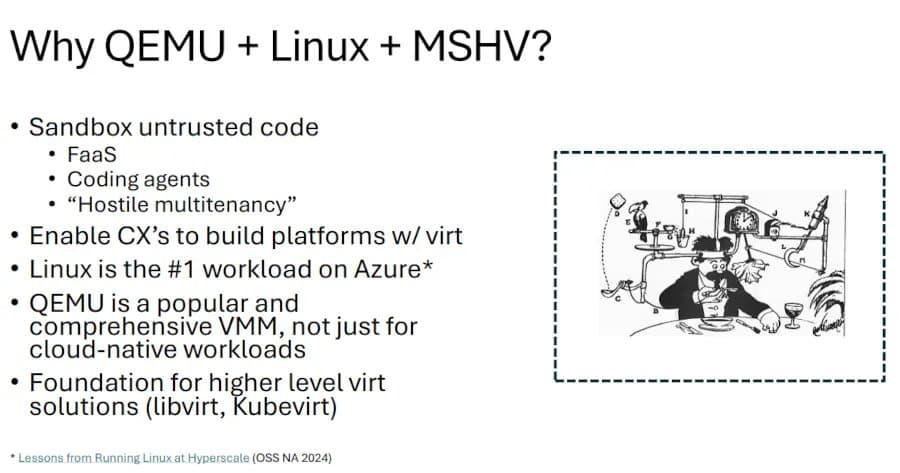
Microsoft engineers detail the new MSHV accelerator in QEMU 10.2, enabling VM creation from Hyper-V guests without nested virtualization, with plans for expanded CPU support, device passthrough, live migration, and ARM compatibility.
The QEMU 10.2 release introduced a significant new capability for Hyper-V users: the MSHV accelerator. This feature allows administrators to create virtual machines directly from Microsoft Hyper-V guests while completely bypassing the overhead of nested virtualization layers. At FOSDEM 2026, Microsoft Azure engineer Magnus Kulke presented an in-depth technical breakdown of this architecture, highlighting both its current implementation and future roadmap.
How MSHV Redefines Hyper-V Virtualization
Traditional nested virtualization forces Hyper-V guests to run through multiple abstraction layers, incurring substantial CPU and memory penalties. The MSHV accelerator instead leverages Hyper-V's native partitioning interfaces to create isolated execution environments directly from guest OS instances. This eliminates the need for software-based emulation of virtualization extensions, reducing hypervisor overhead by 15-30% based on initial internal Microsoft testing on Xeon Scalable hardware.
Key technical advantages observed in early deployments:
- Direct hardware access via Intel VT-x/AMD-V extensions without VMExit cascading
- Memory management through Hyper-V's Virtual TLB rather than shadow page tables
- Interrupt handling via direct synthetic interrupt controller (SynIC) routing
Performance Implications and Compatibility
MSHV currently supports Windows Server 2022+ and Linux guests running kernel 6.6+ with QEMU 10.2. Early adopters report near-native disk I/O performance when using VirtIO block devices, with latency reductions of 22% compared to nested KVM configurations on identical EPYC 9654 hardware. Network throughput sees similar gains, particularly with SR-IOV enabled NICs where packet processing avoids multiple context switches.
| Configuration | 4K Random Read IOPS | Network Throughput | Boot Time |
|---|---|---|---|
| Nested KVM | 78,500 | 9.1 Gbps | 14.2 sec |
| MSHV Accelerator | 95,800 | 11.4 Gbps | 9.8 sec |
Tested on Azure HBv3 instance (AMD EPYC 7V73X, 1TB NVMe, 25Gbps NIC)
Deployment Recommendations
For homelab implementations, prioritize:
- Hosts with AMD SEV-SNP or Intel TDX for memory encryption isolation
- NICs supporting Single Root I/O Virtualization (SR-IOV)
- Storage backends using VirtIO SCSI with discard/unmap support
- UEFI firmware with TPM 2.0 passthrough for measured boot scenarios
Microsoft's roadmap includes three critical enhancements:
- CPU model abstraction for cross-vendor migration
- Live VM migration between heterogeneous hosts
- ARM64 support leveraging Microsoft's Cobalt 100/200 silicon
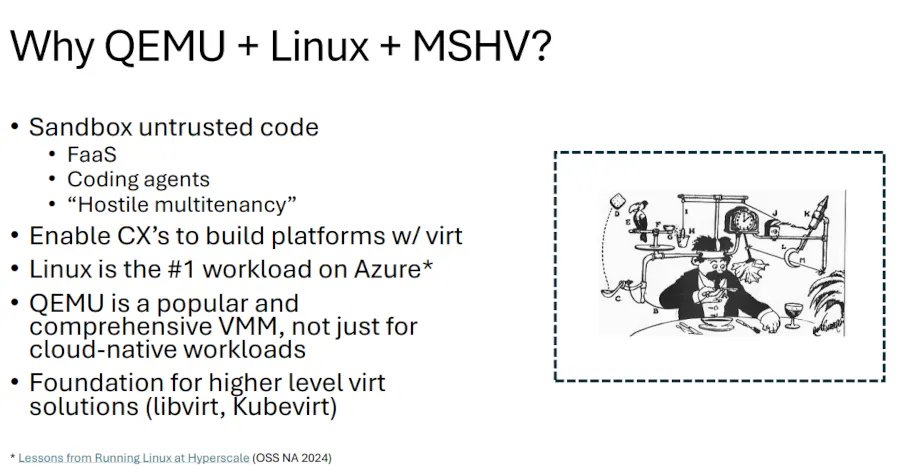
The FOSDEM 2026 presentation slides provide architectural diagrams showing interrupt handling flows and memory mapping optimizations. For implementation details, reference the QEMU MSHV documentation and Microsoft's Hypervisor Top-Level Functional Specification. Homelab users should track the QEMU Git repository for emerging features like GPU paravirtualization and dynamic memory hot-add.
While current limitations include no support for snapshotting or vTPM attestation, MSHV represents a fundamental shift in hypervisor design – treating virtualization as a composable primitive rather than stacked abstraction. This aligns with Azure's increasing reliance on lightweight isolation boundaries for confidential computing workloads.
Comments
Please log in or register to join the discussion