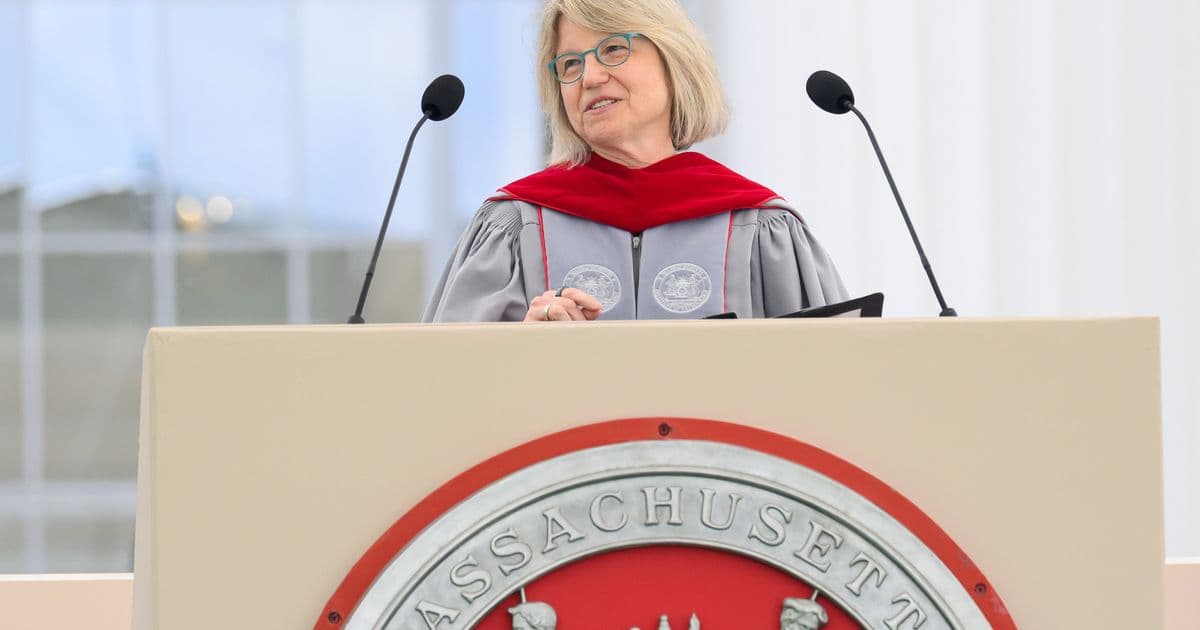
MIT President Sally Kornbluth delivered a compelling commencement address to the Class of 2026, emphasizing the critical importance of curiosity and excellence in addressing global challenges. She called upon graduates to become advocates for curiosity-driven research, which she described as "our intellectual rocket fuel" essential for solving complex problems facing society.
In her commencement address to MIT's Class of 2026, President Sally Kornbluth issued a charge that extends far beyond traditional graduation remarks. With characteristic humility and profound insight, Kornbluth urged graduates to become ambassadors for curiosity-driven research—a fundamental force she described as "our intellectual rocket fuel" essential for addressing humanity's most pressing challenges.
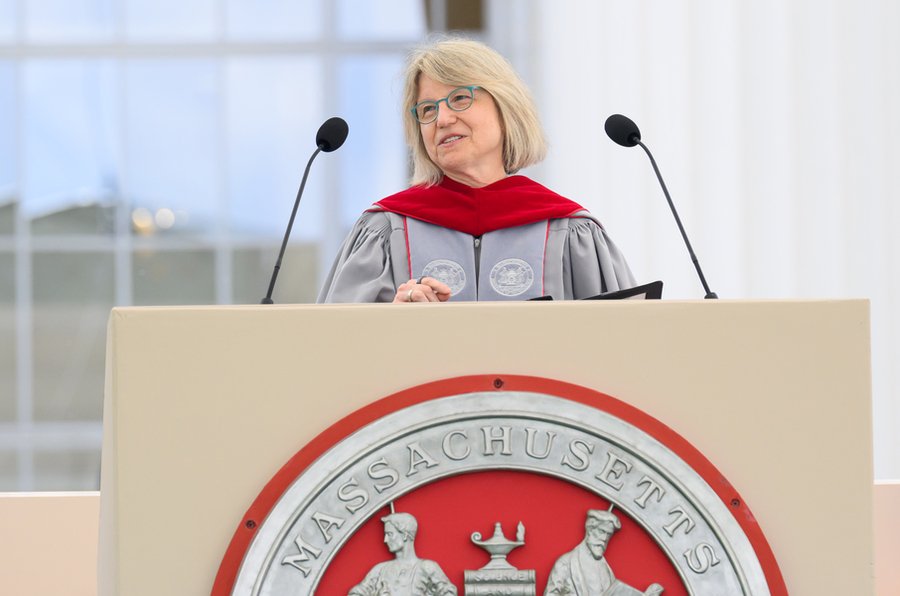
Kornbluth's address, delivered on May 28, 2026, centered on two core MIT values: excellence and curiosity. While excellence represents the institution's commitment to "the highest standards of intellectual and creative excellence," curiosity emerged as the driving force behind transformative innovation. "At MIT, we know that curiosity-driven science is the path to new knowledge—the kind that spawns world-changing innovations," Kornbluth emphasized. "Curiosity is the force that transforms deadly cancers into treatable conditions, that turns fusion energy from a dream to a reality, that uncovers new ways to grow more food using less of every resource."
The president's call to action comes at a critical juncture for scientific research in the United States. As many graduates know from firsthand experience in laboratories across campus, federal investment in curiosity-driven science has declined sharply in recent years. This trend represents what Kornbluth described as a "tragedy" that "chokes off the flow of future solutions, innovations and cures—and shrinking the supply of future scientists."
"Over eight decades, the United States had the foresight to see the value of discovery science," Kornbluth explained. "It invested public money with steady patience, knowing that the 'practical payoff' could be 20, 30, 40 years away. Today, that patient investment is in sharp decline."
The implications of this decline extend far beyond academia. Curiosity-driven research has historically served as the foundation for breakthrough technologies that address complex global challenges. From mRNA vaccines developed through fundamental biological research to AI systems built on mathematical principles explored for their intrinsic interest, the most practical applications often emerge from seemingly impractical questions.
Kornbluth's address highlighted this paradox through personal anecdote. "Years ago, after a long conversation about my PhD work, my own grandmother once asked, 'Wait, you're not trying to cure cancer in humans, you're trying to give it to chickens?'" she recalled. This story illustrates how the "curious" path to deep discoveries can appear wandering or even nonsensical to outsiders, yet often leads to transformative insights.
The president's emphasis on excellence balanced her call for curiosity. "As members of this community, we strive to hold ourselves to 'the highest standards of intellectual and creative excellence,'" she stated. "Just as important, we inspire each other to reach for those standards too."
Kornbluth distinguished between excellence and arrogance, invoking Walt Whitman to capture the essence of true scientific excellence: "'I like the scientific spirit—the holding off, the being sure, but not too sure, the willingness to surrender ideas when the evidence is against them: This … keeps the way beyond open [and] … gives the whole man a chance to try over again.'"
This balanced approach—combining rigorous standards with intellectual humility—represents MIT's distinctive contribution to scientific progress. The institution's commitment to "potential over pedigree," evidenced by policies like no legacy admissions and no special consideration for donors, creates an environment where merit and curiosity can flourish.
Kornbluth's charge to the Class of 2026 extends beyond technical excellence to encompass ethical responsibility. "Every one of you here possesses uncommon talent," she acknowledged. "And with great talent comes great responsibility. I have no doubt that, like our alumni, you will be top-flight performers in your fields: Innovators. Engineers. Scientists. Doctors and designers. Entrepreneurs, investors and astronauts. Pioneers in whatever realm you chose."
The president urged graduates to maintain a "core value—the commitment to always act ethically, with integrity, and with consideration for our fellow human beings." This ethical dimension, she suggested, provides the essential framework through which technological advancement should be pursued.

The address concluded with a direct appeal to graduates: "I hope you will join in a great shared effort to sustain the work of scientific curiosity—on a mission to serve." This call reflects a broader recognition that scientific progress cannot be separated from its societal context and that those with specialized knowledge have a particular responsibility to ensure that knowledge benefits humanity.
Kornbluth's message resonates particularly strongly as society faces increasingly complex challenges—from climate change to pandemics to technological disruption—that require innovative solutions. The graduates, equipped with MIT's distinctive combination of technical excellence and intellectual curiosity, are positioned to contribute meaningfully to these efforts.
The full text of President Kornbluth's commencement address can be found on the MIT News website, where the speech is available alongside related coverage of MIT's 2026 Commencement ceremonies. For more information about MIT's approach to scientific research and education, the official MIT Values Statement provides additional context for the principles highlighted in the address.
Comments
Please log in or register to join the discussion