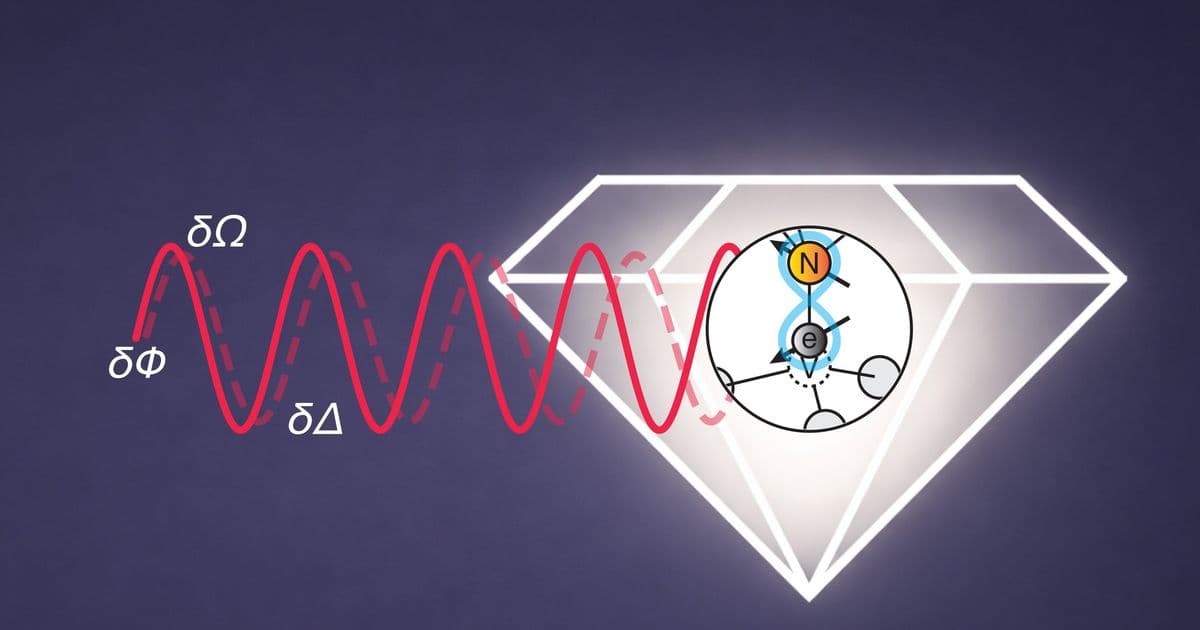
MIT engineers have developed a quantum sensor that can simultaneously measure multiple physical properties at room temperature, overcoming a major limitation in current quantum sensing technology.
MIT engineers have achieved a significant breakthrough in quantum sensing technology by developing a sensor capable of measuring multiple physical properties simultaneously at room temperature. This advancement, detailed in a recent paper published by researchers from MIT's Department of Nuclear Science and Engineering and Department of Physics, represents a major step toward practical quantum sensing applications in biomedical research, materials characterization, and beyond.
The Challenge of Multiparameter Quantum Sensing
Quantum sensors have emerged as powerful tools for measuring tiny signals at levels impossible with classical sensors alone. These devices exploit quantum properties like entanglement, spin states, and superposition to detect changes in magnetic fields, electric fields, gravity, acceleration, and other physical quantities with extraordinary precision.
Among the most promising quantum sensors are those based on nitrogen-vacancy (NV) centers in diamonds. These defects occur when a carbon atom in the diamond's crystal lattice is replaced by a nitrogen atom, with a neighboring lattice site vacant. The resulting electronic spin is extremely sensitive to external effects such as magnetic fields and temperature, allowing measurements at extremely high resolution.
However, a fundamental limitation has plagued solid-state quantum sensors: they typically measure only one physical quantity at a time. When researchers attempt to measure multiple properties simultaneously—such as both magnetic field and temperature—the signals interfere with each other, leading to unreliable measurements. This constraint has forced scientists to conduct sequential measurements, increasing experimental time, reducing sensitivity, and introducing more opportunities for error.
Entangling Qubits for Multiparameter Measurement
The MIT team overcame this limitation by leveraging quantum entanglement, a phenomenon where particles become correlated into a single quantum state. By entangling two spins within the NV center system—one from the electronic spin and one from the nitrogen atom—the researchers created a system capable of simultaneously measuring multiple physical quantities.
"Quantum multiparameter estimation has been mostly theoretical to date," explains Takuya Isogawa, a graduate student in nuclear science and engineering and co-lead author of the paper. "There have been very few experiments that actually demonstrate it, and those focused on photons. We wanted to demonstrate multiparameter estimation in a more application-oriented setup: a solid-state quantum sensor in use today."
Experimental Setup and Results
The experimental setup consisted of NV centers inside a 5-square-millimeter diamond. The researchers used a laser to illuminate the diamond and studied its fluorescence to make measurements—a standard approach for NV center sensors. To manipulate the electronic spin, they employed a microwave antenna, while a radio frequency field was used to study the nitrogen atom's spin.
"We used those two spins as two qubits," Isogawa explains. "If you have only one qubit, you can only measure one outcome: basically, 0 or 1. It's the probability that it spins up or down. Think of it like a coin toss, with the probability of getting heads or tails. With two qubits, we increased the parameters that we could extract."
The entanglement between the sensor qubit and auxiliary qubit enabled the researchers to measure three quantities simultaneously: the amplitude, detuning, and phase of a microwave magnetic field. This was accomplished using a technique known as Bell state measurement, which had previously only been demonstrated at extremely low temperatures.
The MIT team developed a novel approach to perform Bell state measurement at room temperature, making the technology more practical for real-world applications. The researchers also demonstrated that their approach outperformed both sequential measurement methods and traditional sensors.
Practical Applications and Future Directions
The implications of this breakthrough extend across multiple fields. In biomedical sensing, the ability to simultaneously measure multiple physical quantities could provide deeper insights into cellular processes. For example, researchers could study the activity of metabolites or enzymes inside cells with unprecedented detail, potentially advancing our understanding of cancer cell behavior.
In materials characterization, the technology could enable more comprehensive analysis of spin waves in materials—an important topic in condensed matter physics. The NV center sensors' extremely high spatial resolution and versatility make them particularly valuable for studying heterogeneous materials where physical quantities vary across different locations.
"Measuring these parameters simultaneously can help us explore spin waves in materials, which is an important topic in condensed matter physics," Isogawa notes. "NV center sensors have extremely high spatial resolution and versatility. It can measure a lot of different physical quantities."
Looking ahead, the research team plans to explore whether their approach can achieve even higher precision for each measured parameter. They also intend to investigate how the technology performs when characterizing heterogeneous materials, where traditional sensors often struggle.
Technical Innovation and Collaboration
The work represents a collaborative effort involving researchers from MIT, the University of Tokyo, and the Chinese University of Hong Kong. Key contributors include Guoqing Wang PhD '23, Boning Li, Zhiyao Hu, Ayumi Kanamoto, Shunsuke Nishimura, Haidong Yuan, and Paola Cappellaro, MIT's Ford Professor of Engineering.
The approach builds on theoretical foundations while addressing practical implementation challenges. Wang, who was previously a graduate student in Professor Cappellaro's lab, first proposed the technique that enabled room-temperature Bell state measurement.
Significance for Quantum Technology
This research marks an important step toward making quantum sensing technology more practical and accessible. By demonstrating multiparameter estimation in realistic settings using widely used quantum sensors, the team has addressed a critical barrier to broader adoption of quantum sensing technology.
"What makes the NV center quantum sensors so special is they can operate at room temperature," Isogawa emphasizes. "It's very suitable for biological measurements or condensed matter physics experiments."
The work was supported by the U.S. National Science Foundation, the National Research Foundation of Korea, and the Research Grants Council of Hong Kong, highlighting the international significance of this quantum sensing advancement.
As quantum technologies continue to mature, innovations like this multitasking quantum sensor will play a crucial role in bridging the gap between laboratory demonstrations and practical applications. The ability to measure multiple physical quantities simultaneously at room temperature opens new possibilities for scientific discovery and technological innovation across numerous fields.
Comments
Please log in or register to join the discussion