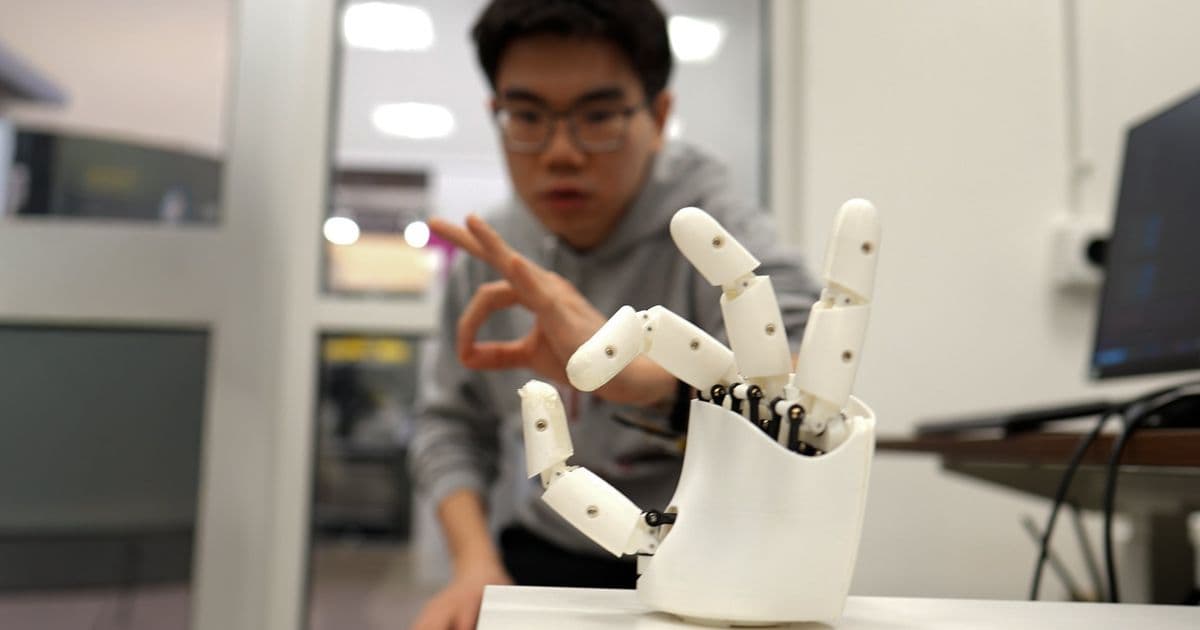
MIT engineers have developed an ultrasound wristband that tracks hand movements by imaging wrist muscles and tendons, enabling precise control of robots and virtual environments without cameras or gloves.
MIT engineers have developed an innovative ultrasound wristband that can precisely track hand movements in real-time by imaging the muscles, tendons, and ligaments in the wrist. This breakthrough technology enables users to control robotic hands, manipulate virtual objects, and interact with digital environments through natural hand gestures, potentially revolutionizing how humans interact with machines.
The Challenge of Mimicking Human Dexterity
The human hand is an extraordinary feat of biological engineering, coordinating 34 muscles, 27 joints, and over 100 tendons and ligaments to perform complex tasks. This remarkable dexterity has long posed a significant challenge for robotics and virtual reality applications. Traditional methods for capturing hand movements have significant limitations - camera-based systems require complex setups and can be obstructed, sensor-laden gloves restrict natural movement, and muscle signal-based approaches are susceptible to environmental noise and lack the sensitivity to capture subtle gestures.
How the Ultrasound Wristband Works
The MIT team's solution involves a wearable device that continuously images the wrist's internal structures as the hand moves. The wristband, about the size of a smartwatch, contains an ultrasound sticker - a miniaturized version of the transducers used in medical imaging, paired with hydrogel material that safely adheres to skin.
As Zhao explains, "The tendons and muscles in your wrist are like strings pulling on puppets, which are your fingers. So the idea is: Each time you take a picture of the state of the strings, you'll know the state of the hand."
The device captures ultrasound images of the wrist's anatomy and uses artificial intelligence to translate these images into corresponding finger positions and movements. The AI algorithm was trained on meticulously labeled ultrasound images, learning to associate specific image patterns with the hand's 22 degrees of freedom - the various ways fingers can extend or angle.
Real-World Demonstrations
The technology has been demonstrated in several compelling applications. In one experiment, a person wearing the wristband could wirelessly control a robotic hand, with the robot mimicking the wearer's gestures in real-time. This "wireless marionette" interaction allowed the wearer to manipulate the robot to play a simple tune on a piano and shoot a small basketball into a desktop hoop.
In virtual reality applications, the wristband enabled smooth manipulation of digital objects. Users could pinch their fingers together to zoom in and out on virtual items, or move and rotate objects on a computer screen with natural hand motions.
Advantages Over Existing Technologies
This ultrasound-based approach offers several advantages over current hand-tracking methods:
- Continuous tracking: Unlike camera systems that can lose sight of hands, the wristband provides uninterrupted monitoring
- Natural movement: Without the bulk of gloves or external sensors, users can move their hands freely
- High precision: The ultrasound imaging can capture subtle differences in movement that other methods miss
- Portability: The compact design makes it practical for everyday use
Future Applications and Research
The MIT team is actively expanding the technology's capabilities. They are collecting hand motion data from users with diverse hand sizes, finger shapes, and gestures to build a comprehensive dataset. This data could be invaluable for training humanoid robots in complex tasks, from surgical procedures to delicate manufacturing operations.
Potential applications extend beyond robotics into gaming, design software, and other virtual environments where precise hand control is essential. The technology could also have significant implications for assistive technology, potentially providing new ways for people with mobility challenges to interact with digital devices.
Technical Development and Collaboration
The research represents a collaborative effort involving MIT's Department of Mechanical Engineering and the University of Southern California. The team includes former postdocs Xiaoyu Chen, Shucong Li, and Bolei Deng; graduate students SeongHyeon Kim, Dian Li, Yushun Zheng, and Junhang Zhang; postdocs Shu Wang and Runze Li; and professors Xuanhe Zhao, Anantha Chandrakasan, and Qifa Zhou.
The work was supported by multiple institutions including MIT, the U.S. National Institutes of Health, the U.S. National Science Foundation, the U.S. Department of Defense, and Singapore National Research Foundation through the Singapore-MIT Alliance for Research and Technology.
Looking Ahead
Zhao and his team are working to further miniaturize the wristband's hardware and expand the AI system's training to recognize an even wider range of gestures and movements. Their ultimate goal is to create a wearable hand tracker that can be used by anyone to control humanoid robots or virtual objects with unprecedented dexterity.
As Zhao notes, "We believe this is the most advanced way to track dexterous hand motion, through wearable imaging of the wrist. We think these wearable ultrasound bands can provide intuitive and versatile controls for virtual reality and robotic hands."
The technology represents a significant step forward in human-machine interaction, potentially bridging the gap between human dexterity and robotic capability in ways that were previously impossible.
Comments
Please log in or register to join the discussion