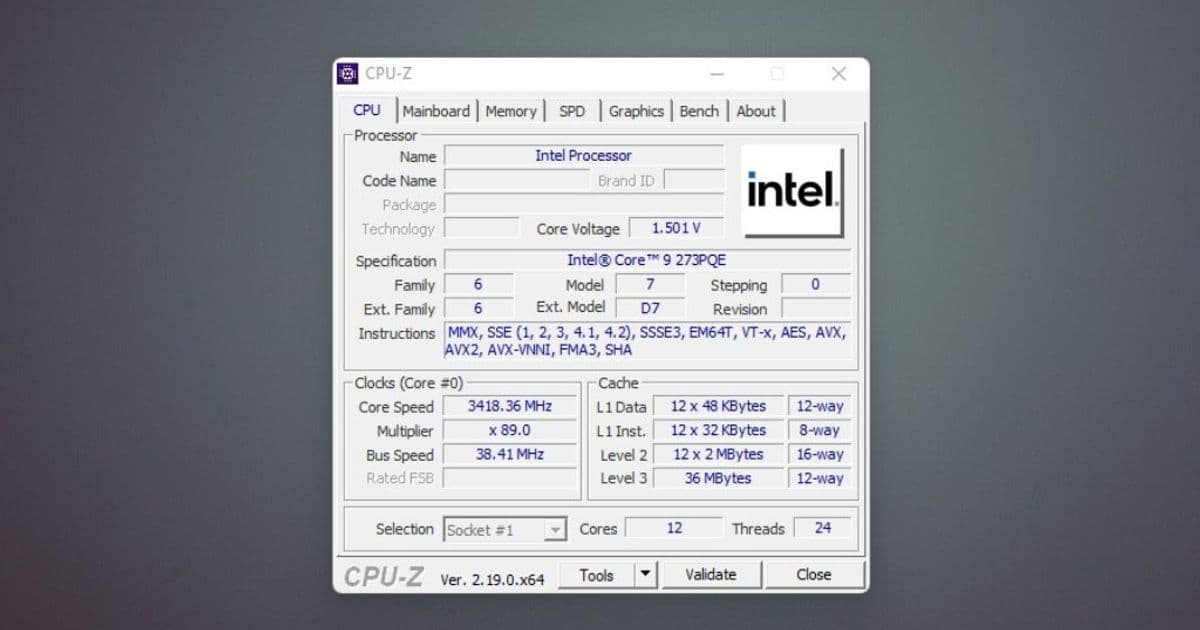
A PC enthusiast has successfully run Intel's OEM-exclusive Core 9-273PQE processor on a consumer Z790 motherboard, marking a significant achievement in hardware modding and opening possibilities for AI workstation enthusiasts.
A PC enthusiast has made history in the world of hardware modding by successfully booting Intel's OEM-exclusive Core 9-273PQE into Windows on a standard Asus Z790 motherboard using the LGA 1700 socket.
Intel's Core 9-273PQE: The AI Workstation CPU That Shouldn't Exist on Consumer Hardware
Intel's Core 9-273PQE is a unique CPU from the Bartlett Lake-S family, designed specifically for embedded and edge-computing AI workstations rather than regular consumer-grade desktops. What makes this processor particularly interesting is its architecture: 12 performance cores and 24 threads with no efficiency cores whatsoever. This pure performance-core design makes it an intriguing option for AI workloads and high-performance computing tasks.
Despite using the same LGA 1700 socket and pin layout as Raptor Lake processors like the Core i9-14900K, motherboard manufacturers have never officially supported the CPU in consumer motherboards. This limitation was intentional, as Intel positioned Bartlett Lake as an OEM-exclusive product for specialized applications.
The Breakthrough: Custom BIOS Hack Makes the Impossible Possible
The breakthrough came from Overclock.net user Kryptonfly, who first acquired the rare and elusive Bartlett Lake CPU. The journey to get the system running wasn't straightforward - it required multiple rounds of BIOS modification and microcode injection.
Kryptonfly's approach involved creating a custom BIOS microcode using Claude AI, then further refining the BIOS to overcome initialization issues. The key innovation was tricking Intel's firmware by making the early boot process treat the Core 9-273PQE as a Raptor Lake CPU during early initialization.
Describing the breakthrough, Kryptonfly wrote: "HISTORICAL! We fixed the SA init by fooling the FSP-M with the Raptor Lake SA/PEG init. The Raptor Lake SA initialized after our Bartlett Lake patches for the memory-init side. No more 5F hanging, and I CAN BOOT INTO WINDOWS! The boot sequence is the same as my 13900K. No weird numbers."
Technical Achievement: From POST to Windows 11
The modding process involved several critical steps:
- Initial BIOS modification to get the PC to POST and reach the BIOS screen
- Custom microcode injection using AI assistance
- SA (System Agent) initialization fixes
- Memory initialization patches
- Final microcode injection to enable Windows boot
After the latest patchwork, the system successfully booted into Windows 11 without any issues. Screenshots shared by the user show the correct processor identification in CPU-Z with 12 cores, 24 threads, and a clock speed of 3,418 MHz.
The achievement is particularly notable because it eliminates the dreaded 5F error codes and black screens that typically plague unsupported CPU installations on consumer motherboards.
Implications for the Modding Community and AI Enthusiasts
While this achievement is primarily a proof-of-concept, it represents a historic moment for the hardware modding community. The success demonstrates that with sufficient technical expertise and persistence, even OEM-exclusive processors can be adapted for consumer use.
However, there's a significant limitation: a pure performance-core processor like the Core 9-273PQE isn't available on the open market for the average PC enthusiast. Kryptonfly may have gotten lucky in procuring the Bartlett Lake CPU to begin with, but the achievement opens the door for performance enthusiasts to experiment with the platform, given the possibility of running it on consumer-grade PCs.
The Future: Could Intel Release All-P-Core Processors for Consumers?
The success of this mod has sparked speculation in the PC enthusiast community. Many gamers and PC enthusiasts are now wondering whether Intel will release an all-P-core processor similar to its Bartlett Lake lineup for regular users.
Such a processor could appeal to users who prioritize single-threaded performance and don't need the power efficiency benefits of efficiency cores. The Bartlett Lake architecture, optimized for AI workloads and edge computing, could potentially offer interesting performance characteristics for certain types of applications.
Technical Context and Significance
This achievement is particularly significant because it demonstrates the flexibility of the LGA 1700 platform and the potential for cross-generational CPU compatibility through BIOS modification. The fact that a processor designed for embedded systems can run on a high-end consumer motherboard opens up new possibilities for hardware enthusiasts and researchers working with specialized CPU architectures.
The use of AI tools like Claude in the BIOS modification process also highlights how artificial intelligence is becoming an increasingly valuable tool in hardware development and modification, potentially accelerating the pace of innovation in the enthusiast community.
For now, this remains a remarkable technical achievement that showcases the ingenuity of the PC modding community and the potential for pushing hardware beyond its intended limitations. Whether Intel will take notice and consider bringing similar architectures to the consumer market remains to be seen, but this mod has certainly demonstrated the demand for such specialized processing capabilities.
Source: Overclock.net
Comments
Please log in or register to join the discussion