
A pragmatic analysis of architectural choices focusing on scaling needs, team structure, and operational complexity rather than industry trends.

"Should we use microservices?" ranks among the most frequently asked – and frequently misguided – questions in backend engineering. After witnessing multiple failed migrations and overengineered systems, I've learned the core question should be: What specific problem are you trying to solve? Let's dissect this debate through the lens of operational reality.
The Monolithic Foundation
A monolithic architecture consolidates all application components into a single deployable unit. All code resides in one repository, shares a common runtime, and typically connects to a unified database.
Operational advantages:
- Development velocity: New features follow linear implementation paths without inter-service coordination
- Debugging simplicity: Stack traces span entire transaction paths in single logs
- Testing efficiency: End-to-end tests validate system behavior without network simulation
- Deployment coordination: Single build pipeline reduces synchronization overhead
Scale limitations:
- Vertical scaling ceiling: Adding CPU/RAM becomes prohibitively expensive beyond certain traffic thresholds
- Deployment bottlenecks: 20-minute deployments become 2-hour deployments as the codebase grows
- Technology lock-in: Difficult to adopt new languages or frameworks without full rewrites
- Failure amplification: A memory leak in any module can crash the entire application
This approach remains optimal for:
- Early-stage startups validating product-market fit
- Teams smaller than 10 engineers sharing a single codebase
- Applications with predictable, linear growth trajectories
The Microservices Reality
Microservices decompose systems by business capability into independently deployable units. Each service owns its data storage, communicates via network APIs, and scales autonomously.
Strategic advantages:
- Targeted scaling: Order service handles Black Friday traffic while user profile service runs minimal instances
- Technology heterogeneity: Machine learning services use Python while transaction systems leverage Go
- Failure containment: Payment service failures don't block order processing
- Team autonomy: Groups deploy without organization-wide coordination
Operational complexity:
- Distributed tracing: Requires OpenTelemetry instrumentation to track requests across services
- Network reliability: Must handle retries, timeouts, and circuit breakers for inter-service calls
- Data consistency: Saga patterns replace ACID transactions, requiring compensation logic
- Deployment orchestration: Kubernetes complexity replaces simple
git pushworkflows
Adopt this model when:
- Multiple teams own distinct business domains
- Components have divergent scaling requirements (>10x difference in load)
- Independent release cycles provide business advantage
Comparative Analysis
| Engineering Factor | Monolithic | Microservices |
|---|---|---|
| Deployment Complexity | Single binary | Coordinated service mesh |
| Scaling Precision | Entire application | Per-service granularity |
| Debugging | Centralized logging | Distributed tracing needed |
| Data Consistency | ACID transactions | Eventual consistency |
| Operational Overhead | Minimal (single app) | Significant (service mesh) |
| Team Coordination | High synchronization | Decoupled ownership |
The Premature Microservices Trap
The most common architectural anti-pattern I encounter is teams adopting microservices before solving fundamental design problems. Distributed systems amplify poor design through:
- Latency multiplication: Chatty services magnify bad API contracts
- Deployment chaos: Unstable interfaces create versioning nightmares
- Debugging paralysis: Distributed systems require new observability strategies
Successful organizations like Amazon and Netflix didn't start with microservices. They evolved from well-structured monoliths after reaching:
- Clear domain boundaries established via Domain-Driven Design
- Automation maturity in testing and deployment pipelines
- Team structures aligned to business capabilities
Decision Framework
Replace "monolith vs microservices" with these operational questions:
- Scaling needs: Do components have >10x differential in resource requirements?
- Team structure: Are >3 teams blocked by shared deployment cycles?
- Domain complexity: Have we identified autonomous business capabilities?
- DevOps readiness: Can we manage service discovery, tracing, and fault injection?
When 3+ answers are "yes", microservices warrant consideration. Otherwise, a modular monolith with clear boundaries often delivers faster iteration with lower risk.
Practical Evolution Path
- Build a modular monolith with explicit bounded contexts
- Implement consumer-driven contracts between modules
- Containerize components independently while maintaining single deployment
- Extract services only when operational requirements force it
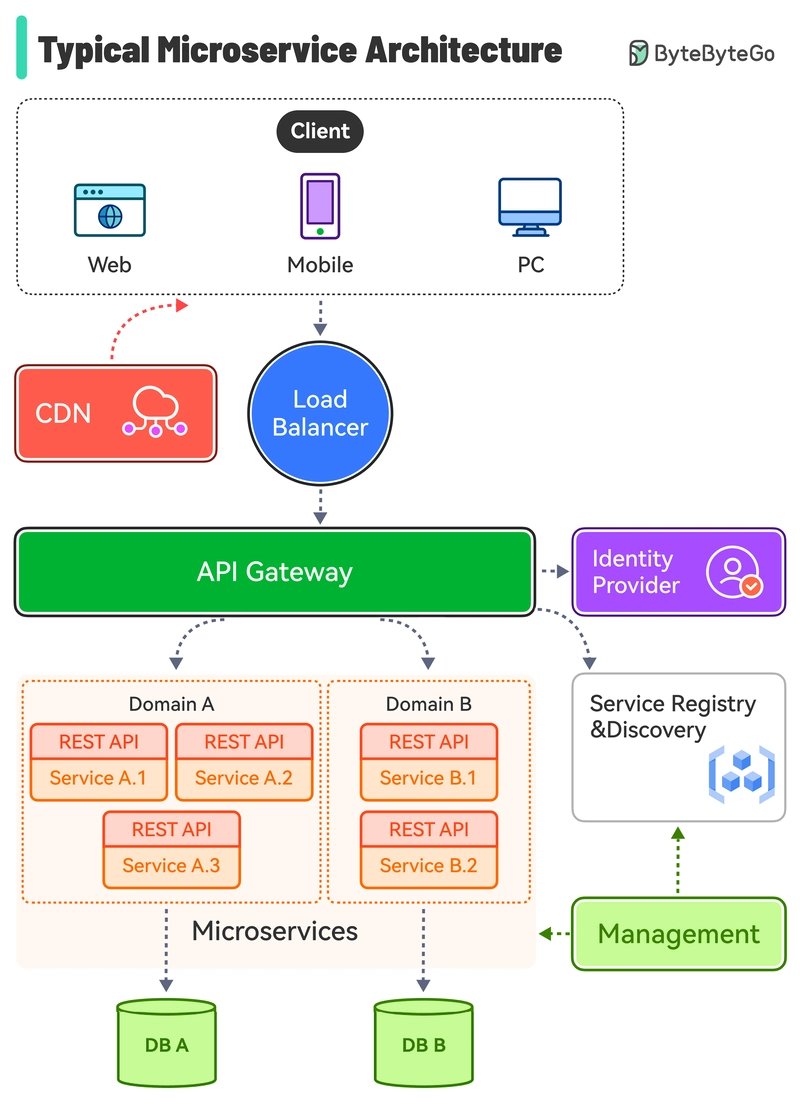 Architecture evolution from monolith to microservices requires intermediate steps
The Verdict
Monolithic architectures optimize for developer efficiency and operational simplicity. Microservices trade complexity for scaling precision and organizational flexibility. Your choice shouldn't reflect industry hype cycles, but rather concrete answers to:
- How many engineering teams work on this system?
- What are the variance in component scaling factors?
- Can we afford 3-5x operational overhead?
As Martin Fowler observed: "The first rule of distributed systems is don't distribute your system." Start consolidated, separate surgically, and remember: every microservice is a future distributed system you must debug at 3 AM.
Comments
Please log in or register to join the discussion