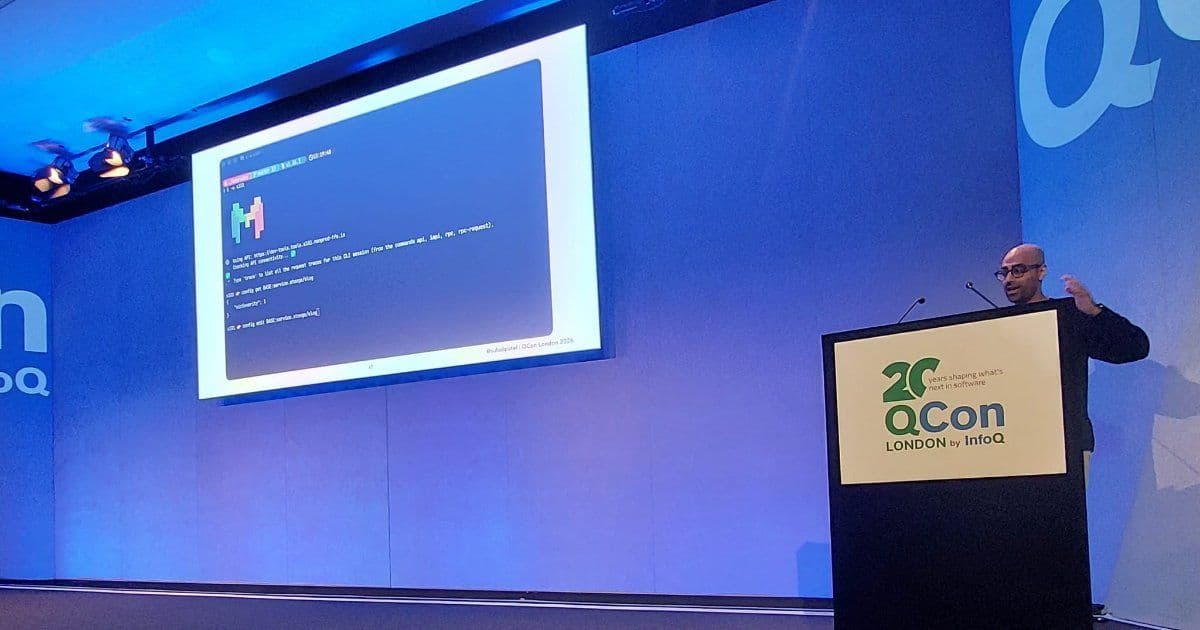
Monzo's principal engineer Suhail Patel revealed how the bank's platform team enables hundreds of daily production deployments through standardized microservices, automated infrastructure, and AI-powered development tools.
At QCon London 2026, Suhail Patel, principal engineer at Monzo and leader of the bank's platform group, detailed how the financial institution has built a developer platform capable of shipping hundreds of changes to production every day. The approach centers on standardization, automation, and strategic use of AI tools to maintain velocity while preserving trust in a regulated environment.
Monzo operates on a microservices architecture of over 3,000 services, all written in a uniform style using a bootstrap generator based on standardized templates. This consistency extends beyond code structure—underlying infrastructure such as Kafka queues, HTTP services, and telemetry is automatically created by libraries, allowing engineers to focus on business logic rather than plumbing.
Every service follows the same folder structure for database logic, queue-consumer logic, and an RPC layer. This uniformity serves a critical purpose in Monzo's AI-driven development workflow. When engineers can generate 10 or 20 candidate implementations within hours using modern LLM-based tooling, the standardized architecture ensures that generated code slots into the platform rather than diverging from it.
Patel reframed the problem of modern software delivery: "We are not freeing up more time in our calendar. We are taking on more work, and therefore there's higher pressure to go and ship these changes." The bottleneck has shifted from implementation to maintaining trust and compliance in a regulated environment.
To address this, Monzo has encoded its backend engineering conventions into a structured "Backend 101" guide that every new engineer must complete. These conventions are also encoded as LLM skills, enabling tools like Claude and Cursor to learn the bank's processes and conform to its service structure. The platform draws on over 3,000 existing repositories as training examples, creating a feedback loop where AI tools become increasingly aligned with organizational standards.
Non-engineering staff, such as product managers and designers, can now take small bugs, data questions, or technical queries directly to an LLM rather than raising tickets for engineers. This democratization of problem-solving reduces friction in the development process while maintaining quality through standardized approaches.
One of Monzo's most innovative solutions addresses the challenge of local development in a complex microservices environment. Spinning up all 250 microservices locally with their dependencies, plus machine learning models with their own Python environments, had historically been impractical. Monzo took inspiration from Stripe's approach to remote development boxes but went further: engineers deploy only the services they have changed into an isolated "tenancy" namespace, backed by dedicated data namespaces, while all other dependencies route through the shared staging environment.
Every request carries a tenancy header so that the service mesh routes correctly in both directions. Acceptance tests now run inside their own tenancies as part of pull requests, eliminating the sequential scheduling and flakiness that had plagued them previously. Patel noted that tenancies are lightweight, with hundreds running simultaneously, and can be provisioned and torn down in minutes.
Quality assurance at Monzo operates on a principle of high-signal, mandatory checks. When an incident occurs due to a code bug, engineers immediately ask how to turn that bug into a CI check so it cannot recur. There's deliberate friction built into bypassing automated checks: doing so requires escalating to multiple people and justifying the exception through a formal process.
LLMs play a role here too. Patel described using Claude to write native Go AST-based syntax checkers and recommended Semgrep for cross-language static analysis. LLM tooling can run checks across the entire codebase and automatically raise pull requests for issues it identifies. "You don't need a fancy AI code review to go and solve all of your problems," Patel said. "Instead, spend the time and energy writing really high-quality CI checks."
For production observability, Monzo relies on Prometheus, Grafana, and OpenTelemetry, feeding automated alerts that trace back to the specific change and team responsible. Patel acknowledged the cost plainly: "We pay a lot of money for all of this. But we are thankful every single time we have an incident and can identify the contributing factors."
The bank also uses Pyroscope for continuous profiling to detect performance regressions as they are deployed. A Slack channel called "Graph Trending Downwards" celebrates improved performance, creating positive reinforcement for optimization work.
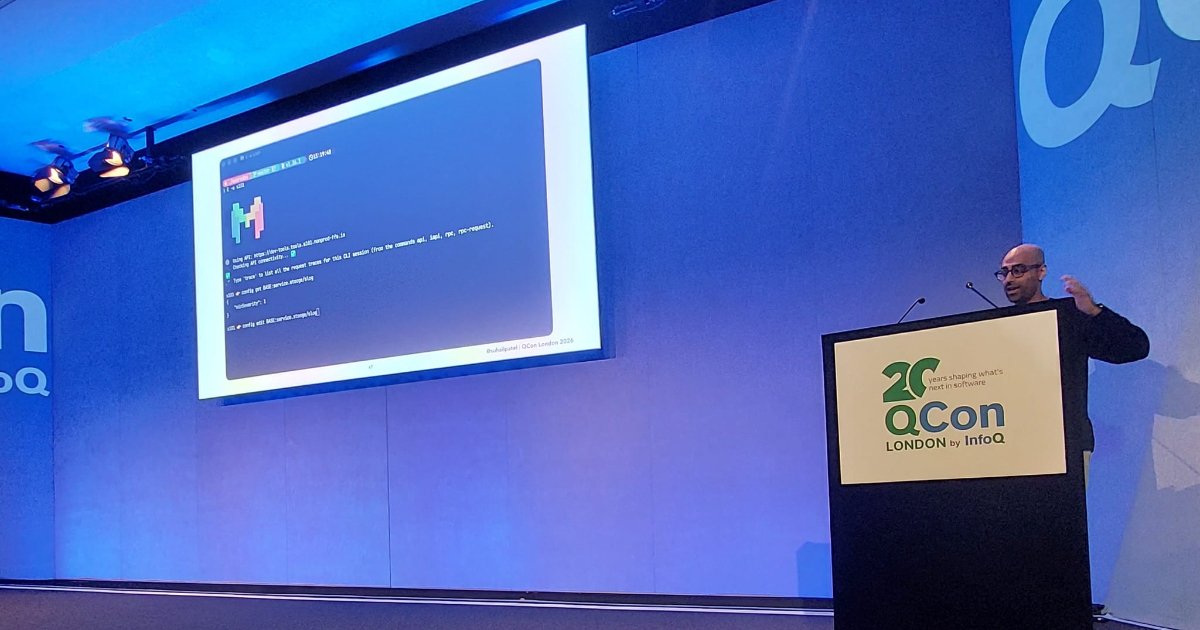
A further focus was Monzo's internal CLI, which engineers and non-engineers alike use to interact with microservices in production, manage service configuration, and schedule operations. The CLI includes a multi-party authorization system that requires a second pair of eyes for sensitive operations. Patel noted that good CLI interfaces also reduce token consumption when LLMs invoke tooling: parsing a structured JSON diff via the GitHub CLI, for example, is far more reliable than asking a model to navigate a rendered web UI.
"Even for LLMs, calling out to deterministic tools leads to a much more reliable result," Patel explained.
Patel closed with three principles for organizations seeking to move fast while maintaining trust: invest in composable, best-in-class tools to encode and automate organizational processes; invest in rapid iteration capabilities; and standardize on a small set of technology choices, continuously improving on those abstractions so that engineers and LLMs alike can focus on the business problem at hand rather than rebuilding infrastructure from scratch.
The approach represents a pragmatic response to the challenges of modern software development, where the ease of generating code through AI tools creates new pressures for organizations to maintain quality, compliance, and developer productivity at scale.
Comments
Please log in or register to join the discussion