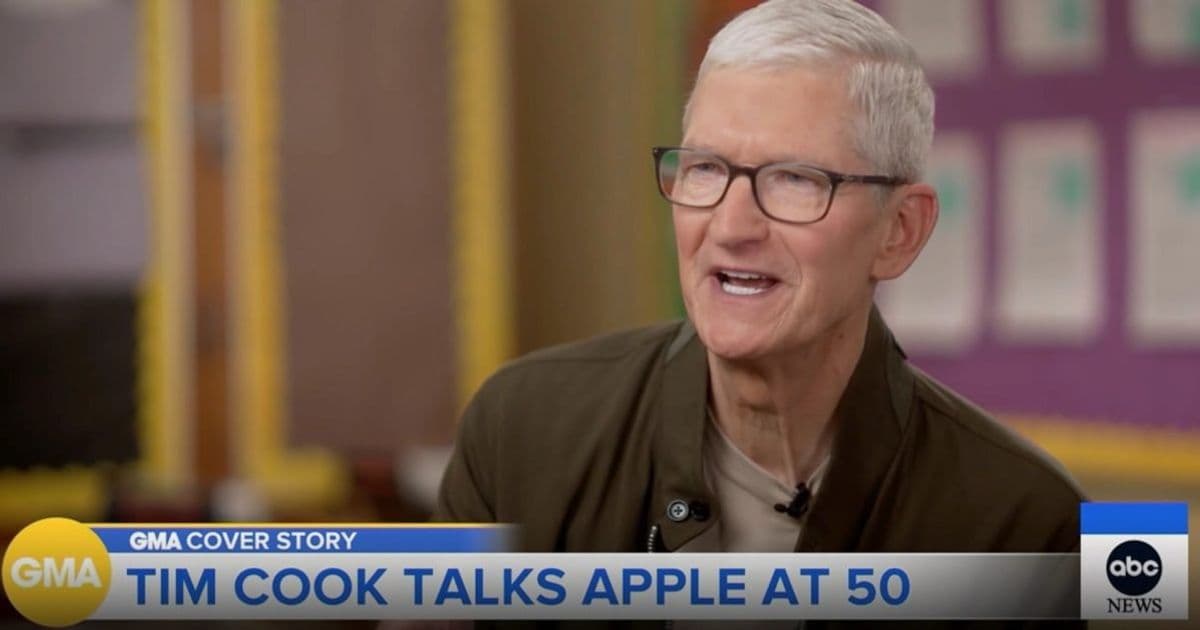
In a wide-ranging interview with Good Morning America, Apple CEO Tim Cook discusses the company's greatest contributions, AI privacy approach, U.S. manufacturing investments, potential tariff refunds, and retirement rumors.
Apple CEO Tim Cook sat down with Michael Strahan on Good Morning America to celebrate the company's 50th anniversary, offering insights into Apple's legacy, future direction, and current challenges. The interview covered everything from music education initiatives to AI privacy, U.S. manufacturing investments, and Cook's own future at the company.
Expanding Music Education Through Save the Music
The conversation began with an announcement about Apple's expanding partnership with Save the Music, a nonprofit organization dedicated to preserving music education in schools. Cook revealed that Apple is doubling its reach from 25 to nearly 50 schools, which will impact approximately 25,000 students with music education programs next year. This initiative reflects Apple's long-standing commitment to creative arts education and its belief in music's transformative power.
Apple's Greatest Contributions Over Five Decades
When asked to reflect on Apple's most significant contributions over the past 50 years, Cook highlighted several transformative moments that have shaped modern technology:
- Reinventing music: From the iPod revolutionizing how we listen to music, to iTunes changing how we purchase and organize it
- Reinventing the smartphone: The iPhone's introduction in 2007 fundamentally changed mobile computing and communication
- Bringing creative arts to technology: Apple's focus on design, graphics, and creative applications has democratized content creation
- Saving lives with Apple Watch: The wearable's health monitoring features have already helped countless users detect medical conditions and emergencies
"Oh my God, you know you can focus on the product moments: reinventing music, reinventing the smartphone, bringing the creative arts to the table, the creative graphics, saving people's lives with the watch," Cook explained, emphasizing how Apple has consistently merged technology with human creativity and well-being.
Balancing Technology and Human Connection
Cook addressed concerns about technology's impact on society, particularly regarding smartphone usage. He acknowledged the importance of maintaining human connections in an increasingly digital world.
"Well, I don't want people using them too much. I don't want people looking at the smartphone more than they're looking in someone's eyes — as if there's just scrolling endlessly — this is not the way you want to spend your day. Go out and spend it in nature," Cook advised, demonstrating a thoughtful approach to technology's role in our lives.
Apple's Approach to AI and Privacy
The conversation turned to artificial intelligence, where Cook offered a nuanced perspective on the technology's potential and risks. He described AI as "profound and can be so positive," but emphasized that its impact depends entirely on how it's developed and deployed.
"I think AI is profound and can be so positive. But, you know, technology doesn't want to be good and it doesn't want to be bad. It's in the hands of the user and the hands of the inventor," Cook explained, highlighting Apple's philosophy that technology should serve humanity rather than the other way around.
Cook specifically pointed to Apple's Private Cloud Compute as an example of privacy-centric AI implementation. This system allows Apple to process complex AI queries while maintaining user privacy:
"Well, we do as much as possible on the device. And on the device is encrypted, which means that even Apple doesn't have access to it. And then when we can't answer a question on your device, we send it to something called Private Cloud Compute, which is essentially, think of it as a big device in the sky that has the same kind of security and architecture as your phone."
This approach demonstrates Apple's commitment to privacy as a fundamental human right, even as the company embraces advanced AI capabilities.
Massive U.S. Manufacturing Investment
Cook provided detailed updates on Apple's substantial investments in American manufacturing, revealing plans to invest $600 billion in the U.S. over the next four years. This investment spans multiple states and product components:
- Kentucky: All iPhone glass covers (front and back) will be manufactured there by year's end
- Arizona: Production of over 100 million system-on-a-chip processors for iPhones this year
- Semiconductors: Over 20 billion semiconductors will be manufactured in the U.S.
"We've invested more in the U.S. We're a very proud American company and want to do as much here as we possibly can," Cook stated, emphasizing Apple's commitment to domestic manufacturing and job creation.
Notably, Cook didn't mention the Made in America Mac mini during the interview, though reports indicate this product is in development.
Tariff Refunds and Political Navigation
Perhaps the most newsworthy portion of the interview addressed Apple's potential response to recent tariff refund rulings. The Supreme Court recently decided that billions in tariffs were collected illegally, and Apple paid approximately $3.3 billion in tariffs that could potentially be refunded.
When asked directly about whether Apple might sue the government over these refunds, Cook took a measured approach: "Well, we're monitoring the situation and to see what the courts will rule there. And we'll decide accordingly."
This cautious response reflects the complex legal and political landscape surrounding international trade policies and their impact on major technology companies.
Cook also addressed questions about his public appearances with political figures, including attending President Trump's inauguration and other high-profile events. He clarified his approach to political engagement:
"Well, what I do is I interact on policy, not politics. I'm not a political person, on either side, I'm not political. And so I'm kind of straight down the middle, and I focus on policy. And so I'm very pleased that the President and the administration is accessible to talk about policy."
This statement underscores Cook's strategy of maintaining relationships across the political spectrum while focusing on policy outcomes that benefit Apple and its stakeholders.
Addressing Retirement Rumors
The interview concluded with questions about Cook's future as Apple CEO, specifically addressing rumors that he might be considering stepping back from his role.
"No, I didn't say that. I haven't said that. That's a rumor going around," Cook responded, then elaborated on his deep connection to Apple:
"Well, here's the way I look at it: I love what I do deeply. 28 years ago, I walked into Apple, and I've loved every day of it since. We've had ups and downs, but the people I work with are so amazing. They bring out the best in me, and hopefully I can bring out the best in them. And Michael, I can't imagine life without Apple."
This passionate response demonstrates Cook's enduring commitment to Apple and suggests he has no immediate plans to step down from his leadership role.
Apple's Continued Innovation
The interview comes at a pivotal time for Apple as the company continues to evolve its product lineup and services. Recent developments include:
- AirTag 2: The latest tracking device for finding lost items
- Beats USB-A to USB-C Cable: Official CarPlay cable for seamless connectivity
- Wireless CarPlay Adapter: Eliminating the need for physical connections
- AirPods 4: Apple's most affordable AirPods with active noise cancellation
These products demonstrate Apple's ongoing commitment to refining existing categories while exploring new technological frontiers.
As Apple enters its next 50 years, Cook's leadership continues to balance innovation with responsibility, privacy with progress, and global ambition with local investment. The company's approach to AI, manufacturing, and social responsibility will likely define its next era as much as the iPhone defined its first five decades.
The full interview is available on ABC News, offering viewers a comprehensive look at how one of the world's most influential technology leaders thinks about Apple's past, present, and future.
Comments
Please log in or register to join the discussion