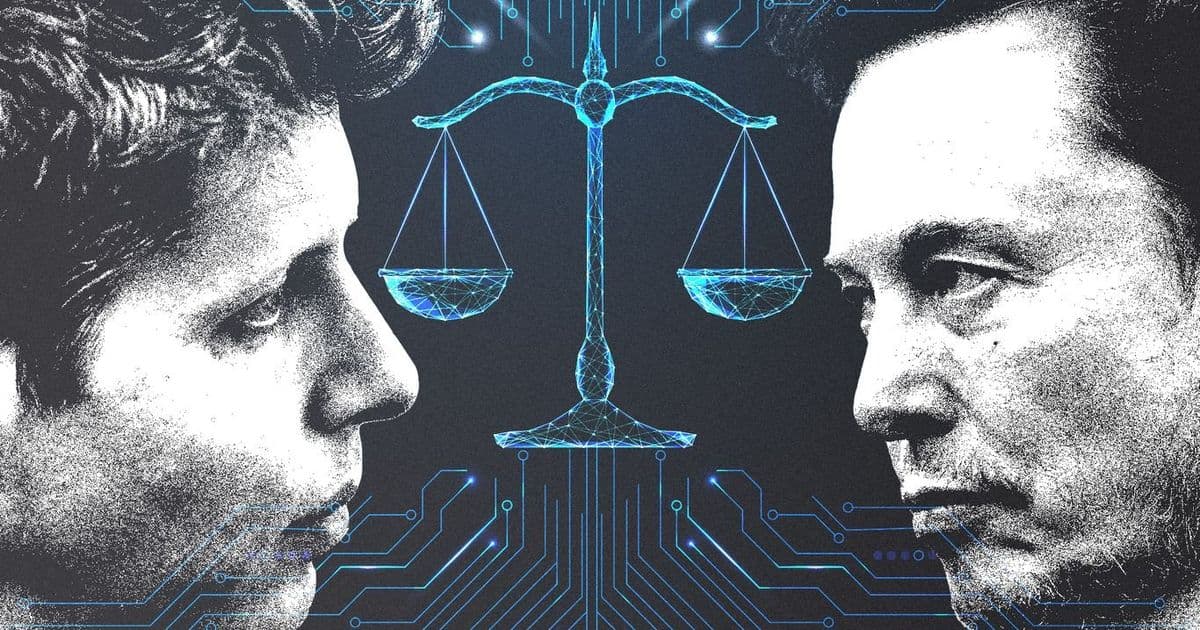
Beyond the public spectacle, the rivalry between Elon Musk and Sam Altman represents a deeper competition for control of AI's future direction, with billions at stake and unknown strategic maneuvers reshaping the landscape.
The public spectacle of Elon Musk and Sam Altman exchanging barbs on social media obscures a more consequential battle: the unseen competition for control of artificial intelligence's trajectory. While their public disagreements garner headlines, the real strategic maneuvering occurs behind closed doors, with billions of dollars in market value and technological influence hanging in the balance.
The surface-level narrative portrays Musk as an AI skeptic warning of existential threats while simultaneously developing his own AI company, xAI. Meanwhile, Altman positions OpenAI as the responsible steward of increasingly powerful models, despite growing criticism about the company's governance structure and relationship with Microsoft. This public contrast masks a more complex reality where both leaders are pursuing similar technological objectives through different strategic paths.
Financial data reveals the stakes. OpenAI's valuation has soared to approximately $80 billion following its latest funding round, while xAI has secured $6 billion in its Series C funding at a $18 billion valuation. These figures represent more than just company valuations—they reflect market expectations about which approach to advanced AI will ultimately dominate.
What remains less visible are the strategic pivots each leader is undertaking away from public scrutiny. Musk's xAI has reportedly been developing its own AI chip technology, reducing dependence on Nvidia hardware that has constrained the industry. Meanwhile, OpenAI has been quietly expanding its enterprise partnerships, with revenue projections exceeding $3.8 billion for 2024, according to internal documents obtained by Reuters.
The technological divergence extends beyond visible products. Musk's focus on "truth-seeking" AI contrasts with OpenAI's more mainstream approach, but both are investing heavily in multimodal systems that can process text, images, and potentially physical inputs. The unknown variable is which architecture will achieve the breakthrough in reasoning capabilities that both companies are pursuing.
Market context reveals this as part of a broader pattern in tech competition. The AI arms race mirrors earlier battles between cloud providers, with similar dynamics of massive investment, talent acquisition, and infrastructure build-out. The global AI market is projected to reach $1.8 trillion by 2030, according to Statista, making the Musk-Altman rivalry a contest for a substantial portion of this economic value.
Strategically, the competition extends beyond technical superiority to regulatory positioning. Musk has positioned himself as an AI safety advocate while simultaneously advocating for lighter regulation—a stance that gives him influence without constraining his own development efforts. Altman has navigated regulatory discussions more directly, testifying before Congress and engaging with policymakers, potentially positioning OpenAI for a more established role in a regulated AI ecosystem.
The most significant unknown is how each leader's personal vision will shape their respective organizations. Musk's history of demanding extreme performance from his companies has led to both breakthrough innovations and significant organizational turmoil. Altman's approach has emphasized consensus-building, though this has faced criticism from some OpenAI researchers who claim it slows innovation.
What happens next remains unclear. Both companies are reportedly working on next-generation models that could represent significant advances. The unknown factors—breakthrough algorithms, unexpected partnerships, or shifts in regulatory landscape—could rapidly alter the balance of power.
For investors and industry observers, the key question isn't who will win the public relations battle, but which strategic approach will deliver on the promise of artificial general intelligence first. The answer to that question will determine not only market leadership but potentially the direction of human-AI interaction for decades to come.
The Musk-Altman rivalry, ultimately, is less about what we can see and more about which leader's unseen vision will shape our technological future.
Comments
Please log in or register to join the discussion